

264
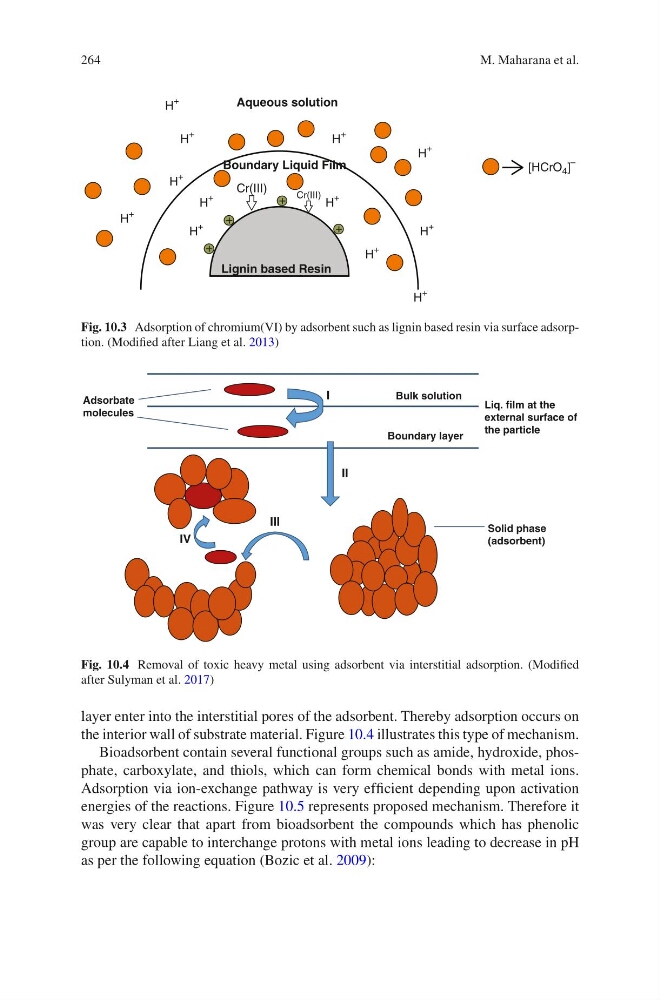
layer enter into the interstitial pores of the adsorbent. Thereby adsorption occurs on
the interior wall of substrate material. Figure 10.4 illustrates this type of mechanism.
Bioadsorbent contain several functional groups such as amide, hydroxide, phosphate, carboxylate, and thiols, which can form chemical bonds with metal ions.
Adsorption via ion-exchange pathway is very efficient depending upon activation
energies of the reactions. Figure 10.5 represents proposed mechanism. Therefore it
was very clear that apart from bioadsorbent the compounds which has phenolic
group are capable to interchange protons with metal ions leading to decrease in pH
as per the following equation (Bozic et al. 2009):
+
+
+
+
H
+
H
+
H
+
H
+
Cr(III)
H
+
H
+
Boundary Liquid Film
Aqueous solution
H
+
Lignin based Resin
H
+
H
+
H
+
H
+
[HCrO 4 ]
–
H
+
Cr(III)
Fig. 10.3 Adsorption of chromium(VI) by adsorbent such as lignin based resin via surface adsorption. (Modified after Liang et al. 2013)
Adsorbate
molecules
Bulk solution
Boundary layer
Liq. film at the
external surface of
the particle
Solid phase
(adsorbent)
I
II
III
IV
Fig. 10.4 Removal of toxic heavy metal using adsorbent via interstitial adsorption. (Modified
after Sulyman et al. 2017)
M. Maharana et al.
layer enter into the interstitial pores of the adsorbent. Thereby adsorption occurs on
the interior wall of substrate material. Figure 10.4 illustrates this type of mechanism.
Bioadsorbent contain several functional groups such as amide, hydroxide, phosphate, carboxylate, and thiols, which can form chemical bonds with metal ions.
Adsorption via ion-exchange pathway is very efficient depending upon activation
energies of the reactions. Figure 10.5 represents proposed mechanism. Therefore it
was very clear that apart from bioadsorbent the compounds which has phenolic
group are capable to interchange protons with metal ions leading to decrease in pH
as per the following equation (Bozic et al. 2009):
+
+
+
+
H
+
H
+
H
+
H
+
Cr(III)
H
+
H
+
Boundary Liquid Film
Aqueous solution
H
+
Lignin based Resin
H
+
H
+
H
+
H
+
[HCrO 4 ]
–
H
+
Cr(III)
Fig. 10.3 Adsorption of chromium(VI) by adsorbent such as lignin based resin via surface adsorption. (Modified after Liang et al. 2013)
Adsorbate
molecules
Bulk solution
Boundary layer
Liq. film at the
external surface of
the particle
Solid phase
(adsorbent)
I
II
III
IV
Fig. 10.4 Removal of toxic heavy metal using adsorbent via interstitial adsorption. (Modified
after Sulyman et al. 2017)
M. Maharana et al.