

265
M
R OH
M OR
H
2
2
2
2
+
+
+ (
)® ( ) +
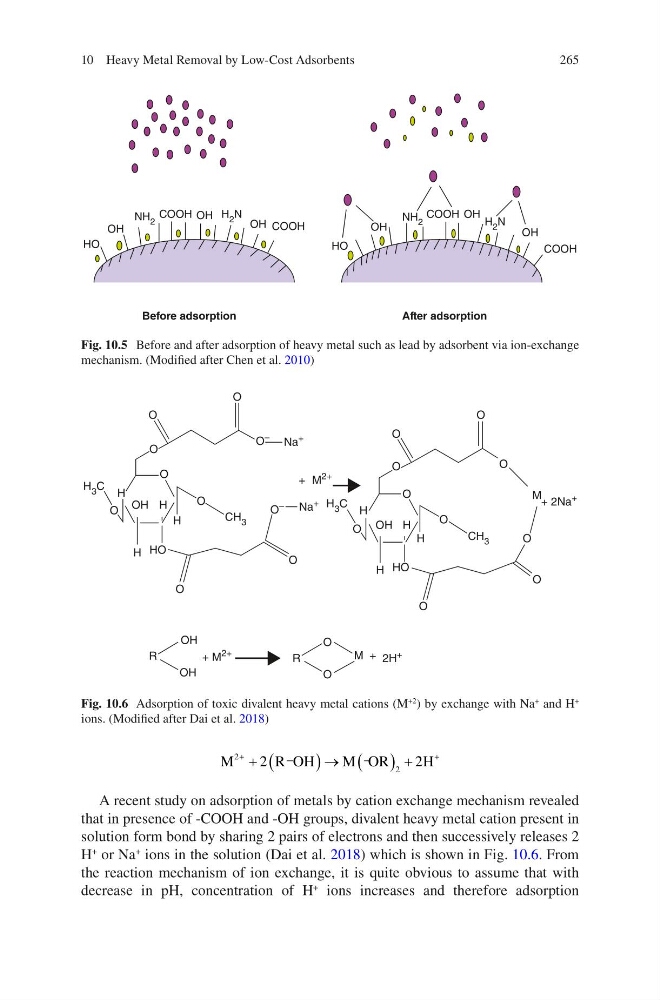
A recent study on adsorption of metals by cation exchange mechanism revealed
that in presence of -COOH and -OH groups, divalent heavy metal cation present in
solution form bond by sharing 2 pairs of electrons and then successively releases 2
H
+
or Na
+
ions in the solution (Dai et al. 2018) which is shown in Fig. 10.6. From
the reaction mechanism of ion exchange, it is quite obvious to assume that with
decrease in pH, concentration of H
+
ions increases and therefore adsorption
HO
OH
NH 2
NH 2
H 2 N
H 2 N
OH
COOH
OH
COOH
Before adsorption
After adsorption
COOH
OH
COOH
HO
OH
OH
Fig. 10.5 Before and after adsorption of heavy metal such as lead by adsorbent via ion-exchange
mechanism. (Modified after Chen et al. 2010)
O
O
R
OH
OH
O
H
H
O
O
O
O
O –
O
–
Na +
Na
+
M 2+
+
O
O
O
O
O
H
H
H
OH
H HO
O
O
O
O
O
O
CH 3
M
+ 2Na
+
O
O
H 3 C
CH 3
H
H
OH
H 3 C
HO
R
M + 2H
+
+ M
2+
Fig. 10.6 Adsorption of toxic divalent heavy metal cations (M
+2
) by exchange with Na
+ and H
+
ions. (Modified after Dai et al. 2018)
10 Heavy Metal Removal by Low-Cost Adsorbents
M
R OH
M OR
H
2
2
2
2
+
+
+ (
)® ( ) +
A recent study on adsorption of metals by cation exchange mechanism revealed
that in presence of -COOH and -OH groups, divalent heavy metal cation present in
solution form bond by sharing 2 pairs of electrons and then successively releases 2
H
+
or Na
+
ions in the solution (Dai et al. 2018) which is shown in Fig. 10.6. From
the reaction mechanism of ion exchange, it is quite obvious to assume that with
decrease in pH, concentration of H
+
ions increases and therefore adsorption
HO
OH
NH 2
NH 2
H 2 N
H 2 N
OH
COOH
OH
COOH
Before adsorption
After adsorption
COOH
OH
COOH
HO
OH
OH
Fig. 10.5 Before and after adsorption of heavy metal such as lead by adsorbent via ion-exchange
mechanism. (Modified after Chen et al. 2010)
O
O
R
OH
OH
O
H
H
O
O
O
O
O –
O
–
Na +
Na
+
M 2+
+
O
O
O
O
O
H
H
H
OH
H HO
O
O
O
O
O
O
CH 3
M
+ 2Na
+
O
O
H 3 C
CH 3
H
H
OH
H 3 C
HO
R
M + 2H
+
+ M
2+
Fig. 10.6 Adsorption of toxic divalent heavy metal cations (M
+2
) by exchange with Na
+ and H
+
ions. (Modified after Dai et al. 2018)
10 Heavy Metal Removal by Low-Cost Adsorbents