

182
7.2.2 Electrochemically Switched Ion Exchange
The participation of metal cations in the redox reaction (7.1) suggests that the necessary electron flow for the reaction can be mediated by an electrochemical technique. At the same time, ions are inserted, and released, into the peculiar structure
of the metal hexacyanoferrate. This simple concept has been called electrochemically switched ion exchange. It was introduced at the beginning of 2000 (Lilga et al.
2001), allowing ion separations in a reversible and selective manner. It is also an
environmentally friendly method. Basically, after deposition of a suitable Prussian
blue analog on a conductive substrate, the potential can be varied to a negative/positive direction forcing the reduction/oxidation of the active material as indicated by
Eq. (7.3) in the case of nickel hexacyanoferrate KNi
II
Fe
III
(CN) 6 and Cs
+
. Also, Eq.
(7.3) not only suggests that a cesium ion uptake takes place simultaneously but also
that the reverse process is possible, by inverting the electrode polarization. This, in
turn, triggers the release of Cs
+
which causes the regeneration of the pristine nickel
hexacyanoferrate.
KNi Fe CN
Cs e
KCsNi Fe CN
II
III
uptake
release
II
II
( ) + +
®
¬
( )
+
-
6
6
(7.3)
This concept is presented in Fig. 7.4 that reports the cyclic voltammetries of electrosynthesized copper hexacyanoferrate material (i) in aqueous K
+
-solution, (ii) successively immersed and cycled in a solution containing Cs
+
, and finally (iii)
immersed again into a solution containing potassium-ion. During step (ii) the traces
changed accordingly to the uptake of Cs
+
by observing a shift at higher potential of
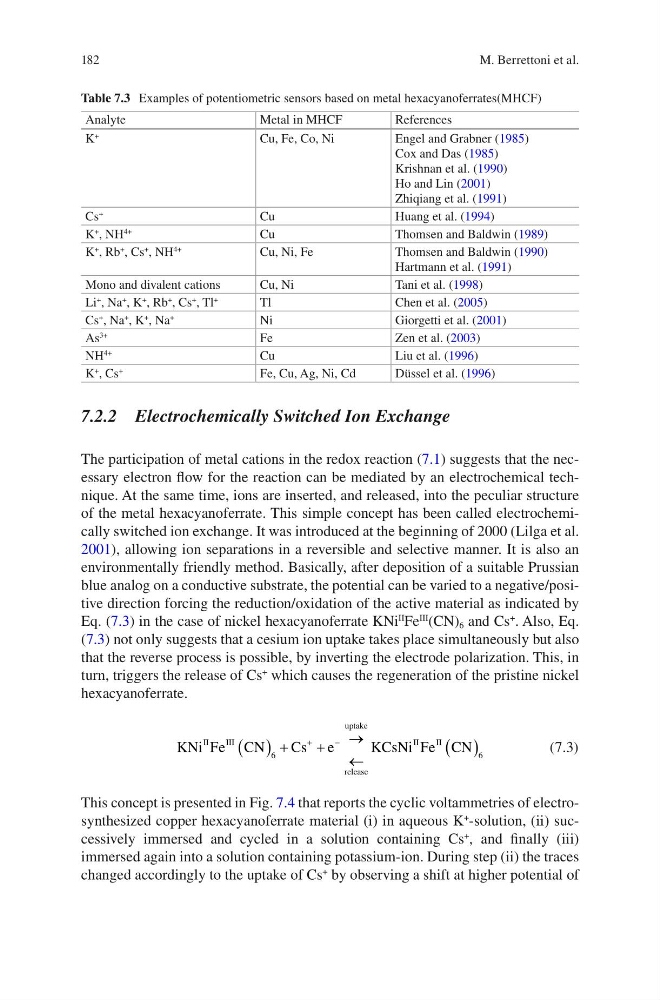
Table 7.3 Examples of potentiometric sensors based on metal hexacyanoferrates(MHCF)
Analyte
Metal in MHCF
References
K
+
Cu, Fe, Co, Ni
Engel and Grabner (1985)
Cox and Das (1985)
Krishnan et al. (1990)
Ho and Lin (2001)
Zhiqiang et al. (1991)
Cs
+
Cu
Huang et al. (1994)
K
+ , NH
4+
Cu
Thomsen and Baldwin (1989)
K
+ , Rb
+
, Cs
+ , NH
4+
Cu, Ni, Fe
Thomsen and Baldwin (1990)
Hartmann et al. (1991)
Mono and divalent cations
Cu, Ni
Tani et al. (1998)
Li
+
, Na
+
, K
+ , Rb
+ , Cs
+
, Tl
+
Tl
Chen et al. (2005)
Cs
+
, Na
+
, K
+
, Na
+
Ni
Giorgetti et al. (2001)
As
3+
Fe
Zen et al. (2003)
NH
4+
Cu
Liu et al. (1996)
K
+ , Cs
+
Fe, Cu, Ag, Ni, Cd
Düssel et al. (1996)
M. Berrettoni et al.
7.2.2 Electrochemically Switched Ion Exchange
The participation of metal cations in the redox reaction (7.1) suggests that the necessary electron flow for the reaction can be mediated by an electrochemical technique. At the same time, ions are inserted, and released, into the peculiar structure
of the metal hexacyanoferrate. This simple concept has been called electrochemically switched ion exchange. It was introduced at the beginning of 2000 (Lilga et al.
2001), allowing ion separations in a reversible and selective manner. It is also an
environmentally friendly method. Basically, after deposition of a suitable Prussian
blue analog on a conductive substrate, the potential can be varied to a negative/positive direction forcing the reduction/oxidation of the active material as indicated by
Eq. (7.3) in the case of nickel hexacyanoferrate KNi
II
Fe
III
(CN) 6 and Cs
+
. Also, Eq.
(7.3) not only suggests that a cesium ion uptake takes place simultaneously but also
that the reverse process is possible, by inverting the electrode polarization. This, in
turn, triggers the release of Cs
+
which causes the regeneration of the pristine nickel
hexacyanoferrate.
KNi Fe CN
Cs e
KCsNi Fe CN
II
III
uptake
release
II
II
( ) + +
®
¬
( )
+
-
6
6
(7.3)
This concept is presented in Fig. 7.4 that reports the cyclic voltammetries of electrosynthesized copper hexacyanoferrate material (i) in aqueous K
+
-solution, (ii) successively immersed and cycled in a solution containing Cs
+
, and finally (iii)
immersed again into a solution containing potassium-ion. During step (ii) the traces
changed accordingly to the uptake of Cs
+
by observing a shift at higher potential of
Table 7.3 Examples of potentiometric sensors based on metal hexacyanoferrates(MHCF)
Analyte
Metal in MHCF
References
K
+
Cu, Fe, Co, Ni
Engel and Grabner (1985)
Cox and Das (1985)
Krishnan et al. (1990)
Ho and Lin (2001)
Zhiqiang et al. (1991)
Cs
+
Cu
Huang et al. (1994)
K
+ , NH
4+
Cu
Thomsen and Baldwin (1989)
K
+ , Rb
+
, Cs
+ , NH
4+
Cu, Ni, Fe
Thomsen and Baldwin (1990)
Hartmann et al. (1991)
Mono and divalent cations
Cu, Ni
Tani et al. (1998)
Li
+
, Na
+
, K
+ , Rb
+ , Cs
+
, Tl
+
Tl
Chen et al. (2005)
Cs
+
, Na
+
, K
+
, Na
+
Ni
Giorgetti et al. (2001)
As
3+
Fe
Zen et al. (2003)
NH
4+
Cu
Liu et al. (1996)
K
+ , Cs
+
Fe, Cu, Ag, Ni, Cd
Düssel et al. (1996)
M. Berrettoni et al.