

183
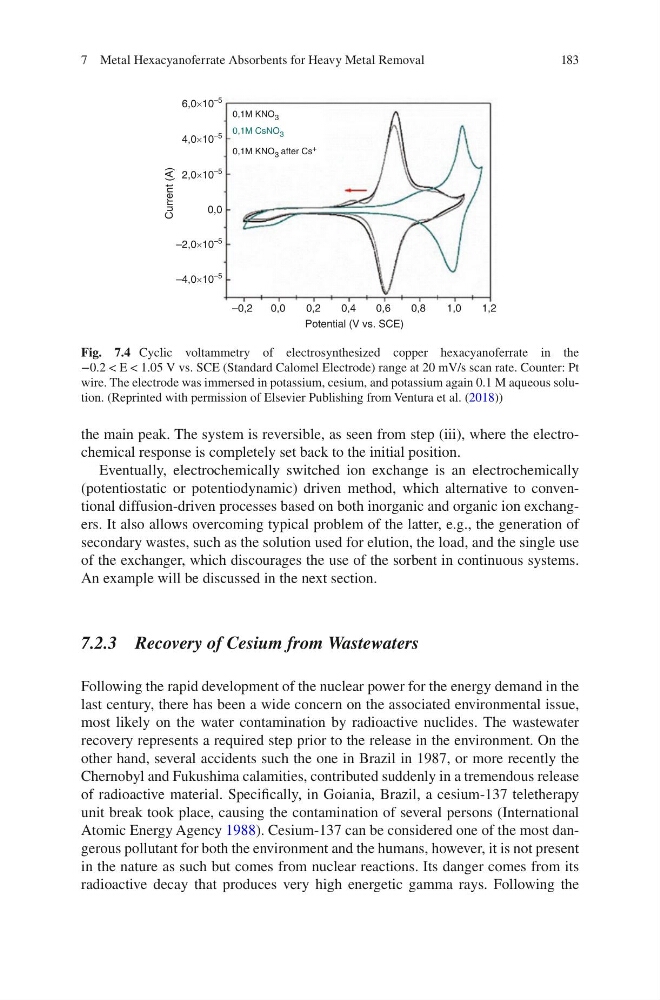
the main peak. The system is reversible, as seen from step (iii), where the electrochemical response is completely set back to the initial position.
Eventually, electrochemically switched ion exchange is an electrochemically
(potentiostatic or potentiodynamic) driven method, which alternative to conventional diffusion-driven processes based on both inorganic and organic ion exchangers. It also allows overcoming typical problem of the latter, e.g., the generation of
secondary wastes, such as the solution used for elution, the load, and the single use
of the exchanger, which discourages the use of the sorbent in continuous systems.
An example will be discussed in the next section.
7.2.3 Recovery of Cesium from Wastewaters
Following the rapid development of the nuclear power for the energy demand in the
last century, there has been a wide concern on the associated environmental issue,
most likely on the water contamination by radioactive nuclides. The wastewater
recovery represents a required step prior to the release in the environment. On the
other hand, several accidents such the one in Brazil in 1987, or more recently the
Chernobyl and Fukushima calamities, contributed suddenly in a tremendous release
of radioactive material. Specifically, in Goiania, Brazil, a cesium-137 teletherapy
unit break took place, causing the contamination of several persons (International
Atomic Energy Agency 1988). Cesium-137 can be considered one of the most dangerous pollutant for both the environment and the humans, however, it is not present
in the nature as such but comes from nuclear reactions. Its danger comes from its
radioactive decay that produces very high energetic gamma rays. Following the
6,0×10
–5
0,1M KNO 3
0,1M KNO 3 after Cs +
0,1M CsNO 3
4,0×10
–5
2,0×10
–5
–2,0×10
–5
–4,0×10
–5
–0,2
0,0
0,2
0,4
Potential (V vs. SCE)
Current (A)
0,6
0,8
1,0
1,2
0,0
Fig. 7.4 Cyclic voltammetry of electrosynthesized copper hexacyanoferrate in the
−0.2 < E < 1.05 V vs. SCE (Standard Calomel Electrode) range at 20 mV/s scan rate. Counter: Pt
wire. The electrode was immersed in potassium, cesium, and potassium again 0.1 M aqueous solution. (Reprinted with permission of Elsevier Publishing from Ventura et al. (2018))
7 Metal Hexacyanoferrate Absorbents for Heavy Metal Removal
the main peak. The system is reversible, as seen from step (iii), where the electrochemical response is completely set back to the initial position.
Eventually, electrochemically switched ion exchange is an electrochemically
(potentiostatic or potentiodynamic) driven method, which alternative to conventional diffusion-driven processes based on both inorganic and organic ion exchangers. It also allows overcoming typical problem of the latter, e.g., the generation of
secondary wastes, such as the solution used for elution, the load, and the single use
of the exchanger, which discourages the use of the sorbent in continuous systems.
An example will be discussed in the next section.
7.2.3 Recovery of Cesium from Wastewaters
Following the rapid development of the nuclear power for the energy demand in the
last century, there has been a wide concern on the associated environmental issue,
most likely on the water contamination by radioactive nuclides. The wastewater
recovery represents a required step prior to the release in the environment. On the
other hand, several accidents such the one in Brazil in 1987, or more recently the
Chernobyl and Fukushima calamities, contributed suddenly in a tremendous release
of radioactive material. Specifically, in Goiania, Brazil, a cesium-137 teletherapy
unit break took place, causing the contamination of several persons (International
Atomic Energy Agency 1988). Cesium-137 can be considered one of the most dangerous pollutant for both the environment and the humans, however, it is not present
in the nature as such but comes from nuclear reactions. Its danger comes from its
radioactive decay that produces very high energetic gamma rays. Following the
6,0×10
–5
0,1M KNO 3
0,1M KNO 3 after Cs +
0,1M CsNO 3
4,0×10
–5
2,0×10
–5
–2,0×10
–5
–4,0×10
–5
–0,2
0,0
0,2
0,4
Potential (V vs. SCE)
Current (A)
0,6
0,8
1,0
1,2
0,0
Fig. 7.4 Cyclic voltammetry of electrosynthesized copper hexacyanoferrate in the
−0.2 < E < 1.05 V vs. SCE (Standard Calomel Electrode) range at 20 mV/s scan rate. Counter: Pt
wire. The electrode was immersed in potassium, cesium, and potassium again 0.1 M aqueous solution. (Reprinted with permission of Elsevier Publishing from Ventura et al. (2018))
7 Metal Hexacyanoferrate Absorbents for Heavy Metal Removal