

181
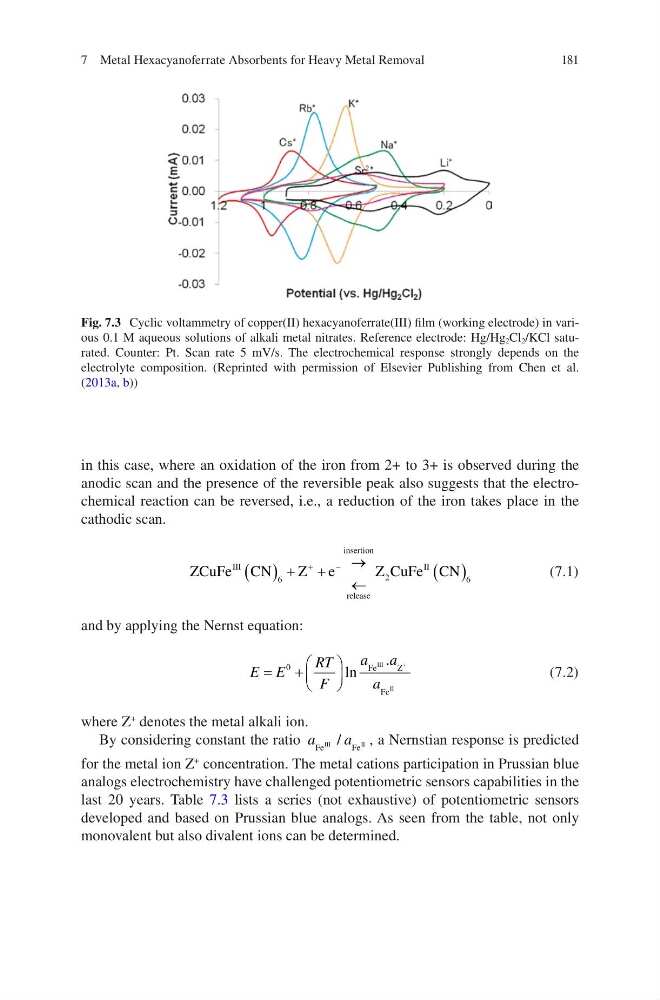
in this case, where an oxidation of the iron from 2+ to 3+ is observed during the
anodic scan and the presence of the reversible peak also suggests that the electrochemical reaction can be reversed, i.e., a reduction of the iron takes place in the
cathodic scan.
ZCuFe CN
Z e
Z CuFe CN
III
insertion
release
II
( ) + +
®
¬
( )
+
-
6
2
6
(7.1)
and by applying the Nernst equation:
E E
RT
F
a a
a
=
+
æ
è
ç
ö
ø
÷
+
0
ln
.
Fe
Z
Fe
III
II
(7.2)
where Z
+
denotes the metal alkali ion.
By considering constant the ratio a
a
Fe
Fe
III
II
/
, a Nernstian response is predicted
for the metal ion Z
+
concentration. The metal cations participation in Prussian blue
analogs electrochemistry have challenged potentiometric sensors capabilities in the
last 20 years. Table 7.3 lists a series (not exhaustive) of potentiometric sensors
developed and based on Prussian blue analogs. As seen from the table, not only
monovalent but also divalent ions can be determined.
Fig. 7.3 Cyclic voltammetry of copper(II) hexacyanoferrate(III) film (working electrode) in various 0.1 M aqueous solutions of alkali metal nitrates. Reference electrode: Hg/Hg 2 Cl 2 /KCl saturated. Counter: Pt. Scan rate 5 mV/s. The electrochemical response strongly depends on the
electrolyte composition. (Reprinted with permission of Elsevier Publishing from Chen et al.
(2013a, b))
7 Metal Hexacyanoferrate Absorbents for Heavy Metal Removal
in this case, where an oxidation of the iron from 2+ to 3+ is observed during the
anodic scan and the presence of the reversible peak also suggests that the electrochemical reaction can be reversed, i.e., a reduction of the iron takes place in the
cathodic scan.
ZCuFe CN
Z e
Z CuFe CN
III
insertion
release
II
( ) + +
®
¬
( )
+
-
6
2
6
(7.1)
and by applying the Nernst equation:
E E
RT
F
a a
a
=
+
æ
è
ç
ö
ø
÷
+
0
ln
.
Fe
Z
Fe
III
II
(7.2)
where Z
+
denotes the metal alkali ion.
By considering constant the ratio a
a
Fe
Fe
III
II
/
, a Nernstian response is predicted
for the metal ion Z
+
concentration. The metal cations participation in Prussian blue
analogs electrochemistry have challenged potentiometric sensors capabilities in the
last 20 years. Table 7.3 lists a series (not exhaustive) of potentiometric sensors
developed and based on Prussian blue analogs. As seen from the table, not only
monovalent but also divalent ions can be determined.
Fig. 7.3 Cyclic voltammetry of copper(II) hexacyanoferrate(III) film (working electrode) in various 0.1 M aqueous solutions of alkali metal nitrates. Reference electrode: Hg/Hg 2 Cl 2 /KCl saturated. Counter: Pt. Scan rate 5 mV/s. The electrochemical response strongly depends on the
electrolyte composition. (Reprinted with permission of Elsevier Publishing from Chen et al.
(2013a, b))
7 Metal Hexacyanoferrate Absorbents for Heavy Metal Removal