

180
ion (generally an analyte) is partitioned in two media according to its relative concentration in both phases:
K
a
a
d =
phase
phase
1
2
The formula states that a stronger affinity of a given metal ion with the phase 1 is
observed for high K d value. Generally speaking, a value of 5000 is good, and a K d
value greater than 50,000 can be considered excellent. According to the work of
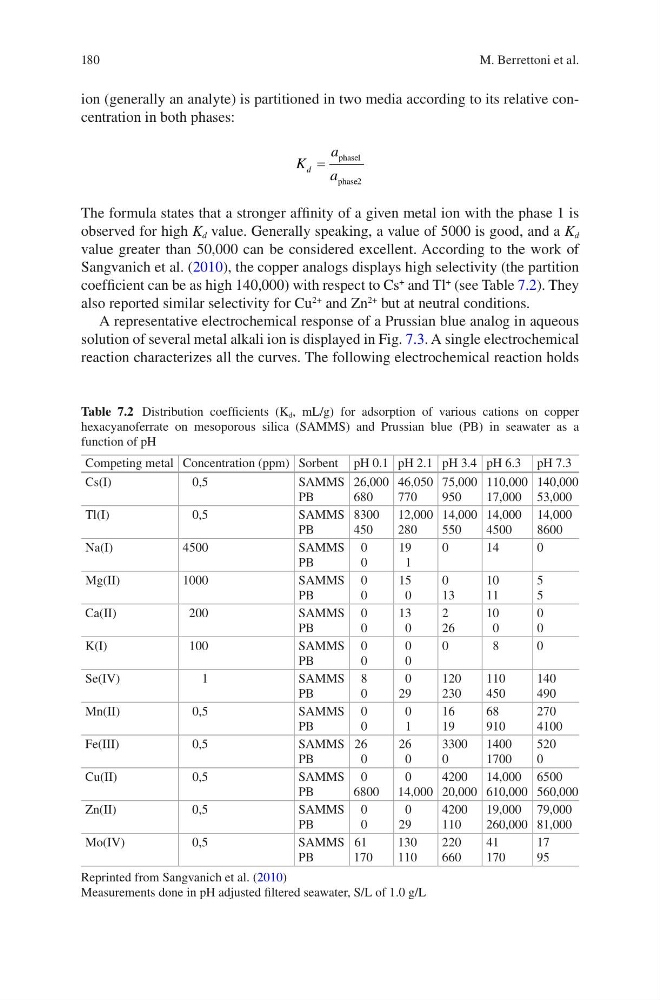
Sangvanich et al. (2010), the copper analogs displays high selectivity (the partition
coefficient can be as high 140,000) with respect to Cs
+
and Tl
+
(see Table 7.2). They
also reported similar selectivity for Cu
2+
and Zn
2+
but at neutral conditions.
A representative electrochemical response of a Prussian blue analog in aqueous
solution of several metal alkali ion is displayed in Fig. 7.3. A single electrochemical
reaction characterizes all the curves. The following electrochemical reaction holds
Table 7.2 Distribution coefficients (K d , mL/g) for adsorption of various cations on copper
hexacyanoferrate on mesoporous silica (SAMMS) and Prussian blue (PB) in seawater as a
function of pH
Competing metal Concentration (ppm) Sorbent pH 0.1 pH 2.1 pH 3.4 pH 6.3 pH 7.3
Cs(I)
0,5
SAMMS
PB
26,000
680
46,050
770
75,000
950
110,000
17,000
140,000
53,000
Tl(I)
0,5
SAMMS
PB
8300
450
12,000
280
14,000
550
14,000
4500
14,000
8600
Na(I)
4500
SAMMS
PB
0
0
19
1
0
14
0
Mg(II)
1000
SAMMS
PB
0
0
15
0
0
13
10
11
5
5
Ca(II)
200
SAMMS
PB
0
0
13
0
2
26
10
0
0
0
K(I)
100
SAMMS
PB
0
0
0
0
0
8
0
Se(IV)
1
SAMMS
PB
8
0
0
29
120
230
110
450
140
490
Mn(II)
0,5
SAMMS
PB
0
0
0
1
16
19
68
910
270
4100
Fe(III)
0,5
SAMMS
PB
26
0
26
0
3300
0
1400
1700
520
0
Cu(II)
0,5
SAMMS
PB
0
6800
0
14,000
4200
20,000
14,000
610,000
6500
560,000
Zn(II)
0,5
SAMMS
PB
0
0
0
29
4200
110
19,000
260,000
79,000
81,000
Mo(IV)
0,5
SAMMS
PB
61
170
130
110
220
660
41
170
17
95
Reprinted from Sangvanich et al. (2010)
Measurements done in pH adjusted filtered seawater, S/L of 1.0 g/L
M. Berrettoni et al.
ion (generally an analyte) is partitioned in two media according to its relative concentration in both phases:
K
a
a
d =
phase
phase
1
2
The formula states that a stronger affinity of a given metal ion with the phase 1 is
observed for high K d value. Generally speaking, a value of 5000 is good, and a K d
value greater than 50,000 can be considered excellent. According to the work of
Sangvanich et al. (2010), the copper analogs displays high selectivity (the partition
coefficient can be as high 140,000) with respect to Cs
+
and Tl
+
(see Table 7.2). They
also reported similar selectivity for Cu
2+
and Zn
2+
but at neutral conditions.
A representative electrochemical response of a Prussian blue analog in aqueous
solution of several metal alkali ion is displayed in Fig. 7.3. A single electrochemical
reaction characterizes all the curves. The following electrochemical reaction holds
Table 7.2 Distribution coefficients (K d , mL/g) for adsorption of various cations on copper
hexacyanoferrate on mesoporous silica (SAMMS) and Prussian blue (PB) in seawater as a
function of pH
Competing metal Concentration (ppm) Sorbent pH 0.1 pH 2.1 pH 3.4 pH 6.3 pH 7.3
Cs(I)
0,5
SAMMS
PB
26,000
680
46,050
770
75,000
950
110,000
17,000
140,000
53,000
Tl(I)
0,5
SAMMS
PB
8300
450
12,000
280
14,000
550
14,000
4500
14,000
8600
Na(I)
4500
SAMMS
PB
0
0
19
1
0
14
0
Mg(II)
1000
SAMMS
PB
0
0
15
0
0
13
10
11
5
5
Ca(II)
200
SAMMS
PB
0
0
13
0
2
26
10
0
0
0
K(I)
100
SAMMS
PB
0
0
0
0
0
8
0
Se(IV)
1
SAMMS
PB
8
0
0
29
120
230
110
450
140
490
Mn(II)
0,5
SAMMS
PB
0
0
0
1
16
19
68
910
270
4100
Fe(III)
0,5
SAMMS
PB
26
0
26
0
3300
0
1400
1700
520
0
Cu(II)
0,5
SAMMS
PB
0
6800
0
14,000
4200
20,000
14,000
610,000
6500
560,000
Zn(II)
0,5
SAMMS
PB
0
0
0
29
4200
110
19,000
260,000
79,000
81,000
Mo(IV)
0,5
SAMMS
PB
61
170
130
110
220
660
41
170
17
95
Reprinted from Sangvanich et al. (2010)
Measurements done in pH adjusted filtered seawater, S/L of 1.0 g/L
M. Berrettoni et al.