

123
The treated sawdust removed 100% Cr(VI), 83% Ni(II), 86% Cu(II), and Zn(II)
each from water. 87% of the adsorbed Cr(VI) was recovered by 0.01 M NaOH solution (Ajmal et al. 1996). Some other scientists investigated sawdust as potential
adsorbent for wastewater treatment (Shukla et al. 2002). Sciban and Klasnja used
poplar sawdust for Cu(II) remotion, and the maximum Langmuir value was
3.24 mg g
−1
(Sciban and Klasnja 2003). They also (Sciban et al. 2006a) attempted
poplar and fir tree sawdust treated with NaOH and Na 2 CO 3 for Cu(II) and Zn(II)
removal and compared the results with the untreated one. They observed that the
modified sawdust from both origins had higher removal capacity than the unmodified one. However, the removal capacity of Cu(II) was less than Zn(II). In another
work, they (Sciban et al. 2006b) further observed that 1% conc. NaOH solution was
sufficient for surface modification of sawdust, and thereafter, concentration increase
was not effective, and temperature was not an important factor. Acar and Eren used
sulfuric acid-treated poplar sawdust, and 92.4% Cu(II) was removed, while the
untreated poplar sawdust could remove only 47% at pH 5. The kinetics of the
adsorption was fast, and 70–80% copper was removed in 10 min (Acar and Eren
2006). Coconut tree sawdust modified with sulfuric acid was tried by researchers
(Kadirvelu et al. 2003) for Hg(II) and Ni(II) remotion. 100% Hg(II) and 81% Ni(II)
were removed in 1 h. Others attempted sawdust for Cr(VI) and obtained better
removal at pH 1. More than 95% desorption efficiency was achieved by acid and
base treatment of the used adsorbent (Gupta and Babu 2009). Others tried Romanian
fir tree sawdust (Nagy et al. 2013) and coconut tree sawdust (Putra et al. 2014) for
the treatment of different heavy metal-laden wastewater. The Langmuir adsorption
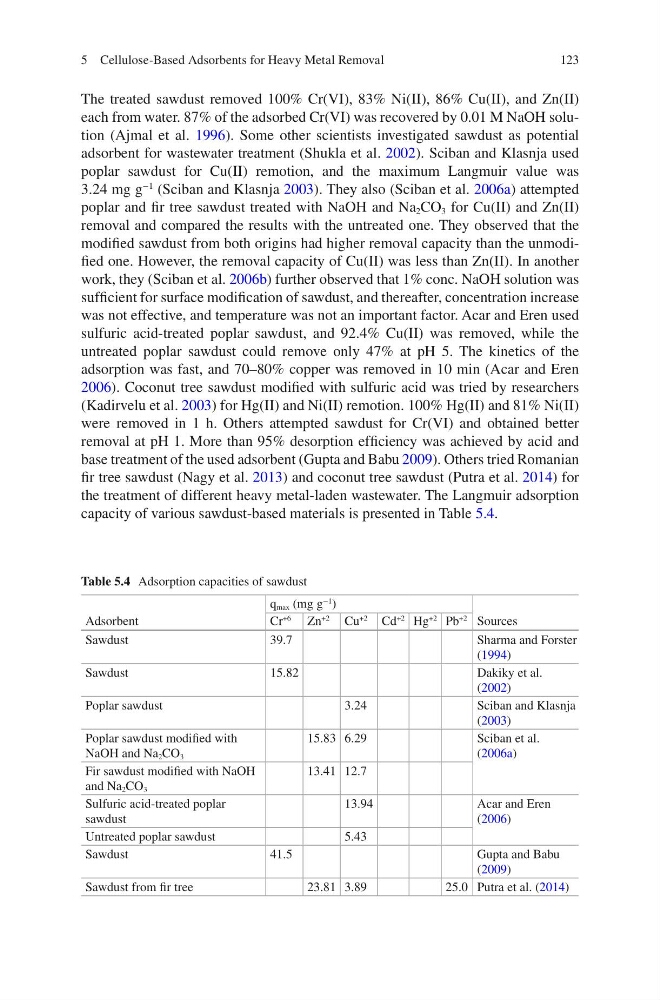
capacity of various sawdust-based materials is presented in Table 5.4.
Table 5.4 Adsorption capacities of sawdust
Adsorbent
q max (mg g
−1 )
Sources
Cr
+6
Zn
+2
Cu
+2
Cd
+2 Hg
+2 Pb
+2
Sawdust
39.7
Sharma and Forster
(1994)
Sawdust
15.82
Dakiky et al.
(2002)
Poplar sawdust
3.24
Sciban and Klasnja
(2003)
Poplar sawdust modified with
NaOH and Na 2 CO 3
15.83 6.29
Sciban et al.
(2006a)
Fir sawdust modified with NaOH
and Na 2 CO 3
13.41 12.7
Sulfuric acid-treated poplar
sawdust
13.94
Acar and Eren
(2006)
Untreated poplar sawdust
5.43
Sawdust
41.5
Gupta and Babu
(2009)
Sawdust from fir tree
23.81 3.89
25.0 Putra et al. (2014)
5 Cellulose-Based Adsorbents for Heavy Metal Removal
The treated sawdust removed 100% Cr(VI), 83% Ni(II), 86% Cu(II), and Zn(II)
each from water. 87% of the adsorbed Cr(VI) was recovered by 0.01 M NaOH solution (Ajmal et al. 1996). Some other scientists investigated sawdust as potential
adsorbent for wastewater treatment (Shukla et al. 2002). Sciban and Klasnja used
poplar sawdust for Cu(II) remotion, and the maximum Langmuir value was
3.24 mg g
−1
(Sciban and Klasnja 2003). They also (Sciban et al. 2006a) attempted
poplar and fir tree sawdust treated with NaOH and Na 2 CO 3 for Cu(II) and Zn(II)
removal and compared the results with the untreated one. They observed that the
modified sawdust from both origins had higher removal capacity than the unmodified one. However, the removal capacity of Cu(II) was less than Zn(II). In another
work, they (Sciban et al. 2006b) further observed that 1% conc. NaOH solution was
sufficient for surface modification of sawdust, and thereafter, concentration increase
was not effective, and temperature was not an important factor. Acar and Eren used
sulfuric acid-treated poplar sawdust, and 92.4% Cu(II) was removed, while the
untreated poplar sawdust could remove only 47% at pH 5. The kinetics of the
adsorption was fast, and 70–80% copper was removed in 10 min (Acar and Eren
2006). Coconut tree sawdust modified with sulfuric acid was tried by researchers
(Kadirvelu et al. 2003) for Hg(II) and Ni(II) remotion. 100% Hg(II) and 81% Ni(II)
were removed in 1 h. Others attempted sawdust for Cr(VI) and obtained better
removal at pH 1. More than 95% desorption efficiency was achieved by acid and
base treatment of the used adsorbent (Gupta and Babu 2009). Others tried Romanian
fir tree sawdust (Nagy et al. 2013) and coconut tree sawdust (Putra et al. 2014) for
the treatment of different heavy metal-laden wastewater. The Langmuir adsorption
capacity of various sawdust-based materials is presented in Table 5.4.
Table 5.4 Adsorption capacities of sawdust
Adsorbent
q max (mg g
−1 )
Sources
Cr
+6
Zn
+2
Cu
+2
Cd
+2 Hg
+2 Pb
+2
Sawdust
39.7
Sharma and Forster
(1994)
Sawdust
15.82
Dakiky et al.
(2002)
Poplar sawdust
3.24
Sciban and Klasnja
(2003)
Poplar sawdust modified with
NaOH and Na 2 CO 3
15.83 6.29
Sciban et al.
(2006a)
Fir sawdust modified with NaOH
and Na 2 CO 3
13.41 12.7
Sulfuric acid-treated poplar
sawdust
13.94
Acar and Eren
(2006)
Untreated poplar sawdust
5.43
Sawdust
41.5
Gupta and Babu
(2009)
Sawdust from fir tree
23.81 3.89
25.0 Putra et al. (2014)
5 Cellulose-Based Adsorbents for Heavy Metal Removal