

124
5.5.3 Rice Wastes
Rice husk has 32.24% cellulose (Rahman et al., 1997) and is known for its metal
removal capacity. Chuah et al. observed that arsenic, gold, cadmium, mercury, copper, zinc, cobalt, nickel, and lead, i.e., most of the heavy metals, were remediated by
rice husk successfully (Chuah et al. 2005). Some others applied treated rice husk in
column mode for Cd(II) removal, and the regeneration efficiency was 97–95.4% in
the first two cycles, indicating the reversibility of sorption process without loss of
binding efficiency (Kumar and Bandyopadhyay 2006). Mohan and Sreelakshmi
conducted column study with raw and treated rice husk. The adsorption rate and
capacity were double in case of the treated rice husk compared to raw one (Mohan
and Sreelakshmi 2008). Another group of scientists (Bansal et al. 2009) attempted
treated rice husk. The boiled rice husk removed 71% Cr(VI), whereas formaldehydetreated rice husk could remove 76.5%. Different rice and other wastes were tried
(Singha and Das 2011, 2013) for Cr(VI) and Cu(II) removal. The spontaneity and
reusability suggested the use of these wastes as effective adsorbents. Other researchers found rice husk was successful for iron, lead, copper, and nickel treatment within
the experimental limits (20–60 mg L
−1
) for real wastewater (Hegazi 2013, Vieira
et al. 2014). Research findings also indicated that other wastes, like rice hull and
rice bran, were effective for treatment of Ni
+2
, Cr
+3
, Cu
+2
, Zn
+2
, and Co
+2
ions from
wastewater (Marshall et al. 1993). Mercury was eliminated successfully by rice
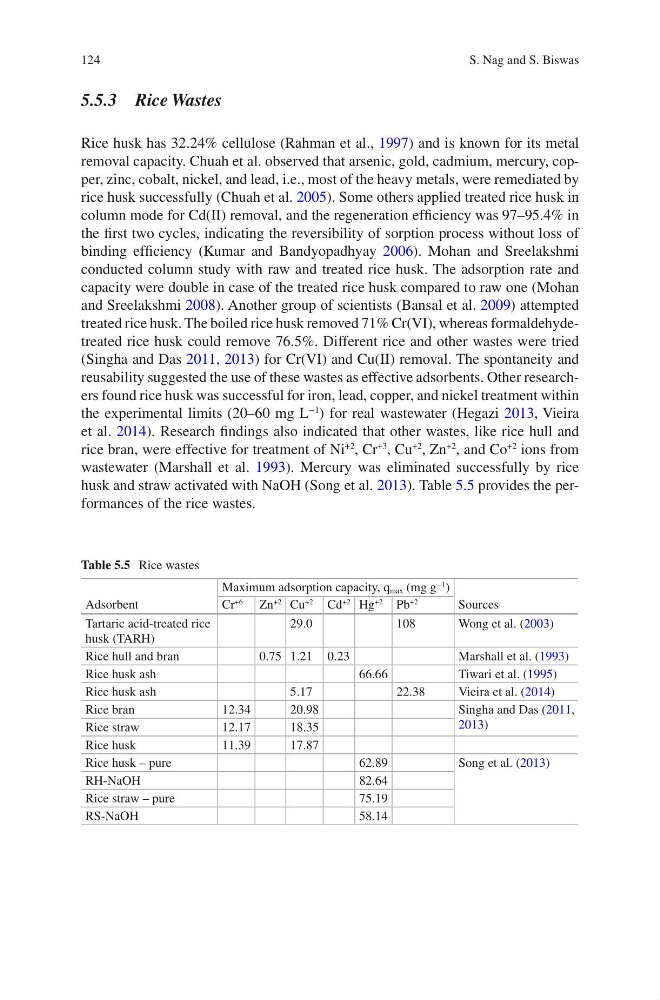
husk and straw activated with NaOH (Song et al. 2013). Table 5.5 provides the performances of the rice wastes.
Table 5.5 Rice wastes
Adsorbent
Maximum adsorption capacity, q max (mg g
−1
)
Sources
Cr
+6
Zn
+2 Cu
+2
Cd
+2 Hg
+2
Pb
+2
Tartaric acid-treated rice
husk (TARH)
29.0
108
Wong et al. (2003)
Rice hull and bran
0.75 1.21 0.23
Marshall et al. (1993)
Rice husk ash
66.66
Tiwari et al. (1995)
Rice husk ash
5.17
22.38
Vieira et al. (2014)
Rice bran
12.34
20.98
Singha and Das (2011,
2013)
Rice straw
12.17
18.35
Rice husk
11.39
17.87
Rice husk – pure
62.89
Song et al. (2013)
RH-NaOH
82.64
Rice straw – pure
75.19
RS-NaOH
58.14
S. Nag and S. Biswas
5.5.3 Rice Wastes
Rice husk has 32.24% cellulose (Rahman et al., 1997) and is known for its metal
removal capacity. Chuah et al. observed that arsenic, gold, cadmium, mercury, copper, zinc, cobalt, nickel, and lead, i.e., most of the heavy metals, were remediated by
rice husk successfully (Chuah et al. 2005). Some others applied treated rice husk in
column mode for Cd(II) removal, and the regeneration efficiency was 97–95.4% in
the first two cycles, indicating the reversibility of sorption process without loss of
binding efficiency (Kumar and Bandyopadhyay 2006). Mohan and Sreelakshmi
conducted column study with raw and treated rice husk. The adsorption rate and
capacity were double in case of the treated rice husk compared to raw one (Mohan
and Sreelakshmi 2008). Another group of scientists (Bansal et al. 2009) attempted
treated rice husk. The boiled rice husk removed 71% Cr(VI), whereas formaldehydetreated rice husk could remove 76.5%. Different rice and other wastes were tried
(Singha and Das 2011, 2013) for Cr(VI) and Cu(II) removal. The spontaneity and
reusability suggested the use of these wastes as effective adsorbents. Other researchers found rice husk was successful for iron, lead, copper, and nickel treatment within
the experimental limits (20–60 mg L
−1
) for real wastewater (Hegazi 2013, Vieira
et al. 2014). Research findings also indicated that other wastes, like rice hull and
rice bran, were effective for treatment of Ni
+2
, Cr
+3
, Cu
+2
, Zn
+2
, and Co
+2
ions from
wastewater (Marshall et al. 1993). Mercury was eliminated successfully by rice
husk and straw activated with NaOH (Song et al. 2013). Table 5.5 provides the performances of the rice wastes.
Table 5.5 Rice wastes
Adsorbent
Maximum adsorption capacity, q max (mg g
−1
)
Sources
Cr
+6
Zn
+2 Cu
+2
Cd
+2 Hg
+2
Pb
+2
Tartaric acid-treated rice
husk (TARH)
29.0
108
Wong et al. (2003)
Rice hull and bran
0.75 1.21 0.23
Marshall et al. (1993)
Rice husk ash
66.66
Tiwari et al. (1995)
Rice husk ash
5.17
22.38
Vieira et al. (2014)
Rice bran
12.34
20.98
Singha and Das (2011,
2013)
Rice straw
12.17
18.35
Rice husk
11.39
17.87
Rice husk – pure
62.89
Song et al. (2013)
RH-NaOH
82.64
Rice straw – pure
75.19
RS-NaOH
58.14
S. Nag and S. Biswas