

suitable resilience strategy and for which they
receive financial, logistical and expert guidance
and support in return (100RC 2018).
4 Methodology
The results presented in this chapter are based on
key stakeholder interviews that were carried out
between April 2016 and 2017. The target group
was representatives of cities that joined transnational city networks (e.g. CROs, environmental
coordinators, consultants or engineers or climate
change managers). Overall, 23 interviews with
municipal policymakers were conducted, on-site,
via phone, Skype or email. The interview material
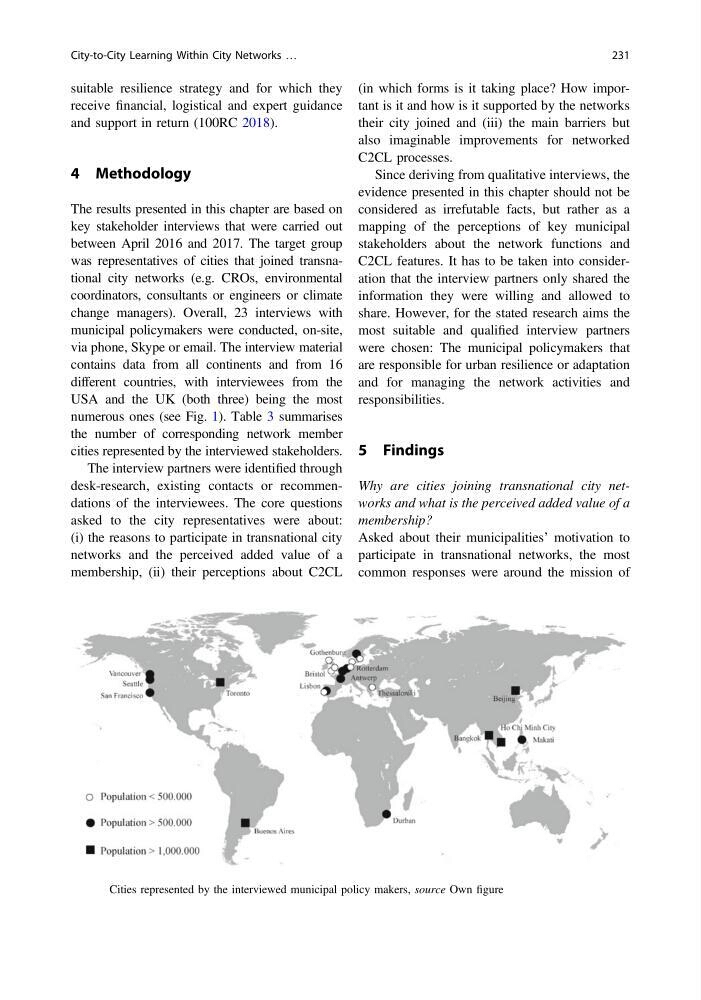
contains data from all continents and from 16
different countries, with interviewees from the
USA and the UK (both three) being the most
numerous ones (see Fig. 1). Table 3 summarises
the number of corresponding network member
cities represented by the interviewed stakeholders.
The interview partners were identified through
desk-research, existing contacts or recommendations of the interviewees. The core questions
asked to the city representatives were about:
(i) the reasons to participate in transnational city
networks and the perceived added value of a
membership, (ii) their perceptions about C2CL
(in which forms is it taking place? How important is it and how is it supported by the networks
their city joined and (iii) the main barriers but
also imaginable improvements for networked
C2CL processes.
Since deriving from qualitative interviews, the
evidence presented in this chapter should not be
considered as irrefutable facts, but rather as a
mapping of the perceptions of key municipal
stakeholders about the network functions and
C2CL features. It has to be taken into consideration that the interview partners only shared the
information they were willing and allowed to
share. However, for the stated research aims the
most suitable and qualified interview partners
were chosen: The municipal policymakers that
are responsible for urban resilience or adaptation
and for managing the network activities and
responsibilities.
5 Findings
Why are cities joining transnational city networks and what is the perceived added value of a
membership?
Asked about their municipalities’ motivation to
participate in transnational networks, the most
common responses were around the mission of
Fig. 1 Cities represented by the interviewed municipal policy makers, source Own figure
City-to-City Learning Within City Networks …
231
receive financial, logistical and expert guidance
and support in return (100RC 2018).
4 Methodology
The results presented in this chapter are based on
key stakeholder interviews that were carried out
between April 2016 and 2017. The target group
was representatives of cities that joined transnational city networks (e.g. CROs, environmental
coordinators, consultants or engineers or climate
change managers). Overall, 23 interviews with
municipal policymakers were conducted, on-site,
via phone, Skype or email. The interview material
contains data from all continents and from 16
different countries, with interviewees from the
USA and the UK (both three) being the most
numerous ones (see Fig. 1). Table 3 summarises
the number of corresponding network member
cities represented by the interviewed stakeholders.
The interview partners were identified through
desk-research, existing contacts or recommendations of the interviewees. The core questions
asked to the city representatives were about:
(i) the reasons to participate in transnational city
networks and the perceived added value of a
membership, (ii) their perceptions about C2CL
(in which forms is it taking place? How important is it and how is it supported by the networks
their city joined and (iii) the main barriers but
also imaginable improvements for networked
C2CL processes.
Since deriving from qualitative interviews, the
evidence presented in this chapter should not be
considered as irrefutable facts, but rather as a
mapping of the perceptions of key municipal
stakeholders about the network functions and
C2CL features. It has to be taken into consideration that the interview partners only shared the
information they were willing and allowed to
share. However, for the stated research aims the
most suitable and qualified interview partners
were chosen: The municipal policymakers that
are responsible for urban resilience or adaptation
and for managing the network activities and
responsibilities.
5 Findings
Why are cities joining transnational city networks and what is the perceived added value of a
membership?
Asked about their municipalities’ motivation to
participate in transnational networks, the most
common responses were around the mission of
Fig. 1 Cities represented by the interviewed municipal policy makers, source Own figure
City-to-City Learning Within City Networks …
231