

the meantime, Mayors Adapt was fully integrated
into the Covenant of Mayors, another European
Commission initiative that originally solely
focussed on climate change mitigation (Cleaner
Energies Saving Mediterranean Cities nd). Both
100RC and ACCCRN were launched by the
Rockefeller Foundation to promote the reinforcement of urban resilience (100RC 2018;
ACCCRN 2018).
The Compact of Mayors represents a special
case since it is an initiative that tries to unite a
number of already existing networks, including
ICLEI, C40, CityNet UCLG and the Covenant of
Mayors (Compact of Mayors nd). The idea is not
to replace existing networks but to establish a
standardised way of reporting and monitoring of
a cities climate action measures, for instance
through robust and transparent data collection
standards (ibd.). Most city networks try to make
their member cities efforts and success representable and measurable through different monitoring and evaluation systems. However, this is
not an easy task and this has also been identified
as one big research gap on city networks and
urban climate governance (see Bulkeley 2010;
Bulkeley and Schroeder 2012; Giest and Howlett
2013; James and Verrest 2015).
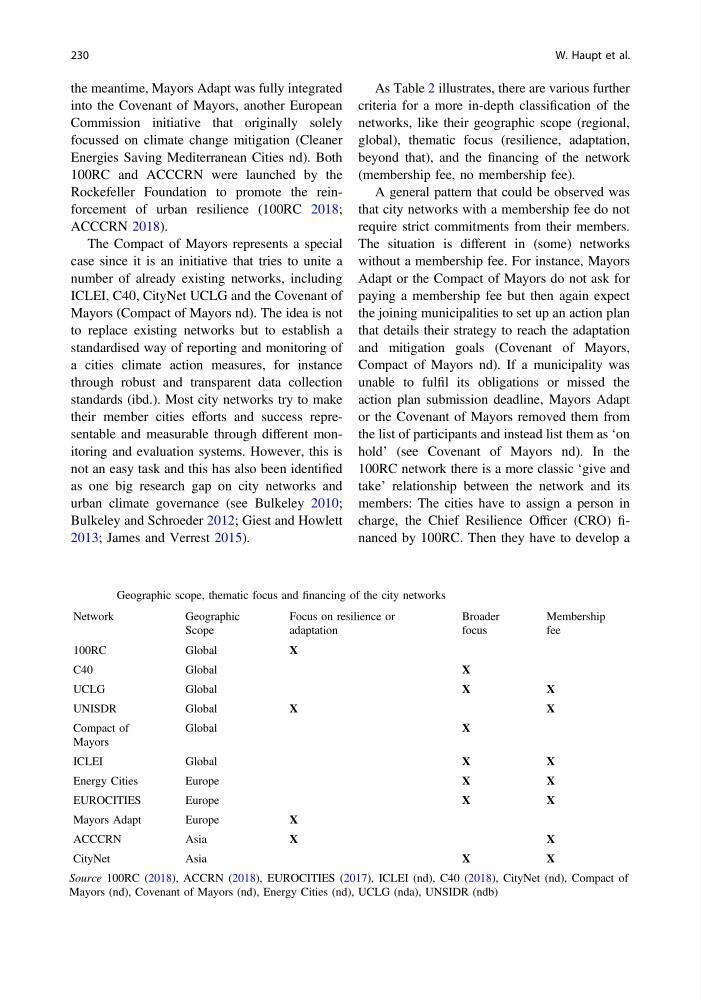
As Table 2 illustrates, there are various further
criteria for a more in-depth classification of the
networks, like their geographic scope (regional,
global), thematic focus (resilience, adaptation,
beyond that), and the financing of the network
(membership fee, no membership fee).
A general pattern that could be observed was
that city networks with a membership fee do not
require strict commitments from their members.
The situation is different in (some) networks
without a membership fee. For instance, Mayors
Adapt or the Compact of Mayors do not ask for
paying a membership fee but then again expect
the joining municipalities to set up an action plan
that details their strategy to reach the adaptation
and mitigation goals (Covenant of Mayors,
Compact of Mayors nd). If a municipality was
unable to fulfil its obligations or missed the
action plan submission deadline, Mayors Adapt
or the Covenant of Mayors removed them from
the list of participants and instead list them as ‘on
hold’ (see Covenant of Mayors nd). In the
100RC network there is a more classic ‘give and
take’ relationship between the network and its
members: The cities have to assign a person in
charge, the Chief Resilience Officer (CRO) financed by 100RC. Then they have to develop a
Table 2 Geographic scope, thematic focus and financing of the city networks
Network
Geographic
Scope
Focus on resilience or
adaptation
Broader
focus
Membership
fee
100RC
Global
X
C40
Global
X
UCLG
Global
X
X
UNISDR
Global
X
X
Compact of
Mayors
Global
X
ICLEI
Global
X
X
Energy Cities
Europe
X
X
EUROCITIES
Europe
X
X
Mayors Adapt
Europe
X
ACCCRN
Asia
X
X
CityNet
Asia
X
X
Source 100RC (2018), ACCRN (2018), EUROCITIES (2017), ICLEI (nd), C40 (2018), CityNet (nd), Compact of
Mayors (nd), Covenant of Mayors (nd), Energy Cities (nd), UCLG (nda), UNSIDR (ndb)
230
W. Haupt et al.
into the Covenant of Mayors, another European
Commission initiative that originally solely
focussed on climate change mitigation (Cleaner
Energies Saving Mediterranean Cities nd). Both
100RC and ACCCRN were launched by the
Rockefeller Foundation to promote the reinforcement of urban resilience (100RC 2018;
ACCCRN 2018).
The Compact of Mayors represents a special
case since it is an initiative that tries to unite a
number of already existing networks, including
ICLEI, C40, CityNet UCLG and the Covenant of
Mayors (Compact of Mayors nd). The idea is not
to replace existing networks but to establish a
standardised way of reporting and monitoring of
a cities climate action measures, for instance
through robust and transparent data collection
standards (ibd.). Most city networks try to make
their member cities efforts and success representable and measurable through different monitoring and evaluation systems. However, this is
not an easy task and this has also been identified
as one big research gap on city networks and
urban climate governance (see Bulkeley 2010;
Bulkeley and Schroeder 2012; Giest and Howlett
2013; James and Verrest 2015).
As Table 2 illustrates, there are various further
criteria for a more in-depth classification of the
networks, like their geographic scope (regional,
global), thematic focus (resilience, adaptation,
beyond that), and the financing of the network
(membership fee, no membership fee).
A general pattern that could be observed was
that city networks with a membership fee do not
require strict commitments from their members.
The situation is different in (some) networks
without a membership fee. For instance, Mayors
Adapt or the Compact of Mayors do not ask for
paying a membership fee but then again expect
the joining municipalities to set up an action plan
that details their strategy to reach the adaptation
and mitigation goals (Covenant of Mayors,
Compact of Mayors nd). If a municipality was
unable to fulfil its obligations or missed the
action plan submission deadline, Mayors Adapt
or the Covenant of Mayors removed them from
the list of participants and instead list them as ‘on
hold’ (see Covenant of Mayors nd). In the
100RC network there is a more classic ‘give and
take’ relationship between the network and its
members: The cities have to assign a person in
charge, the Chief Resilience Officer (CRO) financed by 100RC. Then they have to develop a
Table 2 Geographic scope, thematic focus and financing of the city networks
Network
Geographic
Scope
Focus on resilience or
adaptation
Broader
focus
Membership
fee
100RC
Global
X
C40
Global
X
UCLG
Global
X
X
UNISDR
Global
X
X
Compact of
Mayors
Global
X
ICLEI
Global
X
X
Energy Cities
Europe
X
X
EUROCITIES
Europe
X
X
Mayors Adapt
Europe
X
ACCCRN
Asia
X
X
CityNet
Asia
X
X
Source 100RC (2018), ACCRN (2018), EUROCITIES (2017), ICLEI (nd), C40 (2018), CityNet (nd), Compact of
Mayors (nd), Covenant of Mayors (nd), Energy Cities (nd), UCLG (nda), UNSIDR (ndb)
230
W. Haupt et al.