

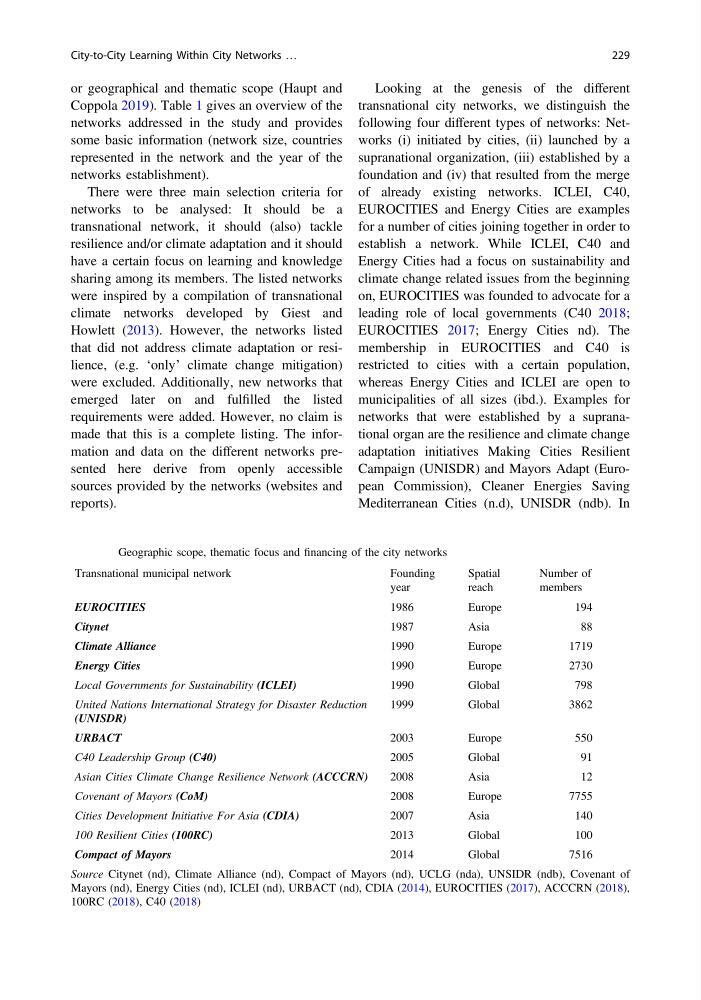
or geographical and thematic scope (Haupt and
Coppola 2019). Table 1 gives an overview of the
networks addressed in the study and provides
some basic information (network size, countries
represented in the network and the year of the
networks establishment).
There were three main selection criteria for
networks to be analysed: It should be a
transnational network, it should (also) tackle
resilience and/or climate adaptation and it should
have a certain focus on learning and knowledge
sharing among its members. The listed networks
were inspired by a compilation of transnational
climate networks developed by Giest and
Howlett (2013). However, the networks listed
that did not address climate adaptation or resilience, (e.g. ‘only’ climate change mitigation)
were excluded. Additionally, new networks that
emerged later on and fulfilled the listed
requirements were added. However, no claim is
made that this is a complete listing. The information and data on the different networks presented here derive from openly accessible
sources provided by the networks (websites and
reports).
Looking at the genesis of the different
transnational city networks, we distinguish the
following four different types of networks: Networks (i) initiated by cities, (ii) launched by a
supranational organization, (iii) established by a
foundation and (iv) that resulted from the merge
of already existing networks. ICLEI, C40,
EUROCITIES and Energy Cities are examples
for a number of cities joining together in order to
establish a network. While ICLEI, C40 and
Energy Cities had a focus on sustainability and
climate change related issues from the beginning
on, EUROCITIES was founded to advocate for a
leading role of local governments (C40 2018;
EUROCITIES 2017; Energy Cities nd). The
membership in EUROCITIES and C40 is
restricted to cities with a certain population,
whereas Energy Cities and ICLEI are open to
municipalities of all sizes (ibd.). Examples for
networks that were established by a supranational organ are the resilience and climate change
adaptation initiatives Making Cities Resilient
Campaign (UNISDR) and Mayors Adapt (European Commission), Cleaner Energies Saving
Mediterranean Cities (n.d), UNISDR (ndb). In
Table 1 Geographic scope, thematic focus and financing of the city networks
Transnational municipal network
Founding
year
Spatial
reach
Number of
members
EUROCITIES
1986
Europe
194
Citynet
1987
Asia
88
Climate Alliance
1990
Europe
1719
Energy Cities
1990
Europe
2730
Local Governments for Sustainability (ICLEI)
1990
Global
798
United Nations International Strategy for Disaster Reduction
(UNISDR)
1999
Global
3862
URBACT
2003
Europe
550
C40 Leadership Group (C40)
2005
Global
91
Asian Cities Climate Change Resilience Network (ACCCRN)
2008
Asia
12
Covenant of Mayors (CoM)
2008
Europe
7755
Cities Development Initiative For Asia (CDIA)
2007
Asia
140
100 Resilient Cities (100RC)
2013
Global
100
Compact of Mayors
2014
Global
7516
Source Citynet (nd), Climate Alliance (nd), Compact of Mayors (nd), UCLG (nda), UNSIDR (ndb), Covenant of
Mayors (nd), Energy Cities (nd), ICLEI (nd), URBACT (nd), CDIA (2014), EUROCITIES (2017), ACCCRN (2018),
100RC (2018), C40 (2018)
City-to-City Learning Within City Networks …
229
Coppola 2019). Table 1 gives an overview of the
networks addressed in the study and provides
some basic information (network size, countries
represented in the network and the year of the
networks establishment).
There were three main selection criteria for
networks to be analysed: It should be a
transnational network, it should (also) tackle
resilience and/or climate adaptation and it should
have a certain focus on learning and knowledge
sharing among its members. The listed networks
were inspired by a compilation of transnational
climate networks developed by Giest and
Howlett (2013). However, the networks listed
that did not address climate adaptation or resilience, (e.g. ‘only’ climate change mitigation)
were excluded. Additionally, new networks that
emerged later on and fulfilled the listed
requirements were added. However, no claim is
made that this is a complete listing. The information and data on the different networks presented here derive from openly accessible
sources provided by the networks (websites and
reports).
Looking at the genesis of the different
transnational city networks, we distinguish the
following four different types of networks: Networks (i) initiated by cities, (ii) launched by a
supranational organization, (iii) established by a
foundation and (iv) that resulted from the merge
of already existing networks. ICLEI, C40,
EUROCITIES and Energy Cities are examples
for a number of cities joining together in order to
establish a network. While ICLEI, C40 and
Energy Cities had a focus on sustainability and
climate change related issues from the beginning
on, EUROCITIES was founded to advocate for a
leading role of local governments (C40 2018;
EUROCITIES 2017; Energy Cities nd). The
membership in EUROCITIES and C40 is
restricted to cities with a certain population,
whereas Energy Cities and ICLEI are open to
municipalities of all sizes (ibd.). Examples for
networks that were established by a supranational organ are the resilience and climate change
adaptation initiatives Making Cities Resilient
Campaign (UNISDR) and Mayors Adapt (European Commission), Cleaner Energies Saving
Mediterranean Cities (n.d), UNISDR (ndb). In
Table 1 Geographic scope, thematic focus and financing of the city networks
Transnational municipal network
Founding
year
Spatial
reach
Number of
members
EUROCITIES
1986
Europe
194
Citynet
1987
Asia
88
Climate Alliance
1990
Europe
1719
Energy Cities
1990
Europe
2730
Local Governments for Sustainability (ICLEI)
1990
Global
798
United Nations International Strategy for Disaster Reduction
(UNISDR)
1999
Global
3862
URBACT
2003
Europe
550
C40 Leadership Group (C40)
2005
Global
91
Asian Cities Climate Change Resilience Network (ACCCRN)
2008
Asia
12
Covenant of Mayors (CoM)
2008
Europe
7755
Cities Development Initiative For Asia (CDIA)
2007
Asia
140
100 Resilient Cities (100RC)
2013
Global
100
Compact of Mayors
2014
Global
7516
Source Citynet (nd), Climate Alliance (nd), Compact of Mayors (nd), UCLG (nda), UNSIDR (ndb), Covenant of
Mayors (nd), Energy Cities (nd), ICLEI (nd), URBACT (nd), CDIA (2014), EUROCITIES (2017), ACCCRN (2018),
100RC (2018), C40 (2018)
City-to-City Learning Within City Networks …
229