

3.2 Linking Scenario Example
2—Nucleus Principle
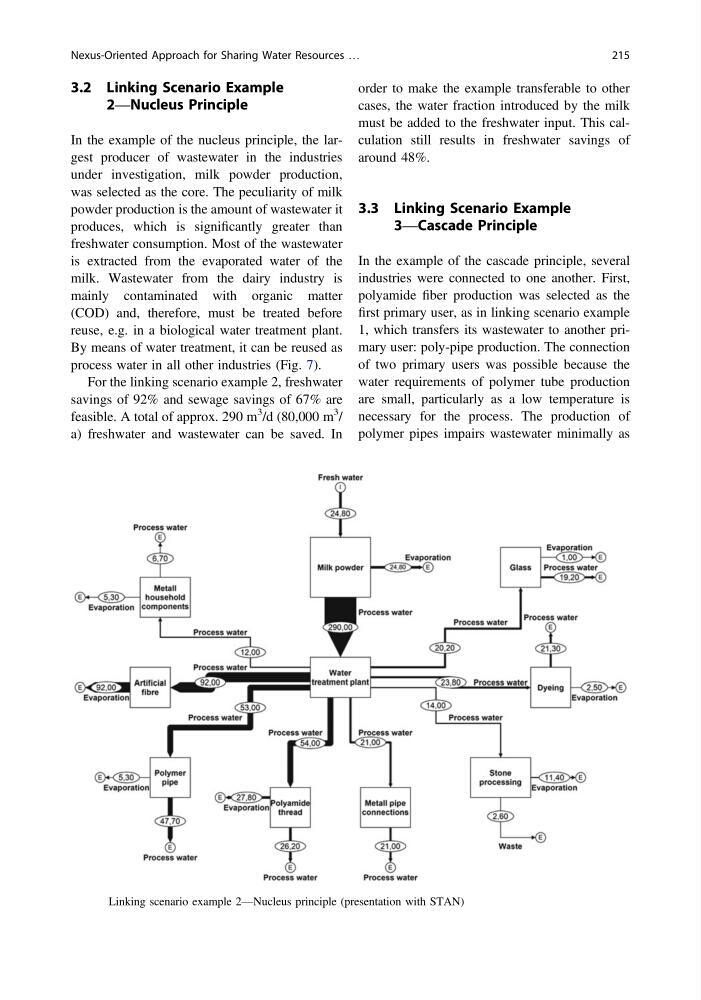
In the example of the nucleus principle, the largest producer of wastewater in the industries
under investigation, milk powder production,
was selected as the core. The peculiarity of milk
powder production is the amount of wastewater it
produces, which is significantly greater than
freshwater consumption. Most of the wastewater
is extracted from the evaporated water of the
milk. Wastewater from the dairy industry is
mainly contaminated with organic matter
(COD) and, therefore, must be treated before
reuse, e.g. in a biological water treatment plant.
By means of water treatment, it can be reused as
process water in all other industries (Fig. 7).
For the linking scenario example 2, freshwater
savings of 92% and sewage savings of 67% are
feasible. A total of approx. 290 m
3 /d (80,000 m
3 /
a) freshwater and wastewater can be saved. In
order to make the example transferable to other
cases, the water fraction introduced by the milk
must be added to the freshwater input. This calculation still results in freshwater savings of
around 48%.
3.3 Linking Scenario Example
3—Cascade Principle
In the example of the cascade principle, several
industries were connected to one another. First,
polyamide fiber production was selected as the
first primary user, as in linking scenario example
1, which transfers its wastewater to another primary user: poly-pipe production. The connection
of two primary users was possible because the
water requirements of polymer tube production
are small, particularly as a low temperature is
necessary for the process. The production of
polymer pipes impairs wastewater minimally as
Fig. 7 Linking scenario example 2—Nucleus principle (presentation with STAN)
Nexus-Oriented Approach for Sharing Water Resources …
215
2—Nucleus Principle
In the example of the nucleus principle, the largest producer of wastewater in the industries
under investigation, milk powder production,
was selected as the core. The peculiarity of milk
powder production is the amount of wastewater it
produces, which is significantly greater than
freshwater consumption. Most of the wastewater
is extracted from the evaporated water of the
milk. Wastewater from the dairy industry is
mainly contaminated with organic matter
(COD) and, therefore, must be treated before
reuse, e.g. in a biological water treatment plant.
By means of water treatment, it can be reused as
process water in all other industries (Fig. 7).
For the linking scenario example 2, freshwater
savings of 92% and sewage savings of 67% are
feasible. A total of approx. 290 m
3 /d (80,000 m
3 /
a) freshwater and wastewater can be saved. In
order to make the example transferable to other
cases, the water fraction introduced by the milk
must be added to the freshwater input. This calculation still results in freshwater savings of
around 48%.
3.3 Linking Scenario Example
3—Cascade Principle
In the example of the cascade principle, several
industries were connected to one another. First,
polyamide fiber production was selected as the
first primary user, as in linking scenario example
1, which transfers its wastewater to another primary user: poly-pipe production. The connection
of two primary users was possible because the
water requirements of polymer tube production
are small, particularly as a low temperature is
necessary for the process. The production of
polymer pipes impairs wastewater minimally as
Fig. 7 Linking scenario example 2—Nucleus principle (presentation with STAN)
Nexus-Oriented Approach for Sharing Water Resources …
215