

conservation potentials are shown in m
3 /d. In
order to be able to represent the potential savings
in m
3 /a, a value of the average working days per
year was assumed. The mean value is 277 days
per year. To make it simple, it is assumed that
tertiary and secondary industries may substitute
their freshwater demand to 100% with wastewater from other industries.
3.1 Linking Scenario Example
1—Bilateral Principle
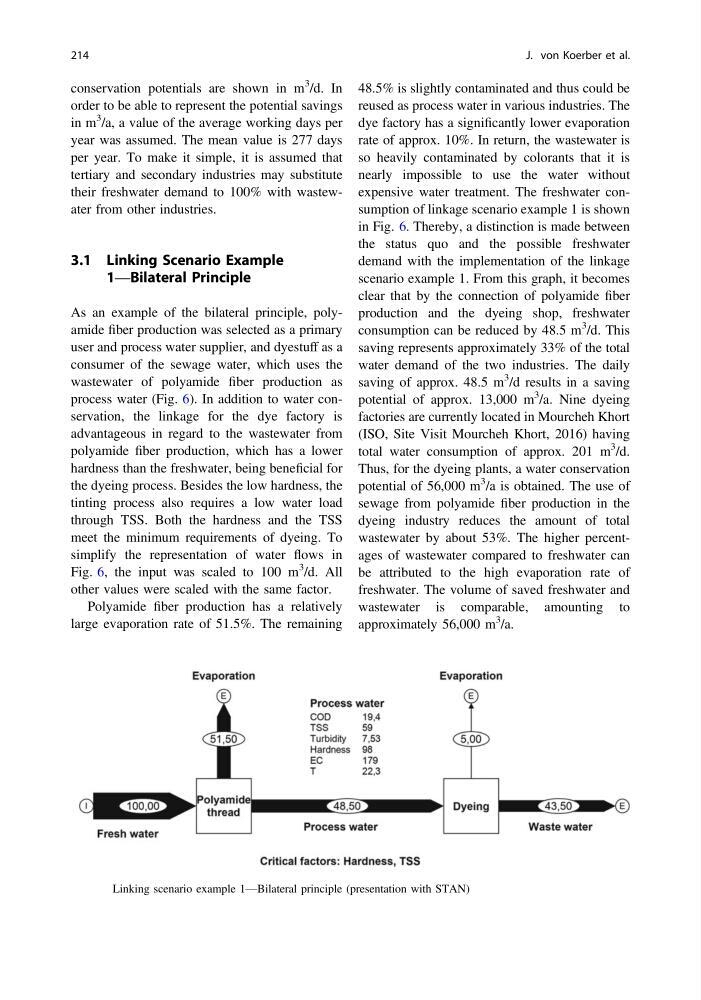
As an example of the bilateral principle, polyamide fiber production was selected as a primary
user and process water supplier, and dyestuff as a
consumer of the sewage water, which uses the
wastewater of polyamide fiber production as
process water (Fig. 6). In addition to water conservation, the linkage for the dye factory is
advantageous in regard to the wastewater from
polyamide fiber production, which has a lower
hardness than the freshwater, being beneficial for
the dyeing process. Besides the low hardness, the
tinting process also requires a low water load
through TSS. Both the hardness and the TSS
meet the minimum requirements of dyeing. To
simplify the representation of water flows in
Fig. 6, the input was scaled to 100 m
3 /d. All
other values were scaled with the same factor.
Polyamide fiber production has a relatively
large evaporation rate of 51.5%. The remaining
48.5% is slightly contaminated and thus could be
reused as process water in various industries. The
dye factory has a significantly lower evaporation
rate of approx. 10%. In return, the wastewater is
so heavily contaminated by colorants that it is
nearly impossible to use the water without
expensive water treatment. The freshwater consumption of linkage scenario example 1 is shown
in Fig. 6. Thereby, a distinction is made between
the status quo and the possible freshwater
demand with the implementation of the linkage
scenario example 1. From this graph, it becomes
clear that by the connection of polyamide fiber
production and the dyeing shop, freshwater
consumption can be reduced by 48.5 m
3 /d. This
saving represents approximately 33% of the total
water demand of the two industries. The daily
saving of approx. 48.5 m
3 /d results in a saving
potential of approx. 13,000 m
3 /a. Nine dyeing
factories are currently located in Mourcheh Khort
(ISO, Site Visit Mourcheh Khort, 2016) having
total water consumption of approx. 201 m
3 /d.
Thus, for the dyeing plants, a water conservation
potential of 56,000 m
3 /a is obtained. The use of
sewage from polyamide fiber production in the
dyeing industry reduces the amount of total
wastewater by about 53%. The higher percentages of wastewater compared to freshwater can
be attributed to the high evaporation rate of
freshwater. The volume of saved freshwater and
wastewater is comparable, amounting to
approximately 56,000 m
3 /a.
Fig. 6 Linking scenario example 1—Bilateral principle (presentation with STAN)
214
J. von Koerber et al.
3 /d. In
order to be able to represent the potential savings
in m
3 /a, a value of the average working days per
year was assumed. The mean value is 277 days
per year. To make it simple, it is assumed that
tertiary and secondary industries may substitute
their freshwater demand to 100% with wastewater from other industries.
3.1 Linking Scenario Example
1—Bilateral Principle
As an example of the bilateral principle, polyamide fiber production was selected as a primary
user and process water supplier, and dyestuff as a
consumer of the sewage water, which uses the
wastewater of polyamide fiber production as
process water (Fig. 6). In addition to water conservation, the linkage for the dye factory is
advantageous in regard to the wastewater from
polyamide fiber production, which has a lower
hardness than the freshwater, being beneficial for
the dyeing process. Besides the low hardness, the
tinting process also requires a low water load
through TSS. Both the hardness and the TSS
meet the minimum requirements of dyeing. To
simplify the representation of water flows in
Fig. 6, the input was scaled to 100 m
3 /d. All
other values were scaled with the same factor.
Polyamide fiber production has a relatively
large evaporation rate of 51.5%. The remaining
48.5% is slightly contaminated and thus could be
reused as process water in various industries. The
dye factory has a significantly lower evaporation
rate of approx. 10%. In return, the wastewater is
so heavily contaminated by colorants that it is
nearly impossible to use the water without
expensive water treatment. The freshwater consumption of linkage scenario example 1 is shown
in Fig. 6. Thereby, a distinction is made between
the status quo and the possible freshwater
demand with the implementation of the linkage
scenario example 1. From this graph, it becomes
clear that by the connection of polyamide fiber
production and the dyeing shop, freshwater
consumption can be reduced by 48.5 m
3 /d. This
saving represents approximately 33% of the total
water demand of the two industries. The daily
saving of approx. 48.5 m
3 /d results in a saving
potential of approx. 13,000 m
3 /a. Nine dyeing
factories are currently located in Mourcheh Khort
(ISO, Site Visit Mourcheh Khort, 2016) having
total water consumption of approx. 201 m
3 /d.
Thus, for the dyeing plants, a water conservation
potential of 56,000 m
3 /a is obtained. The use of
sewage from polyamide fiber production in the
dyeing industry reduces the amount of total
wastewater by about 53%. The higher percentages of wastewater compared to freshwater can
be attributed to the high evaporation rate of
freshwater. The volume of saved freshwater and
wastewater is comparable, amounting to
approximately 56,000 m
3 /a.
Fig. 6 Linking scenario example 1—Bilateral principle (presentation with STAN)
214
J. von Koerber et al.