

according to different linking options in terms of
their linking feasibility (Fig. 5).
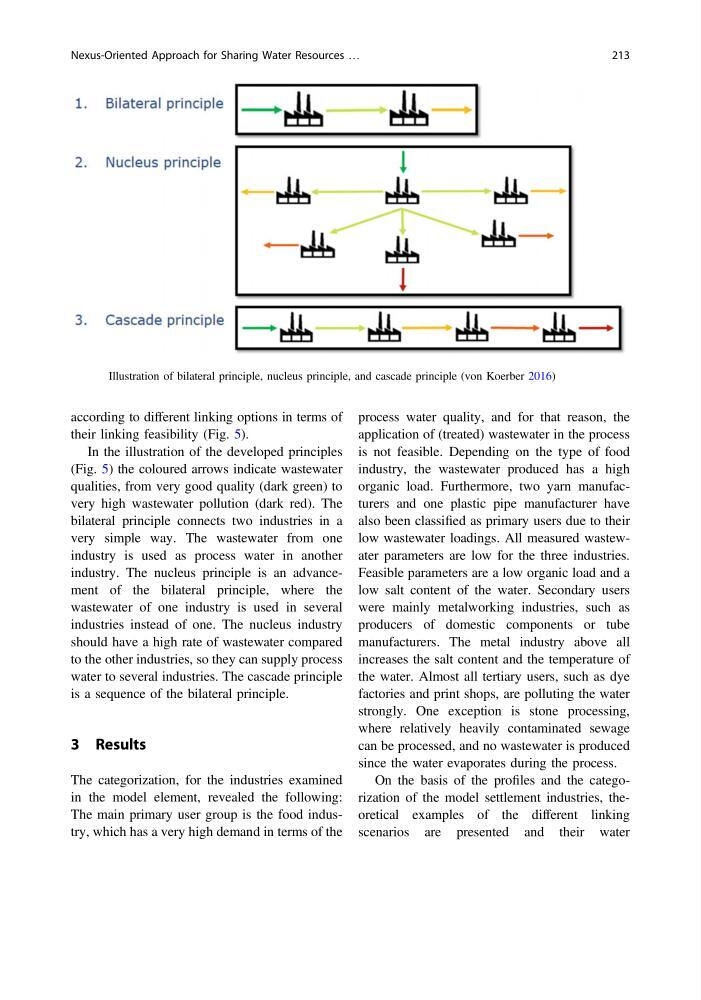
In the illustration of the developed principles
(Fig. 5) the coloured arrows indicate wastewater
qualities, from very good quality (dark green) to
very high wastewater pollution (dark red). The
bilateral principle connects two industries in a
very simple way. The wastewater from one
industry is used as process water in another
industry. The nucleus principle is an advancement of the bilateral principle, where the
wastewater of one industry is used in several
industries instead of one. The nucleus industry
should have a high rate of wastewater compared
to the other industries, so they can supply process
water to several industries. The cascade principle
is a sequence of the bilateral principle.
3 Results
The categorization, for the industries examined
in the model element, revealed the following:
The main primary user group is the food industry, which has a very high demand in terms of the
process water quality, and for that reason, the
application of (treated) wastewater in the process
is not feasible. Depending on the type of food
industry, the wastewater produced has a high
organic load. Furthermore, two yarn manufacturers and one plastic pipe manufacturer have
also been classified as primary users due to their
low wastewater loadings. All measured wastewater parameters are low for the three industries.
Feasible parameters are a low organic load and a
low salt content of the water. Secondary users
were mainly metalworking industries, such as
producers of domestic components or tube
manufacturers. The metal industry above all
increases the salt content and the temperature of
the water. Almost all tertiary users, such as dye
factories and print shops, are polluting the water
strongly. One exception is stone processing,
where relatively heavily contaminated sewage
can be processed, and no wastewater is produced
since the water evaporates during the process.
On the basis of the profiles and the categorization of the model settlement industries, theoretical examples of the different linking
scenarios are presented and their water
Fig. 5 Illustration of bilateral principle, nucleus principle, and cascade principle (von Koerber 2016)
Nexus-Oriented Approach for Sharing Water Resources …
213
their linking feasibility (Fig. 5).
In the illustration of the developed principles
(Fig. 5) the coloured arrows indicate wastewater
qualities, from very good quality (dark green) to
very high wastewater pollution (dark red). The
bilateral principle connects two industries in a
very simple way. The wastewater from one
industry is used as process water in another
industry. The nucleus principle is an advancement of the bilateral principle, where the
wastewater of one industry is used in several
industries instead of one. The nucleus industry
should have a high rate of wastewater compared
to the other industries, so they can supply process
water to several industries. The cascade principle
is a sequence of the bilateral principle.
3 Results
The categorization, for the industries examined
in the model element, revealed the following:
The main primary user group is the food industry, which has a very high demand in terms of the
process water quality, and for that reason, the
application of (treated) wastewater in the process
is not feasible. Depending on the type of food
industry, the wastewater produced has a high
organic load. Furthermore, two yarn manufacturers and one plastic pipe manufacturer have
also been classified as primary users due to their
low wastewater loadings. All measured wastewater parameters are low for the three industries.
Feasible parameters are a low organic load and a
low salt content of the water. Secondary users
were mainly metalworking industries, such as
producers of domestic components or tube
manufacturers. The metal industry above all
increases the salt content and the temperature of
the water. Almost all tertiary users, such as dye
factories and print shops, are polluting the water
strongly. One exception is stone processing,
where relatively heavily contaminated sewage
can be processed, and no wastewater is produced
since the water evaporates during the process.
On the basis of the profiles and the categorization of the model settlement industries, theoretical examples of the different linking
scenarios are presented and their water
Fig. 5 Illustration of bilateral principle, nucleus principle, and cascade principle (von Koerber 2016)
Nexus-Oriented Approach for Sharing Water Resources …
213