

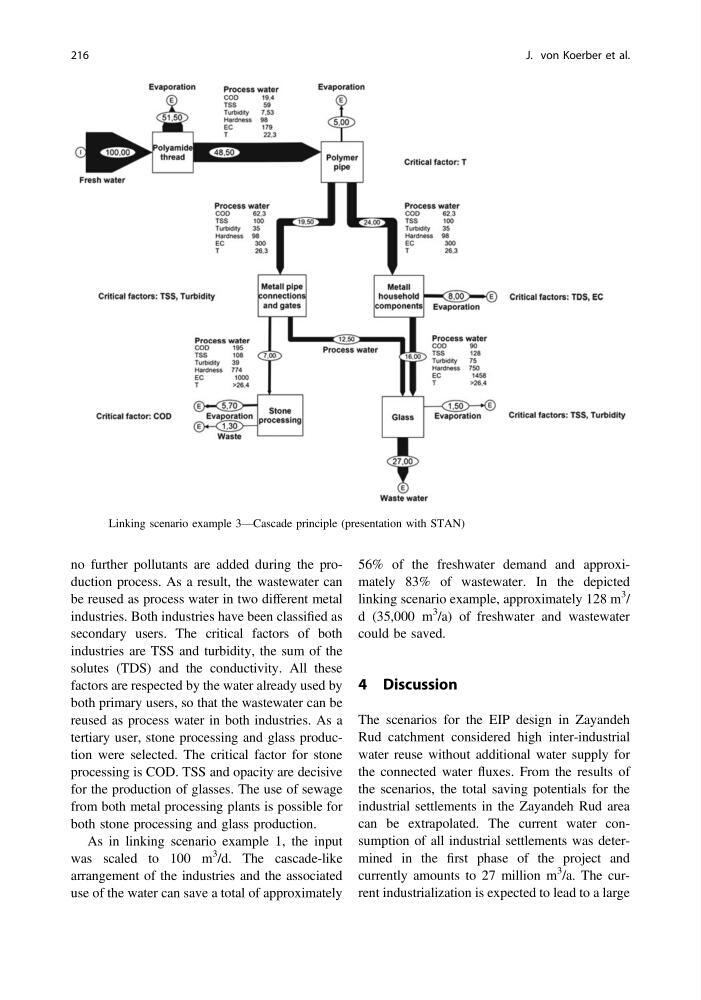
no further pollutants are added during the production process. As a result, the wastewater can
be reused as process water in two different metal
industries. Both industries have been classified as
secondary users. The critical factors of both
industries are TSS and turbidity, the sum of the
solutes (TDS) and the conductivity. All these
factors are respected by the water already used by
both primary users, so that the wastewater can be
reused as process water in both industries. As a
tertiary user, stone processing and glass production were selected. The critical factor for stone
processing is COD. TSS and opacity are decisive
for the production of glasses. The use of sewage
from both metal processing plants is possible for
both stone processing and glass production.
As in linking scenario example 1, the input
was scaled to 100 m
3 /d. The cascade-like
arrangement of the industries and the associated
use of the water can save a total of approximately
56% of the freshwater demand and approximately 83% of wastewater. In the depicted
linking scenario example, approximately 128 m
3 /
d (35,000 m
3 /a) of freshwater and wastewater
could be saved.
4 Discussion
The scenarios for the EIP design in Zayandeh
Rud catchment considered high inter-industrial
water reuse without additional water supply for
the connected water fluxes. From the results of
the scenarios, the total saving potentials for the
industrial settlements in the Zayandeh Rud area
can be extrapolated. The current water consumption of all industrial settlements was determined in the first phase of the project and
currently amounts to 27 million m
3 /a. The current industrialization is expected to lead to a large
Fig. 8 Linking scenario example 3—Cascade principle (presentation with STAN)
216
J. von Koerber et al.
be reused as process water in two different metal
industries. Both industries have been classified as
secondary users. The critical factors of both
industries are TSS and turbidity, the sum of the
solutes (TDS) and the conductivity. All these
factors are respected by the water already used by
both primary users, so that the wastewater can be
reused as process water in both industries. As a
tertiary user, stone processing and glass production were selected. The critical factor for stone
processing is COD. TSS and opacity are decisive
for the production of glasses. The use of sewage
from both metal processing plants is possible for
both stone processing and glass production.
As in linking scenario example 1, the input
was scaled to 100 m
3 /d. The cascade-like
arrangement of the industries and the associated
use of the water can save a total of approximately
56% of the freshwater demand and approximately 83% of wastewater. In the depicted
linking scenario example, approximately 128 m
3 /
d (35,000 m
3 /a) of freshwater and wastewater
could be saved.
4 Discussion
The scenarios for the EIP design in Zayandeh
Rud catchment considered high inter-industrial
water reuse without additional water supply for
the connected water fluxes. From the results of
the scenarios, the total saving potentials for the
industrial settlements in the Zayandeh Rud area
can be extrapolated. The current water consumption of all industrial settlements was determined in the first phase of the project and
currently amounts to 27 million m
3 /a. The current industrialization is expected to lead to a large
Fig. 8 Linking scenario example 3—Cascade principle (presentation with STAN)
216
J. von Koerber et al.