

and his people). The dynamics at the regional
level are also supported by the current structure
of the special status of the kingdom within the
authority of the regional government. This status
permits the Sultan as the Governor and the Paku
Alam (a relative of the Sultan) as Vice Governor
for life. Although this position is renewed every
five years, the same structure will serve the
region or kingdom. For these people, the patrons
are the Sultan and the Kraton people (relatives of
the Sultan, for example, Princes or Princesses),
making the decisions for them based on cultural
knowledge and modern science as suggested by
professionals in the governmental agencies.
Therefore, the dynamics for each of the sub-cases
follow orders from the Sultan, as he was chosen
to rule the kingdom.
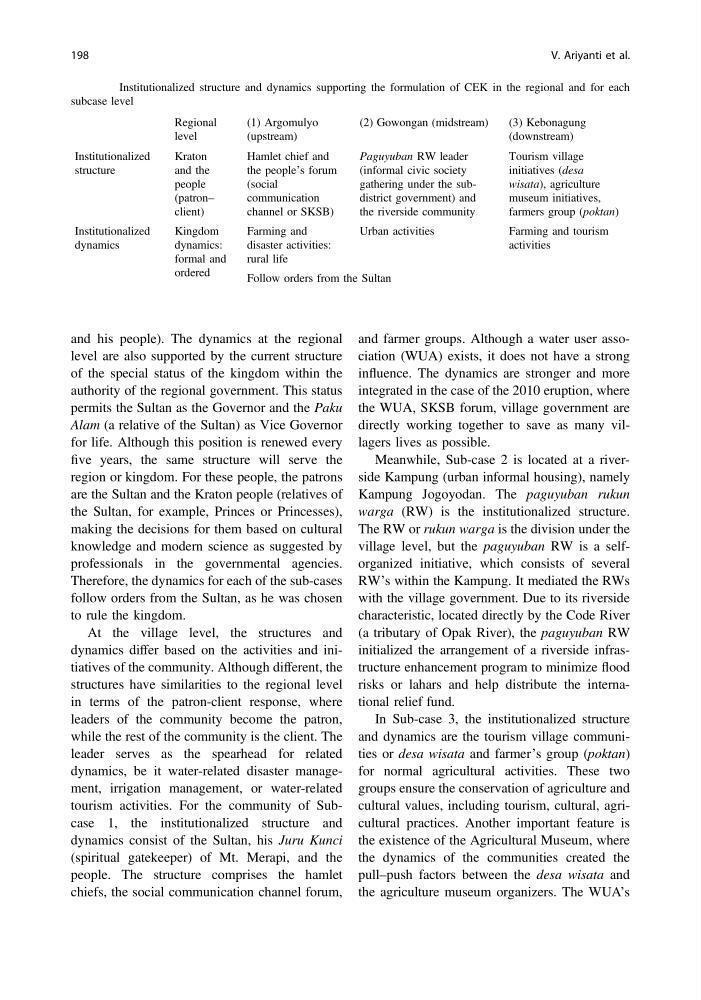
At the village level, the structures and
dynamics differ based on the activities and initiatives of the community. Although different, the
structures have similarities to the regional level
in terms of the patron-client response, where
leaders of the community become the patron,
while the rest of the community is the client. The
leader serves as the spearhead for related
dynamics, be it water-related disaster management, irrigation management, or water-related
tourism activities. For the community of Subcase 1, the institutionalized structure and
dynamics consist of the Sultan, his Juru Kunci
(spiritual gatekeeper) of Mt. Merapi, and the
people. The structure comprises the hamlet
chiefs, the social communication channel forum,
and farmer groups. Although a water user association (WUA) exists, it does not have a strong
influence. The dynamics are stronger and more
integrated in the case of the 2010 eruption, where
the WUA, SKSB forum, village government are
directly working together to save as many villagers lives as possible.
Meanwhile, Sub-case 2 is located at a riverside Kampung (urban informal housing), namely
Kampung Jogoyodan. The paguyuban rukun
warga (RW) is the institutionalized structure.
The RW or rukun warga is the division under the
village level, but the paguyuban RW is a selforganized initiative, which consists of several
RW’s within the Kampung. It mediated the RWs
with the village government. Due to its riverside
characteristic, located directly by the Code River
(a tributary of Opak River), the paguyuban RW
initialized the arrangement of a riverside infrastructure enhancement program to minimize flood
risks or lahars and help distribute the international relief fund.
In Sub-case 3, the institutionalized structure
and dynamics are the tourism village communities or desa wisata and farmer’s group (poktan)
for normal agricultural activities. These two
groups ensure the conservation of agriculture and
cultural values, including tourism, cultural, agricultural practices. Another important feature is
the existence of the Agricultural Museum, where
the dynamics of the communities created the
pull–push factors between the desa wisata and
the agriculture museum organizers. The WUA’s
Table 2 Institutionalized structure and dynamics supporting the formulation of CEK in the regional and for each
subcase level
Regional
level
(1) Argomulyo
(upstream)
(2) Gowongan (midstream)
(3) Kebonagung
(downstream)
Institutionalized
structure
Kraton
and the
people
(patron–
client)
Hamlet chief and
the people’s forum
(social
communication
channel or SKSB)
Paguyuban RW leader
(informal civic society
gathering under the subdistrict government) and
the riverside community
Tourism village
initiatives (desa
wisata), agriculture
museum initiatives,
farmers group (poktan)
Institutionalized
dynamics
Kingdom
dynamics:
formal and
ordered
Farming and
disaster activities:
rural life
Urban activities
Farming and tourism
activities
Follow orders from the Sultan
198
V. Ariyanti et al.
level are also supported by the current structure
of the special status of the kingdom within the
authority of the regional government. This status
permits the Sultan as the Governor and the Paku
Alam (a relative of the Sultan) as Vice Governor
for life. Although this position is renewed every
five years, the same structure will serve the
region or kingdom. For these people, the patrons
are the Sultan and the Kraton people (relatives of
the Sultan, for example, Princes or Princesses),
making the decisions for them based on cultural
knowledge and modern science as suggested by
professionals in the governmental agencies.
Therefore, the dynamics for each of the sub-cases
follow orders from the Sultan, as he was chosen
to rule the kingdom.
At the village level, the structures and
dynamics differ based on the activities and initiatives of the community. Although different, the
structures have similarities to the regional level
in terms of the patron-client response, where
leaders of the community become the patron,
while the rest of the community is the client. The
leader serves as the spearhead for related
dynamics, be it water-related disaster management, irrigation management, or water-related
tourism activities. For the community of Subcase 1, the institutionalized structure and
dynamics consist of the Sultan, his Juru Kunci
(spiritual gatekeeper) of Mt. Merapi, and the
people. The structure comprises the hamlet
chiefs, the social communication channel forum,
and farmer groups. Although a water user association (WUA) exists, it does not have a strong
influence. The dynamics are stronger and more
integrated in the case of the 2010 eruption, where
the WUA, SKSB forum, village government are
directly working together to save as many villagers lives as possible.
Meanwhile, Sub-case 2 is located at a riverside Kampung (urban informal housing), namely
Kampung Jogoyodan. The paguyuban rukun
warga (RW) is the institutionalized structure.
The RW or rukun warga is the division under the
village level, but the paguyuban RW is a selforganized initiative, which consists of several
RW’s within the Kampung. It mediated the RWs
with the village government. Due to its riverside
characteristic, located directly by the Code River
(a tributary of Opak River), the paguyuban RW
initialized the arrangement of a riverside infrastructure enhancement program to minimize flood
risks or lahars and help distribute the international relief fund.
In Sub-case 3, the institutionalized structure
and dynamics are the tourism village communities or desa wisata and farmer’s group (poktan)
for normal agricultural activities. These two
groups ensure the conservation of agriculture and
cultural values, including tourism, cultural, agricultural practices. Another important feature is
the existence of the Agricultural Museum, where
the dynamics of the communities created the
pull–push factors between the desa wisata and
the agriculture museum organizers. The WUA’s
Table 2 Institutionalized structure and dynamics supporting the formulation of CEK in the regional and for each
subcase level
Regional
level
(1) Argomulyo
(upstream)
(2) Gowongan (midstream)
(3) Kebonagung
(downstream)
Institutionalized
structure
Kraton
and the
people
(patron–
client)
Hamlet chief and
the people’s forum
(social
communication
channel or SKSB)
Paguyuban RW leader
(informal civic society
gathering under the subdistrict government) and
the riverside community
Tourism village
initiatives (desa
wisata), agriculture
museum initiatives,
farmers group (poktan)
Institutionalized
dynamics
Kingdom
dynamics:
formal and
ordered
Farming and
disaster activities:
rural life
Urban activities
Farming and tourism
activities
Follow orders from the Sultan
198
V. Ariyanti et al.