

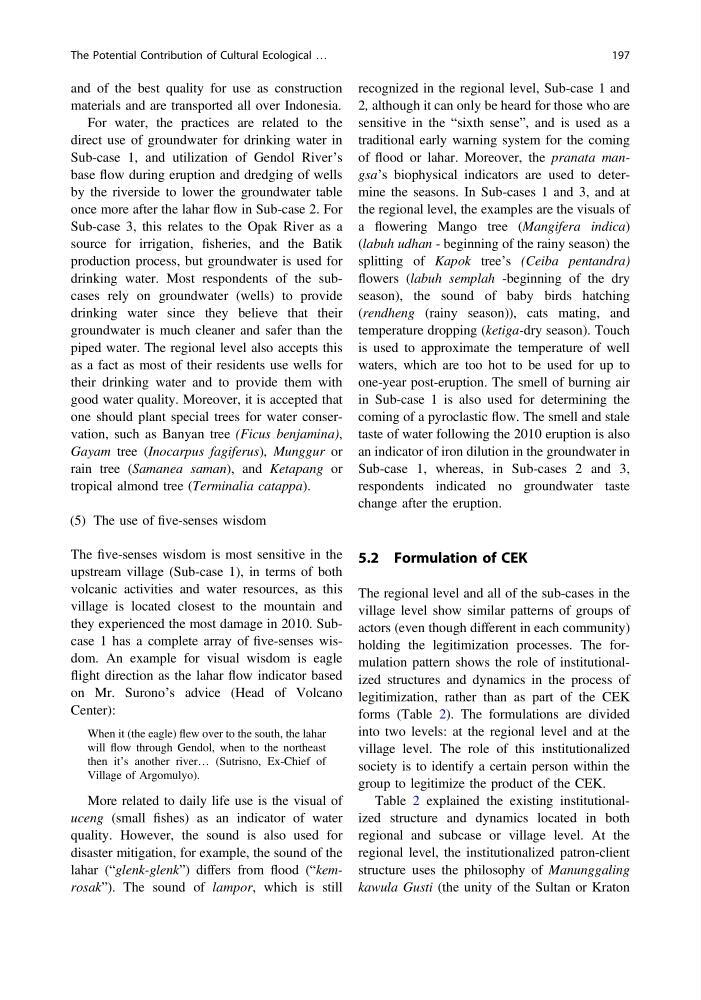
and of the best quality for use as construction
materials and are transported all over Indonesia.
For water, the practices are related to the
direct use of groundwater for drinking water in
Sub-case 1, and utilization of Gendol River’s
base flow during eruption and dredging of wells
by the riverside to lower the groundwater table
once more after the lahar flow in Sub-case 2. For
Sub-case 3, this relates to the Opak River as a
source for irrigation, fisheries, and the Batik
production process, but groundwater is used for
drinking water. Most respondents of the subcases rely on groundwater (wells) to provide
drinking water since they believe that their
groundwater is much cleaner and safer than the
piped water. The regional level also accepts this
as a fact as most of their residents use wells for
their drinking water and to provide them with
good water quality. Moreover, it is accepted that
one should plant special trees for water conservation, such as Banyan tree (Ficus benjamina),
Gayam tree (Inocarpus fagiferus), Munggur or
rain tree (Samanea saman), and Ketapang or
tropical almond tree (Terminalia catappa).
(5) The use of five-senses wisdom
The five-senses wisdom is most sensitive in the
upstream village (Sub-case 1), in terms of both
volcanic activities and water resources, as this
village is located closest to the mountain and
they experienced the most damage in 2010. Subcase 1 has a complete array of five-senses wisdom. An example for visual wisdom is eagle
flight direction as the lahar flow indicator based
on Mr. Surono’s advice (Head of Volcano
Center):
When it (the eagle) flew over to the south, the lahar
will flow through Gendol, when to the northeast
then it’s another river… (Sutrisno, Ex-Chief of
Village of Argomulyo).
More related to daily life use is the visual of
uceng (small fishes) as an indicator of water
quality. However, the sound is also used for
disaster mitigation, for example, the sound of the
lahar (“glenk-glenk”) differs from flood (“kemrosak”). The sound of lampor, which is still
recognized in the regional level, Sub-case 1 and
2, although it can only be heard for those who are
sensitive in the “sixth sense”, and is used as a
traditional early warning system for the coming
of flood or lahar. Moreover, the pranata mangsa’s biophysical indicators are used to determine the seasons. In Sub-cases 1 and 3, and at
the regional level, the examples are the visuals of
a flowering Mango tree (Mangifera indica)
(labuh udhan - beginning of the rainy season) the
splitting of Kapok tree’s (Ceiba pentandra)
flowers (labuh semplah -beginning of the dry
season), the sound of baby birds hatching
(rendheng (rainy season)), cats mating, and
temperature dropping (ketiga-dry season). Touch
is used to approximate the temperature of well
waters, which are too hot to be used for up to
one-year post-eruption. The smell of burning air
in Sub-case 1 is also used for determining the
coming of a pyroclastic flow. The smell and stale
taste of water following the 2010 eruption is also
an indicator of iron dilution in the groundwater in
Sub-case 1, whereas, in Sub-cases 2 and 3,
respondents indicated no groundwater taste
change after the eruption.
5.2 Formulation of CEK
The regional level and all of the sub-cases in the
village level show similar patterns of groups of
actors (even though different in each community)
holding the legitimization processes. The formulation pattern shows the role of institutionalized structures and dynamics in the process of
legitimization, rather than as part of the CEK
forms (Table 2). The formulations are divided
into two levels: at the regional level and at the
village level. The role of this institutionalized
society is to identify a certain person within the
group to legitimize the product of the CEK.
Table 2 explained the existing institutionalized structure and dynamics located in both
regional and subcase or village level. At the
regional level, the institutionalized patron-client
structure uses the philosophy of Manunggaling
kawula Gusti (the unity of the Sultan or Kraton
The Potential Contribution of Cultural Ecological …
197
materials and are transported all over Indonesia.
For water, the practices are related to the
direct use of groundwater for drinking water in
Sub-case 1, and utilization of Gendol River’s
base flow during eruption and dredging of wells
by the riverside to lower the groundwater table
once more after the lahar flow in Sub-case 2. For
Sub-case 3, this relates to the Opak River as a
source for irrigation, fisheries, and the Batik
production process, but groundwater is used for
drinking water. Most respondents of the subcases rely on groundwater (wells) to provide
drinking water since they believe that their
groundwater is much cleaner and safer than the
piped water. The regional level also accepts this
as a fact as most of their residents use wells for
their drinking water and to provide them with
good water quality. Moreover, it is accepted that
one should plant special trees for water conservation, such as Banyan tree (Ficus benjamina),
Gayam tree (Inocarpus fagiferus), Munggur or
rain tree (Samanea saman), and Ketapang or
tropical almond tree (Terminalia catappa).
(5) The use of five-senses wisdom
The five-senses wisdom is most sensitive in the
upstream village (Sub-case 1), in terms of both
volcanic activities and water resources, as this
village is located closest to the mountain and
they experienced the most damage in 2010. Subcase 1 has a complete array of five-senses wisdom. An example for visual wisdom is eagle
flight direction as the lahar flow indicator based
on Mr. Surono’s advice (Head of Volcano
Center):
When it (the eagle) flew over to the south, the lahar
will flow through Gendol, when to the northeast
then it’s another river… (Sutrisno, Ex-Chief of
Village of Argomulyo).
More related to daily life use is the visual of
uceng (small fishes) as an indicator of water
quality. However, the sound is also used for
disaster mitigation, for example, the sound of the
lahar (“glenk-glenk”) differs from flood (“kemrosak”). The sound of lampor, which is still
recognized in the regional level, Sub-case 1 and
2, although it can only be heard for those who are
sensitive in the “sixth sense”, and is used as a
traditional early warning system for the coming
of flood or lahar. Moreover, the pranata mangsa’s biophysical indicators are used to determine the seasons. In Sub-cases 1 and 3, and at
the regional level, the examples are the visuals of
a flowering Mango tree (Mangifera indica)
(labuh udhan - beginning of the rainy season) the
splitting of Kapok tree’s (Ceiba pentandra)
flowers (labuh semplah -beginning of the dry
season), the sound of baby birds hatching
(rendheng (rainy season)), cats mating, and
temperature dropping (ketiga-dry season). Touch
is used to approximate the temperature of well
waters, which are too hot to be used for up to
one-year post-eruption. The smell of burning air
in Sub-case 1 is also used for determining the
coming of a pyroclastic flow. The smell and stale
taste of water following the 2010 eruption is also
an indicator of iron dilution in the groundwater in
Sub-case 1, whereas, in Sub-cases 2 and 3,
respondents indicated no groundwater taste
change after the eruption.
5.2 Formulation of CEK
The regional level and all of the sub-cases in the
village level show similar patterns of groups of
actors (even though different in each community)
holding the legitimization processes. The formulation pattern shows the role of institutionalized structures and dynamics in the process of
legitimization, rather than as part of the CEK
forms (Table 2). The formulations are divided
into two levels: at the regional level and at the
village level. The role of this institutionalized
society is to identify a certain person within the
group to legitimize the product of the CEK.
Table 2 explained the existing institutionalized structure and dynamics located in both
regional and subcase or village level. At the
regional level, the institutionalized patron-client
structure uses the philosophy of Manunggaling
kawula Gusti (the unity of the Sultan or Kraton
The Potential Contribution of Cultural Ecological …
197