

activities were more important before there was a
weir, but it no longer has an active role. The
poktan is gradually taking over the role of the
WUA, as the members are more or less the same.
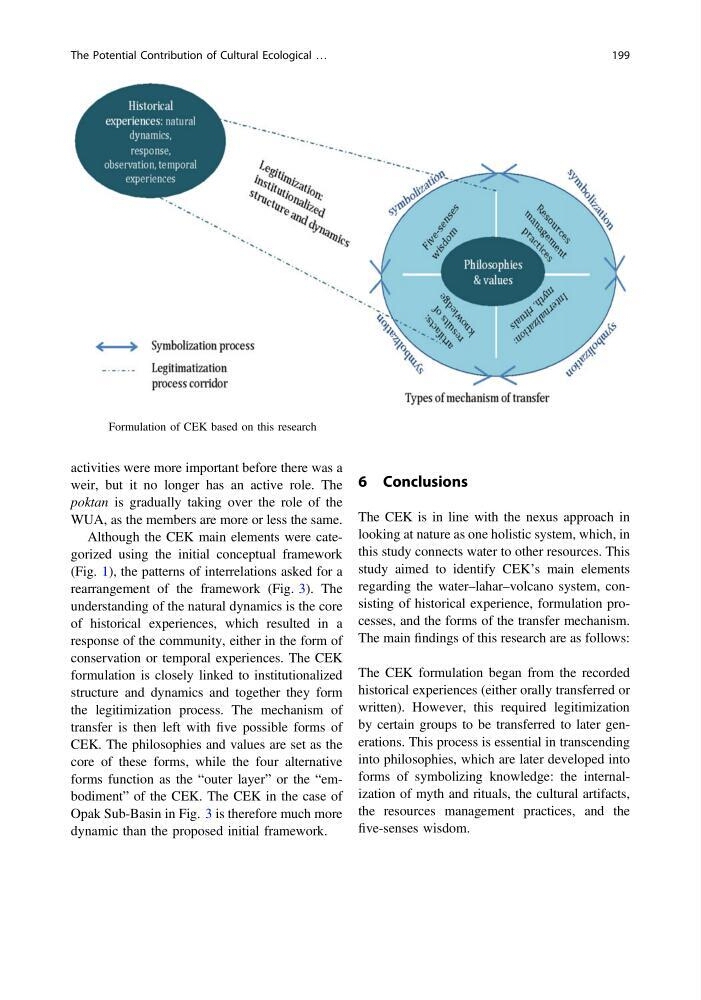
Although the CEK main elements were categorized using the initial conceptual framework
(Fig. 1), the patterns of interrelations asked for a
rearrangement of the framework (Fig. 3). The
understanding of the natural dynamics is the core
of historical experiences, which resulted in a
response of the community, either in the form of
conservation or temporal experiences. The CEK
formulation is closely linked to institutionalized
structure and dynamics and together they form
the legitimization process. The mechanism of
transfer is then left with five possible forms of
CEK. The philosophies and values are set as the
core of these forms, while the four alternative
forms function as the “outer layer” or the “embodiment” of the CEK. The CEK in the case of
Opak Sub-Basin in Fig. 3 is therefore much more
dynamic than the proposed initial framework.
6 Conclusions
The CEK is in line with the nexus approach in
looking at nature as one holistic system, which, in
this study connects water to other resources. This
study aimed to identify CEK’s main elements
regarding the water–lahar–volcano system, consisting of historical experience, formulation processes, and the forms of the transfer mechanism.
The main findings of this research are as follows:
The CEK formulation began from the recorded
historical experiences (either orally transferred or
written). However, this required legitimization
by certain groups to be transferred to later generations. This process is essential in transcending
into philosophies, which are later developed into
forms of symbolizing knowledge: the internalization of myth and rituals, the cultural artifacts,
the resources management practices, and the
five-senses wisdom.
Fig. 3 Formulation of CEK based on this research
The Potential Contribution of Cultural Ecological …
199
weir, but it no longer has an active role. The
poktan is gradually taking over the role of the
WUA, as the members are more or less the same.
Although the CEK main elements were categorized using the initial conceptual framework
(Fig. 1), the patterns of interrelations asked for a
rearrangement of the framework (Fig. 3). The
understanding of the natural dynamics is the core
of historical experiences, which resulted in a
response of the community, either in the form of
conservation or temporal experiences. The CEK
formulation is closely linked to institutionalized
structure and dynamics and together they form
the legitimization process. The mechanism of
transfer is then left with five possible forms of
CEK. The philosophies and values are set as the
core of these forms, while the four alternative
forms function as the “outer layer” or the “embodiment” of the CEK. The CEK in the case of
Opak Sub-Basin in Fig. 3 is therefore much more
dynamic than the proposed initial framework.
6 Conclusions
The CEK is in line with the nexus approach in
looking at nature as one holistic system, which, in
this study connects water to other resources. This
study aimed to identify CEK’s main elements
regarding the water–lahar–volcano system, consisting of historical experience, formulation processes, and the forms of the transfer mechanism.
The main findings of this research are as follows:
The CEK formulation began from the recorded
historical experiences (either orally transferred or
written). However, this required legitimization
by certain groups to be transferred to later generations. This process is essential in transcending
into philosophies, which are later developed into
forms of symbolizing knowledge: the internalization of myth and rituals, the cultural artifacts,
the resources management practices, and the
five-senses wisdom.
Fig. 3 Formulation of CEK based on this research
The Potential Contribution of Cultural Ecological …
199