

centers from one in the early 2000s by more than
ten-fold in 2016. A similar incremental trend for
health centers and health extension systems and
other sectors such as environmental agent branch
offices has been reported in Ethiopia (Dube et al.
2019). Such expansion of public and private
institutions has been supported to develop strong
links with farmers and has created an opportunity
to test, adapt, and disseminate different knowledge, skills, and attitudes with regard to watershed management interventions in the region.
The local farmers and DAs have witnessed that
farmers’ capacity in terms of physical, capital,
and mental assets (readiness and willingness)
have improved over time. These opportunities
also facilitated the adoption of watershed interventions despite the suspicion that there might be
some risks (e.g., waterlogging) associated with
watershed technologies.
3.2.2 Awareness of Diversification
and Intensification
The increased awareness and readiness by
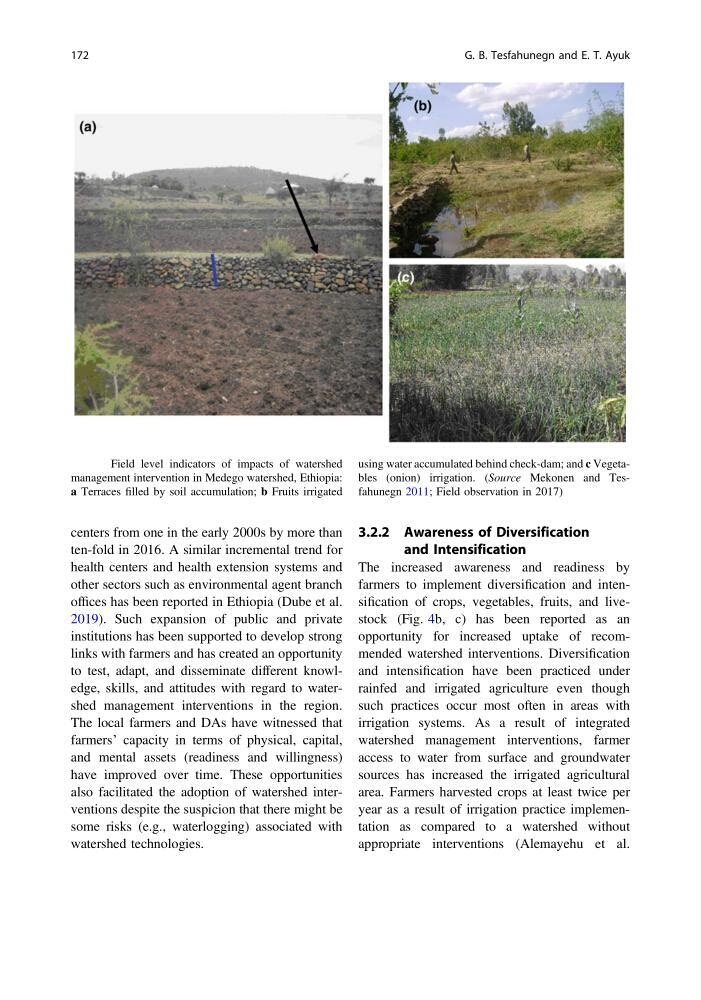
farmers to implement diversification and intensification of crops, vegetables, fruits, and livestock (Fig. 4b, c) has been reported as an
opportunity for increased uptake of recommended watershed interventions. Diversification
and intensification have been practiced under
rainfed and irrigated agriculture even though
such practices occur most often in areas with
irrigation systems. As a result of integrated
watershed management interventions, farmer
access to water from surface and groundwater
sources has increased the irrigated agricultural
area. Farmers harvested crops at least twice per
year as a result of irrigation practice implementation as compared to a watershed without
appropriate interventions (Alemayehu et al.
Fig. 2 Field level indicators of impacts of watershed
management intervention in Medego watershed, Ethiopia:
a Terraces filled by soil accumulation; b Fruits irrigated
using water accumulated behind check-dam; and c Vegetables (onion) irrigation. (Source Mekonen and Tesfahunegn 2011; Field observation in 2017)
172
G. B. Tesfahunegn and E. T. Ayuk
ten-fold in 2016. A similar incremental trend for
health centers and health extension systems and
other sectors such as environmental agent branch
offices has been reported in Ethiopia (Dube et al.
2019). Such expansion of public and private
institutions has been supported to develop strong
links with farmers and has created an opportunity
to test, adapt, and disseminate different knowledge, skills, and attitudes with regard to watershed management interventions in the region.
The local farmers and DAs have witnessed that
farmers’ capacity in terms of physical, capital,
and mental assets (readiness and willingness)
have improved over time. These opportunities
also facilitated the adoption of watershed interventions despite the suspicion that there might be
some risks (e.g., waterlogging) associated with
watershed technologies.
3.2.2 Awareness of Diversification
and Intensification
The increased awareness and readiness by
farmers to implement diversification and intensification of crops, vegetables, fruits, and livestock (Fig. 4b, c) has been reported as an
opportunity for increased uptake of recommended watershed interventions. Diversification
and intensification have been practiced under
rainfed and irrigated agriculture even though
such practices occur most often in areas with
irrigation systems. As a result of integrated
watershed management interventions, farmer
access to water from surface and groundwater
sources has increased the irrigated agricultural
area. Farmers harvested crops at least twice per
year as a result of irrigation practice implementation as compared to a watershed without
appropriate interventions (Alemayehu et al.
Fig. 2 Field level indicators of impacts of watershed
management intervention in Medego watershed, Ethiopia:
a Terraces filled by soil accumulation; b Fruits irrigated
using water accumulated behind check-dam; and c Vegetables (onion) irrigation. (Source Mekonen and Tesfahunegn 2011; Field observation in 2017)
172
G. B. Tesfahunegn and E. T. Ayuk