

2009; Mekonen and Tesfahunegn 2011;
Gebregziabher et al. 2016; Personal observation).
3.2.3 Improved Knowledge
of the Complementarity
of Mixed Crop-Livestock
Systems
In the investigated watersheds, improvement of
farmers’ knowledge on the complementarity of
the crop-livestock system was reported by the
farmers as an opportunity to implement sustainable watershed management interventions. For
example, all the farmers involved in the group
discussions confirmed that livestock is used as a
source of manure (composting), farm power
(ploughing), income diversification, and an
opportunity for coping with risk. Similarly, crop
and livestock complement each other to increase
human nutrition. Crop residue is used as a source
of livestock feed and for soil fertility improvement, e.g., beans are used as sources of feed and
soil fertility, cattle as a source of manure and for
ploughing (Fig. 5a, b).
3.2.4 Evidence of the Improvement
of Landscape Natural
Resources
Long-term watershed interventions implemented
on the marginal/degraded landscape, severely
degraded gullies, and field borders have
improved biomass of trees, bushes, and grasses
and water resources availability (field observations e.g., Fig. 5b; Mekonen and Tesfahunegn
2011). According to all the farmers and DAs
involved during the group discussions, practical
experiences of natural resources improvement on
degraded landscape and used for apiculture, and
integration of biomass produced from stabilized
gully as the source of feed for the dairy farm can
be used as a pilot case study to be scaled-up
under similar conditions. Surface and groundwater resources have increased substantially and
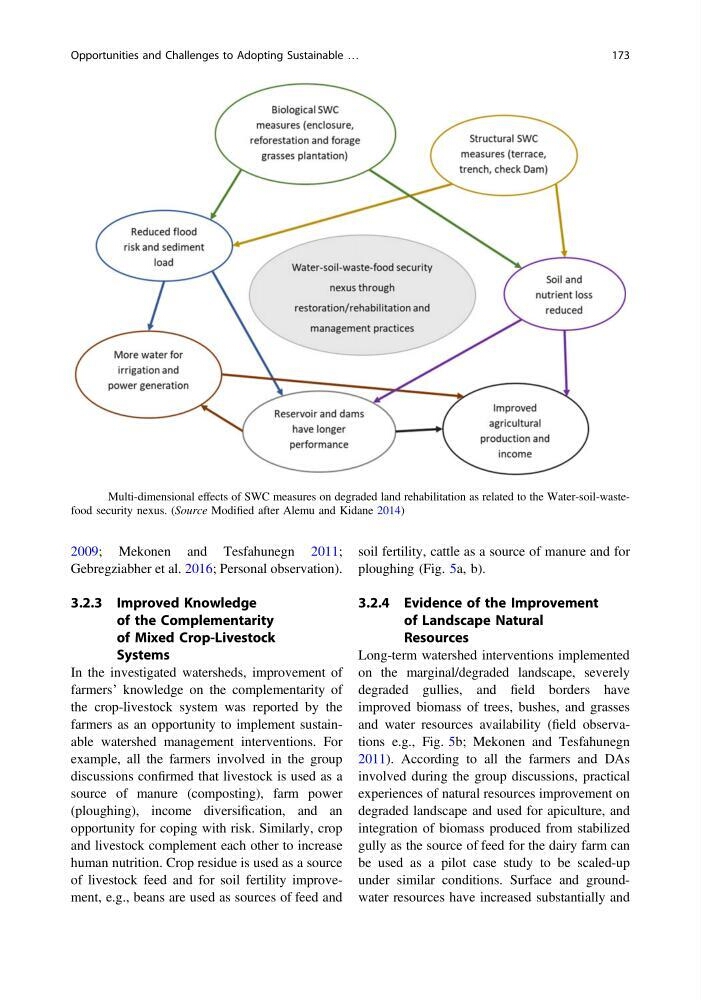
Fig. 3 Multi-dimensional effects of SWC measures on degraded land rehabilitation as related to the Water-soil-wastefood security nexus. (Source Modified after Alemu and Kidane 2014)
Opportunities and Challenges to Adopting Sustainable …
173
Gebregziabher et al. 2016; Personal observation).
3.2.3 Improved Knowledge
of the Complementarity
of Mixed Crop-Livestock
Systems
In the investigated watersheds, improvement of
farmers’ knowledge on the complementarity of
the crop-livestock system was reported by the
farmers as an opportunity to implement sustainable watershed management interventions. For
example, all the farmers involved in the group
discussions confirmed that livestock is used as a
source of manure (composting), farm power
(ploughing), income diversification, and an
opportunity for coping with risk. Similarly, crop
and livestock complement each other to increase
human nutrition. Crop residue is used as a source
of livestock feed and for soil fertility improvement, e.g., beans are used as sources of feed and
soil fertility, cattle as a source of manure and for
ploughing (Fig. 5a, b).
3.2.4 Evidence of the Improvement
of Landscape Natural
Resources
Long-term watershed interventions implemented
on the marginal/degraded landscape, severely
degraded gullies, and field borders have
improved biomass of trees, bushes, and grasses
and water resources availability (field observations e.g., Fig. 5b; Mekonen and Tesfahunegn
2011). According to all the farmers and DAs
involved during the group discussions, practical
experiences of natural resources improvement on
degraded landscape and used for apiculture, and
integration of biomass produced from stabilized
gully as the source of feed for the dairy farm can
be used as a pilot case study to be scaled-up
under similar conditions. Surface and groundwater resources have increased substantially and
Fig. 3 Multi-dimensional effects of SWC measures on degraded land rehabilitation as related to the Water-soil-wastefood security nexus. (Source Modified after Alemu and Kidane 2014)
Opportunities and Challenges to Adopting Sustainable …
173