

21
On the other hand, at exposures exceeding a certain threshold level, deterministic
effects (tissue reactions) appear with the probability of 100%, while below these
levels no such effects can be observed. Stochastic effects occur at exposures up to
about several hundred mSv, while deterministic effects may begin at doses higher
than about 0.5 Gy. For these two kinds of effects two different types of quantities
should be used, namely, Sv and Gy, respectively.
The main aim of radiation protection is to reduce this exposure to the very minimum while allowing the utilization of the radiation for beneficial purposes. To control radiation exposure, one has to quantify it; therefore, quantities have been
introduced to characterize the biological effects of the exposure that a person incurs.
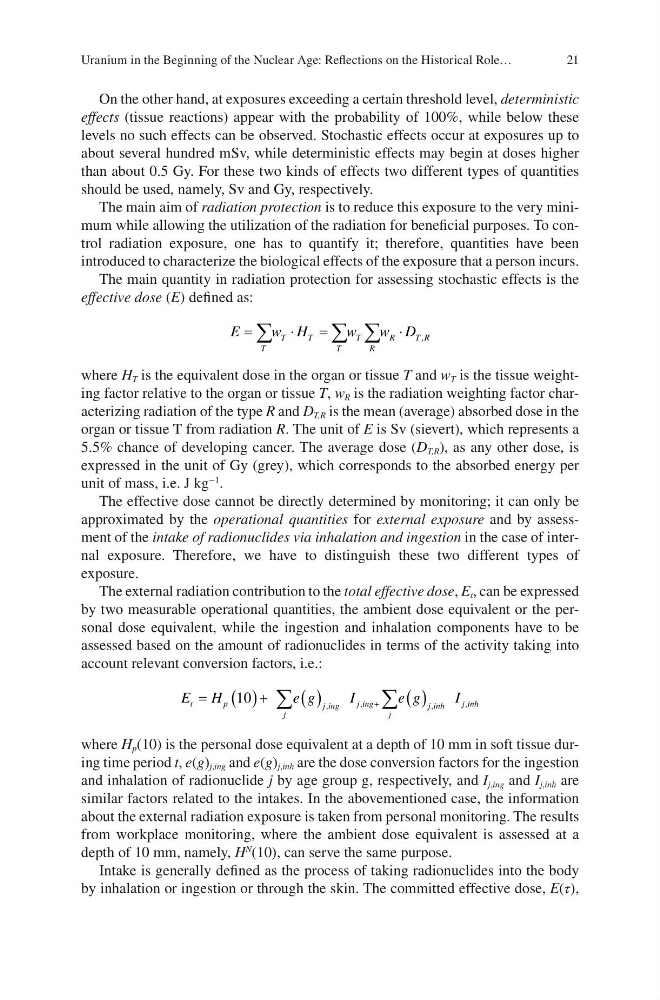
The main quantity in radiation protection for assessing stochastic effects is the
effective dose (E) defined as:
E
w H
w
w D
T
T
T
T
T
R
R
TR
=
⋅
=
⋅
∑
∑ ∑
,
where H T is the equivalent dose in the organ or tissue T and w T is the tissue weighting factor relative to the organ or tissue T, w R is the radiation weighting factor characterizing radiation of the type R and D T,R is the mean (average) absorbed dose in the
organ or tissue T from radiation R. The unit of E is Sv (sievert), which represents a
5.5% chance of developing cancer. The average dose (D T,R ), as any other dose, is
expressed in the unit of Gy (grey), which corresponds to the absorbed energy per
unit of mass, i.e. J kg
−1
.
The effective dose cannot be directly determined by monitoring; it can only be
approximated by the operational quantities for external exposure and by assessment of the intake of radionuclides via inhalation and ingestion in the case of internal exposure. Therefore, we have to distinguish these two different types of
exposure.
The external radiation contribution to the total effective dose, E t , can be expressed
by two measurable operational quantities, the ambient dose equivalent or the personal dose equivalent, while the ingestion and inhalation components have to be
assessed based on the amount of radionuclides in terms of the activity taking into
account relevant conversion factors, i.e.:
E H
eg
I
e g
I
t
p
j
j ing
j ing
j
j inh
j inh
=
( )+
( )
( )
∑
∑
+
10
,
,
,
,
where H p (10) is the personal dose equivalent at a depth of 10 mm in soft tissue during time period t, e(g) j,ing and e(g) j,inh are the dose conversion factors for the ingestion
and inhalation of radionuclide j by age group g, respectively, and I j,ing and I j,inh are
similar factors related to the intakes. In the abovementioned case, the information
about the external radiation exposure is taken from personal monitoring. The results
from workplace monitoring, where the ambient dose equivalent is assessed at a
depth of 10 mm, namely, H
N
(10), can serve the same purpose.
Intake is generally defined as the process of taking radionuclides into the body
by inhalation or ingestion or through the skin. The committed effective dose, E(τ),
Uranium in the Beginning of the Nuclear Age: Reflections on the Historical Role…
On the other hand, at exposures exceeding a certain threshold level, deterministic
effects (tissue reactions) appear with the probability of 100%, while below these
levels no such effects can be observed. Stochastic effects occur at exposures up to
about several hundred mSv, while deterministic effects may begin at doses higher
than about 0.5 Gy. For these two kinds of effects two different types of quantities
should be used, namely, Sv and Gy, respectively.
The main aim of radiation protection is to reduce this exposure to the very minimum while allowing the utilization of the radiation for beneficial purposes. To control radiation exposure, one has to quantify it; therefore, quantities have been
introduced to characterize the biological effects of the exposure that a person incurs.
The main quantity in radiation protection for assessing stochastic effects is the
effective dose (E) defined as:
E
w H
w
w D
T
T
T
T
T
R
R
TR
=
⋅
=
⋅
∑
∑ ∑
,
where H T is the equivalent dose in the organ or tissue T and w T is the tissue weighting factor relative to the organ or tissue T, w R is the radiation weighting factor characterizing radiation of the type R and D T,R is the mean (average) absorbed dose in the
organ or tissue T from radiation R. The unit of E is Sv (sievert), which represents a
5.5% chance of developing cancer. The average dose (D T,R ), as any other dose, is
expressed in the unit of Gy (grey), which corresponds to the absorbed energy per
unit of mass, i.e. J kg
−1
.
The effective dose cannot be directly determined by monitoring; it can only be
approximated by the operational quantities for external exposure and by assessment of the intake of radionuclides via inhalation and ingestion in the case of internal exposure. Therefore, we have to distinguish these two different types of
exposure.
The external radiation contribution to the total effective dose, E t , can be expressed
by two measurable operational quantities, the ambient dose equivalent or the personal dose equivalent, while the ingestion and inhalation components have to be
assessed based on the amount of radionuclides in terms of the activity taking into
account relevant conversion factors, i.e.:
E H
eg
I
e g
I
t
p
j
j ing
j ing
j
j inh
j inh
=
( )+
( )
( )
∑
∑
+
10
,
,
,
,
where H p (10) is the personal dose equivalent at a depth of 10 mm in soft tissue during time period t, e(g) j,ing and e(g) j,inh are the dose conversion factors for the ingestion
and inhalation of radionuclide j by age group g, respectively, and I j,ing and I j,inh are
similar factors related to the intakes. In the abovementioned case, the information
about the external radiation exposure is taken from personal monitoring. The results
from workplace monitoring, where the ambient dose equivalent is assessed at a
depth of 10 mm, namely, H
N
(10), can serve the same purpose.
Intake is generally defined as the process of taking radionuclides into the body
by inhalation or ingestion or through the skin. The committed effective dose, E(τ),
Uranium in the Beginning of the Nuclear Age: Reflections on the Historical Role…