

22
is expressed using the contribution from ingestion and inhalation to the effective
dose by integration over the time τ.
The present system of radiation protection is rather complicated, mainly because
some new or modified quantities are quite often introduced, resulting in too many
different quantities. This would probably be justified for research purposes, but for
practical use it would be desirable to restrict the number of current quantities and
rely mainly on those quantities which can be readily measured or monitored (Sabol
and Šesták 2017).
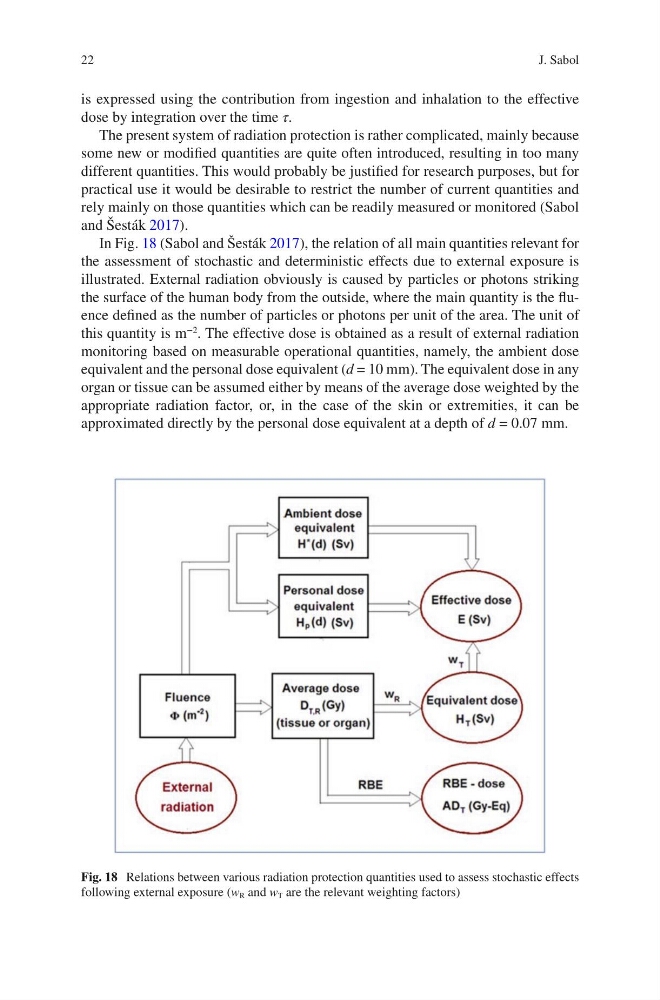
In Fig. 18 (Sabol and Šesták 2017), the relation of all main quantities relevant for
the assessment of stochastic and deterministic effects due to external exposure is
illustrated. External radiation obviously is caused by particles or photons striking
the surface of the human body from the outside, where the main quantity is the fluence defined as the number of particles or photons per unit of the area. The unit of
this quantity is m
−2
. The effective dose is obtained as a result of external radiation
monitoring based on measurable operational quantities, namely, the ambient dose
equivalent and the personal dose equivalent (d = 10 mm). The equivalent dose in any
organ or tissue can be assumed either by means of the average dose weighted by the
appropriate radiation factor, or, in the case of the skin or extremities, it can be
approximated directly by the personal dose equivalent at a depth of d = 0.07 mm.
Fig. 18 Relations between various radiation protection quantities used to assess stochastic effects
following external exposure (w R and w T are the relevant weighting factors)
J. Sabol
is expressed using the contribution from ingestion and inhalation to the effective
dose by integration over the time τ.
The present system of radiation protection is rather complicated, mainly because
some new or modified quantities are quite often introduced, resulting in too many
different quantities. This would probably be justified for research purposes, but for
practical use it would be desirable to restrict the number of current quantities and
rely mainly on those quantities which can be readily measured or monitored (Sabol
and Šesták 2017).
In Fig. 18 (Sabol and Šesták 2017), the relation of all main quantities relevant for
the assessment of stochastic and deterministic effects due to external exposure is
illustrated. External radiation obviously is caused by particles or photons striking
the surface of the human body from the outside, where the main quantity is the fluence defined as the number of particles or photons per unit of the area. The unit of
this quantity is m
−2
. The effective dose is obtained as a result of external radiation
monitoring based on measurable operational quantities, namely, the ambient dose
equivalent and the personal dose equivalent (d = 10 mm). The equivalent dose in any
organ or tissue can be assumed either by means of the average dose weighted by the
appropriate radiation factor, or, in the case of the skin or extremities, it can be
approximated directly by the personal dose equivalent at a depth of d = 0.07 mm.
Fig. 18 Relations between various radiation protection quantities used to assess stochastic effects
following external exposure (w R and w T are the relevant weighting factors)
J. Sabol