

226
density of hair. First-order differential equations are used to represent the movement
of uranium among the various compartments:
dq
dt
q
q
i j
n
i
i
ji j
i
r
i
=
−
+
(
)
= …
∑ λ
λ λ ·
, ,
, ,
1
(5)
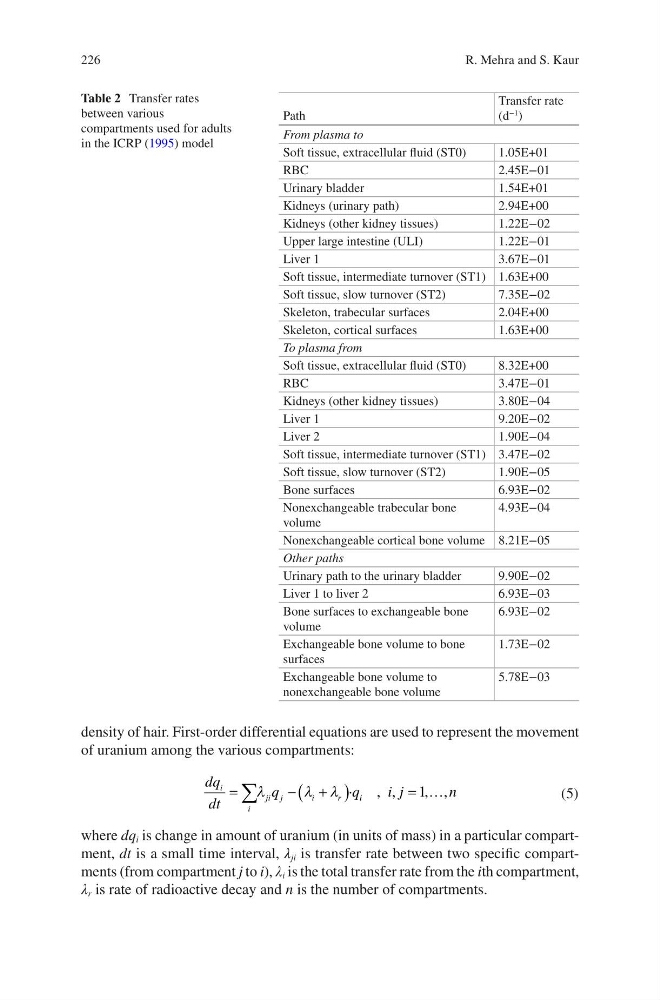
where dq i is change in amount of uranium (in units of mass) in a particular compartment, dt is a small time interval, λ ji is transfer rate between two specific compartments (from compartment j to i), λ i is the total transfer rate from the ith compartment,
λ r is rate of radioactive decay and n is the number of compartments.
Table 2 Transfer rates
between various
compartments used for adults
in the ICRP (1995) model
Path
Transfer rate
(d
−1
)
From plasma to
Soft tissue, extracellular fluid (ST0)
1.05E+01
RBC
2.45E−01
Urinary bladder
1.54E+01
Kidneys (urinary path)
2.94E+00
Kidneys (other kidney tissues)
1.22E−02
Upper large intestine (ULI)
1.22E−01
Liver 1
3.67E−01
Soft tissue, intermediate turnover (ST1) 1.63E+00
Soft tissue, slow turnover (ST2)
7.35E−02
Skeleton, trabecular surfaces
2.04E+00
Skeleton, cortical surfaces
1.63E+00
To plasma from
Soft tissue, extracellular fluid (ST0)
8.32E+00
RBC
3.47E−01
Kidneys (other kidney tissues)
3.80E−04
Liver 1
9.20E−02
Liver 2
1.90E−04
Soft tissue, intermediate turnover (ST1) 3.47E−02
Soft tissue, slow turnover (ST2)
1.90E−05
Bone surfaces
6.93E−02
Nonexchangeable trabecular bone
volume
4.93E−04
Nonexchangeable cortical bone volume 8.21E−05
Other paths
Urinary path to the urinary bladder
9.90E−02
Liver 1 to liver 2
6.93E−03
Bone surfaces to exchangeable bone
volume
6.93E−02
Exchangeable bone volume to bone
surfaces
1.73E−02
Exchangeable bone volume to
nonexchangeable bone volume
5.78E−03
R. Mehra and S. Kaur
density of hair. First-order differential equations are used to represent the movement
of uranium among the various compartments:
dq
dt
q
q
i j
n
i
i
ji j
i
r
i
=
−
+
(
)
= …
∑ λ
λ λ ·
, ,
, ,
1
(5)
where dq i is change in amount of uranium (in units of mass) in a particular compartment, dt is a small time interval, λ ji is transfer rate between two specific compartments (from compartment j to i), λ i is the total transfer rate from the ith compartment,
λ r is rate of radioactive decay and n is the number of compartments.
Table 2 Transfer rates
between various
compartments used for adults
in the ICRP (1995) model
Path
Transfer rate
(d
−1
)
From plasma to
Soft tissue, extracellular fluid (ST0)
1.05E+01
RBC
2.45E−01
Urinary bladder
1.54E+01
Kidneys (urinary path)
2.94E+00
Kidneys (other kidney tissues)
1.22E−02
Upper large intestine (ULI)
1.22E−01
Liver 1
3.67E−01
Soft tissue, intermediate turnover (ST1) 1.63E+00
Soft tissue, slow turnover (ST2)
7.35E−02
Skeleton, trabecular surfaces
2.04E+00
Skeleton, cortical surfaces
1.63E+00
To plasma from
Soft tissue, extracellular fluid (ST0)
8.32E+00
RBC
3.47E−01
Kidneys (other kidney tissues)
3.80E−04
Liver 1
9.20E−02
Liver 2
1.90E−04
Soft tissue, intermediate turnover (ST1) 3.47E−02
Soft tissue, slow turnover (ST2)
1.90E−05
Bone surfaces
6.93E−02
Nonexchangeable trabecular bone
volume
4.93E−04
Nonexchangeable cortical bone volume 8.21E−05
Other paths
Urinary path to the urinary bladder
9.90E−02
Liver 1 to liver 2
6.93E−03
Bone surfaces to exchangeable bone
volume
6.93E−02
Exchangeable bone volume to bone
surfaces
1.73E−02
Exchangeable bone volume to
nonexchangeable bone volume
5.78E−03
R. Mehra and S. Kaur