

225
tation in the ICRP’s biokinetic model are based on the work of Leggett (1994)
(Table 2). Plasma is regarded as a uniformly mixed pool from which uranium is
removed at a rate of 35 d
−1
. The skeleton, liver and kidneys are each modelled as two
distinct compartments. The uranium deposition in the skeleton is considered to be
initially on the surfaces of trabecular and cortical bone. Later, it can either return to
the bloodstream or penetrate deeper into exchangeable and then nonexchangeable
bone volume. The soft tissue compartments ST0 (rapid turnover), ST1 (intermediate
turnover) and ST2 (tenacious retention) balance the model in terms of material distribution. Liver1 receives 1.5% of uranium leaving the circulation with removal halftime of 7 days, 93% of uranium leaving the liver is assumed to return to plasma and
7% enters Liver2, with a removal half-time of 10 years. According to this model,
63% of the uranium leaving the plasma goes directly to the urinary bladder, and 12%
of that leaving plasma is eliminated from the renal tubules to the urinary bladder with
a half-time of 7 days. Another kidney tissue compartment receives 0.05% of uranium
leaving the circulation and is associated with a removal half-time of 5 years. The
current ICRP model employs 2 and 0.2 percent as the uptake fractions from gut for
soluble and highly insoluble forms of uranium, respectively, the latter being specified as uranium dioxide (UO 2 ) and triuranium octoxide (U 3 O 8 ) (ICRP 1994; 1995).
4.5 Hair Compartment Model of Uranium
A hair compartment model proposed by Li et al. (2009) enhances the ICRP biokinetic model for uranium, as it includes a hair compartment for elimination in addition to faeces (GI tract) and urine (urinary bladder). It is only valid for ingestion by
adults. Two input routes are assumed for the hair compartment: one directly from
plasma and the other from intermediate turnover soft tissue at transfer rates
k 1 = 0.017 d
−1
and k 3 = 13.0 d
−1
, respectively. The hair growth rate is normalized at
0.1 g day
−1
taking into account a number of factors such as type, colour, length and
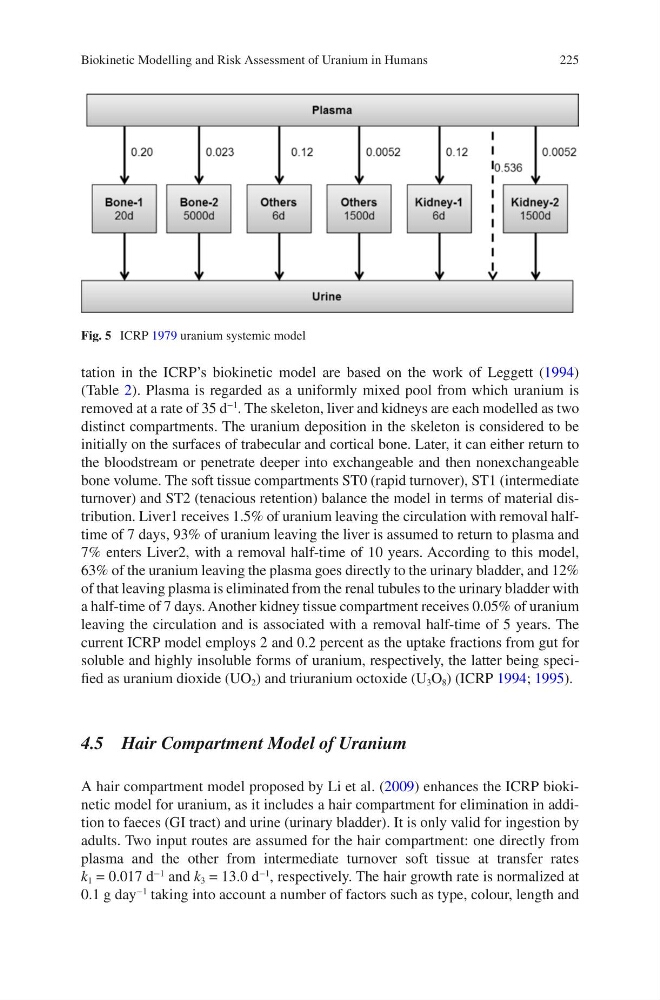
Fig. 5 ICRP 1979 uranium systemic model
Biokinetic Modelling and Risk Assessment of Uranium in Humans
tation in the ICRP’s biokinetic model are based on the work of Leggett (1994)
(Table 2). Plasma is regarded as a uniformly mixed pool from which uranium is
removed at a rate of 35 d
−1
. The skeleton, liver and kidneys are each modelled as two
distinct compartments. The uranium deposition in the skeleton is considered to be
initially on the surfaces of trabecular and cortical bone. Later, it can either return to
the bloodstream or penetrate deeper into exchangeable and then nonexchangeable
bone volume. The soft tissue compartments ST0 (rapid turnover), ST1 (intermediate
turnover) and ST2 (tenacious retention) balance the model in terms of material distribution. Liver1 receives 1.5% of uranium leaving the circulation with removal halftime of 7 days, 93% of uranium leaving the liver is assumed to return to plasma and
7% enters Liver2, with a removal half-time of 10 years. According to this model,
63% of the uranium leaving the plasma goes directly to the urinary bladder, and 12%
of that leaving plasma is eliminated from the renal tubules to the urinary bladder with
a half-time of 7 days. Another kidney tissue compartment receives 0.05% of uranium
leaving the circulation and is associated with a removal half-time of 5 years. The
current ICRP model employs 2 and 0.2 percent as the uptake fractions from gut for
soluble and highly insoluble forms of uranium, respectively, the latter being specified as uranium dioxide (UO 2 ) and triuranium octoxide (U 3 O 8 ) (ICRP 1994; 1995).
4.5 Hair Compartment Model of Uranium
A hair compartment model proposed by Li et al. (2009) enhances the ICRP biokinetic model for uranium, as it includes a hair compartment for elimination in addition to faeces (GI tract) and urine (urinary bladder). It is only valid for ingestion by
adults. Two input routes are assumed for the hair compartment: one directly from
plasma and the other from intermediate turnover soft tissue at transfer rates
k 1 = 0.017 d
−1
and k 3 = 13.0 d
−1
, respectively. The hair growth rate is normalized at
0.1 g day
−1
taking into account a number of factors such as type, colour, length and
Fig. 5 ICRP 1979 uranium systemic model
Biokinetic Modelling and Risk Assessment of Uranium in Humans