

224
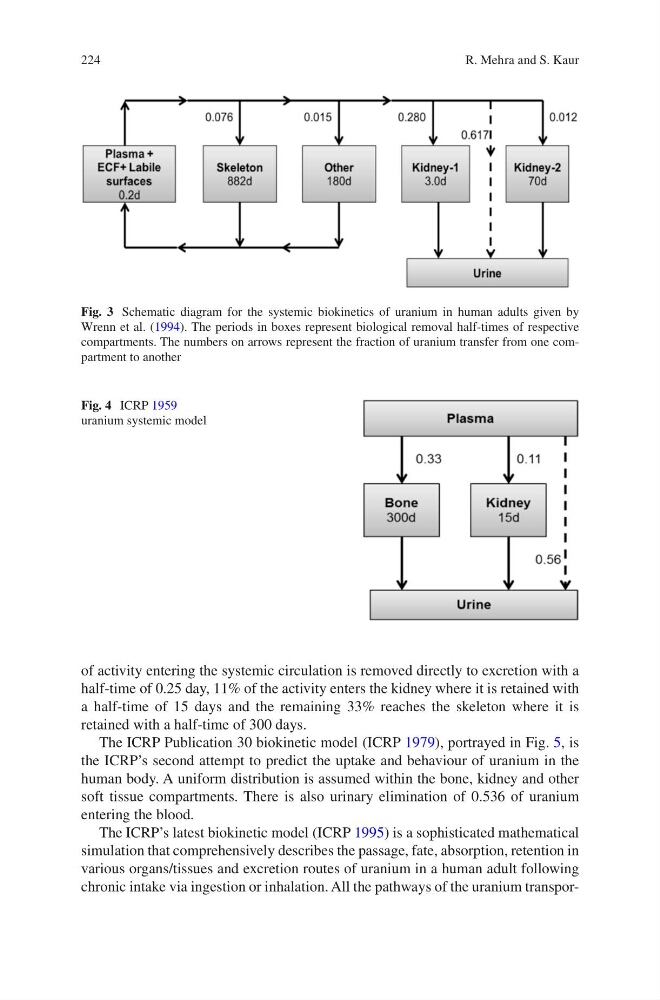
of activity entering the systemic circulation is removed directly to excretion with a
half-time of 0.25 day, 11% of the activity enters the kidney where it is retained with
a half-time of 15 days and the remaining 33% reaches the skeleton where it is
retained with a half-time of 300 days.
The ICRP Publication 30 biokinetic model (ICRP 1979), portrayed in Fig. 5, is
the ICRP’s second attempt to predict the uptake and behaviour of uranium in the
human body. A uniform distribution is assumed within the bone, kidney and other
soft tissue compartments. There is also urinary elimination of 0.536 of uranium
entering the blood.
The ICRP’s latest biokinetic model (ICRP 1995) is a sophisticated mathematical
simulation that comprehensively describes the passage, fate, absorption, retention in
various organs/tissues and excretion routes of uranium in a human adult following
chronic intake via ingestion or inhalation. All the pathways of the uranium transporFig. 3 Schematic diagram for the systemic biokinetics of uranium in human adults given by
Wrenn et al. (1994). The periods in boxes represent biological removal half-times of respective
compartments. The numbers on arrows represent the fraction of uranium transfer from one compartment to another
Fig. 4 ICRP 1959
uranium systemic model
R. Mehra and S. Kaur
of activity entering the systemic circulation is removed directly to excretion with a
half-time of 0.25 day, 11% of the activity enters the kidney where it is retained with
a half-time of 15 days and the remaining 33% reaches the skeleton where it is
retained with a half-time of 300 days.
The ICRP Publication 30 biokinetic model (ICRP 1979), portrayed in Fig. 5, is
the ICRP’s second attempt to predict the uptake and behaviour of uranium in the
human body. A uniform distribution is assumed within the bone, kidney and other
soft tissue compartments. There is also urinary elimination of 0.536 of uranium
entering the blood.
The ICRP’s latest biokinetic model (ICRP 1995) is a sophisticated mathematical
simulation that comprehensively describes the passage, fate, absorption, retention in
various organs/tissues and excretion routes of uranium in a human adult following
chronic intake via ingestion or inhalation. All the pathways of the uranium transporFig. 3 Schematic diagram for the systemic biokinetics of uranium in human adults given by
Wrenn et al. (1994). The periods in boxes represent biological removal half-times of respective
compartments. The numbers on arrows represent the fraction of uranium transfer from one compartment to another
Fig. 4 ICRP 1959
uranium systemic model
R. Mehra and S. Kaur