

223
4.2 Lipsztein’s Model (1981)
This model (Lipsztein 1981) distinguishes the human body into five different compartments: red cells, short-term bone, long-term bone, kidney and urine. The rates
of transfer between these compartments are governed by first-order kinetics. The
model assumes instantaneous transfer from plasma to all other compartments.
Feedback from bone compartments and red cells to plasma is addressed. The gastrointestinal absorption factor, f 1 , calculated was 23%.
4.3 Wrenn’s Model (1994)
Wrenn’s model, as depicted in Fig. 3, forms the backbone of the ICRP’s biokinetic
model of uranium (ICRP 1995) although it does not address chronic environmental
and occupational exposures. The key points of the model are the undivided skeleton,
the aggregation of all soft tissues into a single compartment and the distinction of
the kidneys into two components. The liver is not mentioned explicitly. Faecal
excretion is not represented. This model substantially underestimates urinary excretion at later times, due to the slow release of a small fraction of retained uranium,
mainly from the skeleton. The model is useful for interpreting results from routine
urine bioassay procedures for time periods of less than 100 days post intake.
4.4 ICRP’s Uranium Systemic Model
The ICRP has formulated a number of systemic models for uranium in its publications, the most noteworthy being those described in ICRP Publications 2, 30 and 69.
According to the ICRP Publication 2 model (ICRP 1959), as shown in Fig. 4, 56%
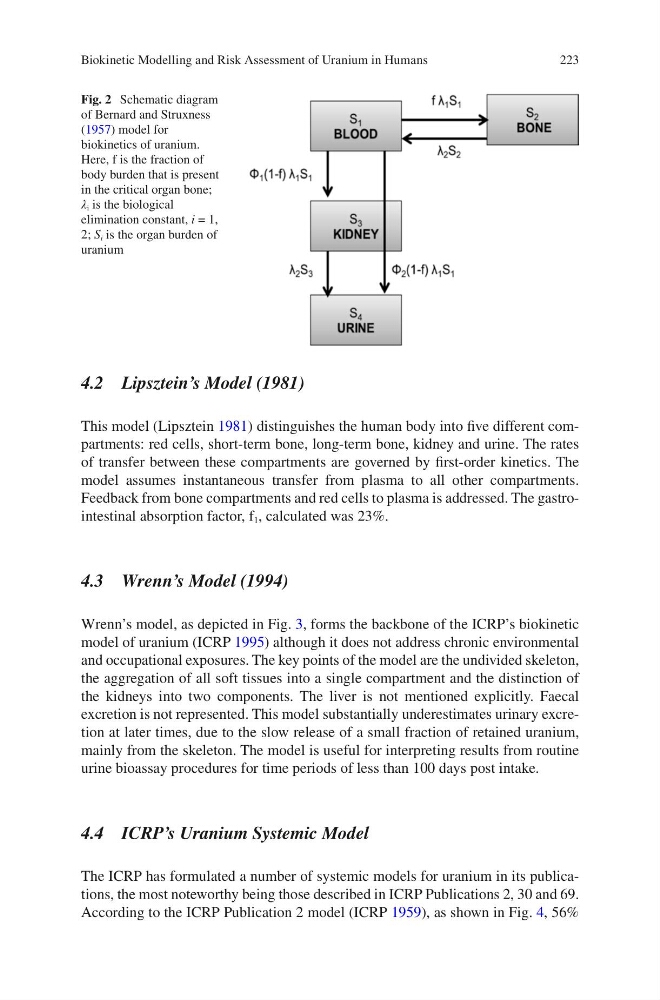
Fig. 2 Schematic diagram
of Bernard and Struxness
(1957) model for
biokinetics of uranium.
Here, f is the fraction of
body burden that is present
in the critical organ bone;
λ i is the biological
elimination constant, i = 1,
2; S i is the organ burden of
uranium
Biokinetic Modelling and Risk Assessment of Uranium in Humans
4.2 Lipsztein’s Model (1981)
This model (Lipsztein 1981) distinguishes the human body into five different compartments: red cells, short-term bone, long-term bone, kidney and urine. The rates
of transfer between these compartments are governed by first-order kinetics. The
model assumes instantaneous transfer from plasma to all other compartments.
Feedback from bone compartments and red cells to plasma is addressed. The gastrointestinal absorption factor, f 1 , calculated was 23%.
4.3 Wrenn’s Model (1994)
Wrenn’s model, as depicted in Fig. 3, forms the backbone of the ICRP’s biokinetic
model of uranium (ICRP 1995) although it does not address chronic environmental
and occupational exposures. The key points of the model are the undivided skeleton,
the aggregation of all soft tissues into a single compartment and the distinction of
the kidneys into two components. The liver is not mentioned explicitly. Faecal
excretion is not represented. This model substantially underestimates urinary excretion at later times, due to the slow release of a small fraction of retained uranium,
mainly from the skeleton. The model is useful for interpreting results from routine
urine bioassay procedures for time periods of less than 100 days post intake.
4.4 ICRP’s Uranium Systemic Model
The ICRP has formulated a number of systemic models for uranium in its publications, the most noteworthy being those described in ICRP Publications 2, 30 and 69.
According to the ICRP Publication 2 model (ICRP 1959), as shown in Fig. 4, 56%
Fig. 2 Schematic diagram
of Bernard and Struxness
(1957) model for
biokinetics of uranium.
Here, f is the fraction of
body burden that is present
in the critical organ bone;
λ i is the biological
elimination constant, i = 1,
2; S i is the organ burden of
uranium
Biokinetic Modelling and Risk Assessment of Uranium in Humans