

204
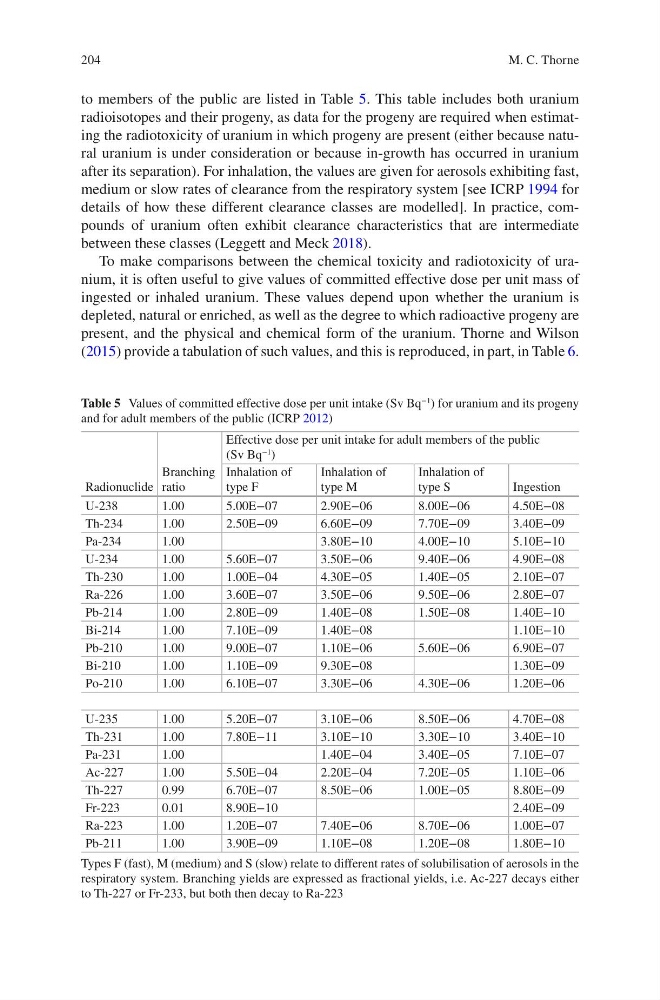
to members of the public are listed in Table 5. This table includes both uranium
radioisotopes and their progeny, as data for the progeny are required when estimating the radiotoxicity of uranium in which progeny are present (either because natural uranium is under consideration or because in-growth has occurred in uranium
after its separation). For inhalation, the values are given for aerosols exhibiting fast,
medium or slow rates of clearance from the respiratory system [see ICRP 1994 for
details of how these different clearance classes are modelled]. In practice, compounds of uranium often exhibit clearance characteristics that are intermediate
between these classes (Leggett and Meck 2018).
To make comparisons between the chemical toxicity and radiotoxicity of uranium, it is often useful to give values of committed effective dose per unit mass of
ingested or inhaled uranium. These values depend upon whether the uranium is
depleted, natural or enriched, as well as the degree to which radioactive progeny are
present, and the physical and chemical form of the uranium. Thorne and Wilson
(2015) provide a tabulation of such values, and this is reproduced, in part, in Table 6.
Table 5 Values of committed effective dose per unit intake (Sv Bq
−1
) for uranium and its progeny
and for adult members of the public (ICRP 2012)
Radionuclide
Branching
ratio
Effective dose per unit intake for adult members of the public
(Sv Bq
−1 )
Inhalation of
type F
Inhalation of
type M
Inhalation of
type S
Ingestion
U-238
1.00
5.00E−07
2.90E−06
8.00E−06
4.50E−08
Th-234
1.00
2.50E−09
6.60E−09
7.70E−09
3.40E−09
Pa-234
1.00
3.80E−10
4.00E−10
5.10E−10
U-234
1.00
5.60E−07
3.50E−06
9.40E−06
4.90E−08
Th-230
1.00
1.00E−04
4.30E−05
1.40E−05
2.10E−07
Ra-226
1.00
3.60E−07
3.50E−06
9.50E−06
2.80E−07
Pb-214
1.00
2.80E−09
1.40E−08
1.50E−08
1.40E−10
Bi-214
1.00
7.10E−09
1.40E−08
1.10E−10
Pb-210
1.00
9.00E−07
1.10E−06
5.60E−06
6.90E−07
Bi-210
1.00
1.10E−09
9.30E−08
1.30E−09
Po-210
1.00
6.10E−07
3.30E−06
4.30E−06
1.20E−06
U-235
1.00
5.20E−07
3.10E−06
8.50E−06
4.70E−08
Th-231
1.00
7.80E−11
3.10E−10
3.30E−10
3.40E−10
Pa-231
1.00
1.40E−04
3.40E−05
7.10E−07
Ac-227
1.00
5.50E−04
2.20E−04
7.20E−05
1.10E−06
Th-227
0.99
6.70E−07
8.50E−06
1.00E−05
8.80E−09
Fr-223
0.01
8.90E−10
2.40E−09
Ra-223
1.00
1.20E−07
7.40E−06
8.70E−06
1.00E−07
Pb-211
1.00
3.90E−09
1.10E−08
1.20E−08
1.80E−10
Types F (fast), M (medium) and S (slow) relate to different rates of solubilisation of aerosols in the
respiratory system. Branching yields are expressed as fractional yields, i.e. Ac-227 decays either
to Th-227 or Fr-233, but both then decay to Ra-223
M. C. Thorne
to members of the public are listed in Table 5. This table includes both uranium
radioisotopes and their progeny, as data for the progeny are required when estimating the radiotoxicity of uranium in which progeny are present (either because natural uranium is under consideration or because in-growth has occurred in uranium
after its separation). For inhalation, the values are given for aerosols exhibiting fast,
medium or slow rates of clearance from the respiratory system [see ICRP 1994 for
details of how these different clearance classes are modelled]. In practice, compounds of uranium often exhibit clearance characteristics that are intermediate
between these classes (Leggett and Meck 2018).
To make comparisons between the chemical toxicity and radiotoxicity of uranium, it is often useful to give values of committed effective dose per unit mass of
ingested or inhaled uranium. These values depend upon whether the uranium is
depleted, natural or enriched, as well as the degree to which radioactive progeny are
present, and the physical and chemical form of the uranium. Thorne and Wilson
(2015) provide a tabulation of such values, and this is reproduced, in part, in Table 6.
Table 5 Values of committed effective dose per unit intake (Sv Bq
−1
) for uranium and its progeny
and for adult members of the public (ICRP 2012)
Radionuclide
Branching
ratio
Effective dose per unit intake for adult members of the public
(Sv Bq
−1 )
Inhalation of
type F
Inhalation of
type M
Inhalation of
type S
Ingestion
U-238
1.00
5.00E−07
2.90E−06
8.00E−06
4.50E−08
Th-234
1.00
2.50E−09
6.60E−09
7.70E−09
3.40E−09
Pa-234
1.00
3.80E−10
4.00E−10
5.10E−10
U-234
1.00
5.60E−07
3.50E−06
9.40E−06
4.90E−08
Th-230
1.00
1.00E−04
4.30E−05
1.40E−05
2.10E−07
Ra-226
1.00
3.60E−07
3.50E−06
9.50E−06
2.80E−07
Pb-214
1.00
2.80E−09
1.40E−08
1.50E−08
1.40E−10
Bi-214
1.00
7.10E−09
1.40E−08
1.10E−10
Pb-210
1.00
9.00E−07
1.10E−06
5.60E−06
6.90E−07
Bi-210
1.00
1.10E−09
9.30E−08
1.30E−09
Po-210
1.00
6.10E−07
3.30E−06
4.30E−06
1.20E−06
U-235
1.00
5.20E−07
3.10E−06
8.50E−06
4.70E−08
Th-231
1.00
7.80E−11
3.10E−10
3.30E−10
3.40E−10
Pa-231
1.00
1.40E−04
3.40E−05
7.10E−07
Ac-227
1.00
5.50E−04
2.20E−04
7.20E−05
1.10E−06
Th-227
0.99
6.70E−07
8.50E−06
1.00E−05
8.80E−09
Fr-223
0.01
8.90E−10
2.40E−09
Ra-223
1.00
1.20E−07
7.40E−06
8.70E−06
1.00E−07
Pb-211
1.00
3.90E−09
1.10E−08
1.20E−08
1.80E−10
Types F (fast), M (medium) and S (slow) relate to different rates of solubilisation of aerosols in the
respiratory system. Branching yields are expressed as fractional yields, i.e. Ac-227 decays either
to Th-227 or Fr-233, but both then decay to Ra-223
M. C. Thorne