

203
Table 3, based on IAEA (2014), gives a summary of uranium concentration factors
for various groups of biota from brackish and marine environments, and Table 4
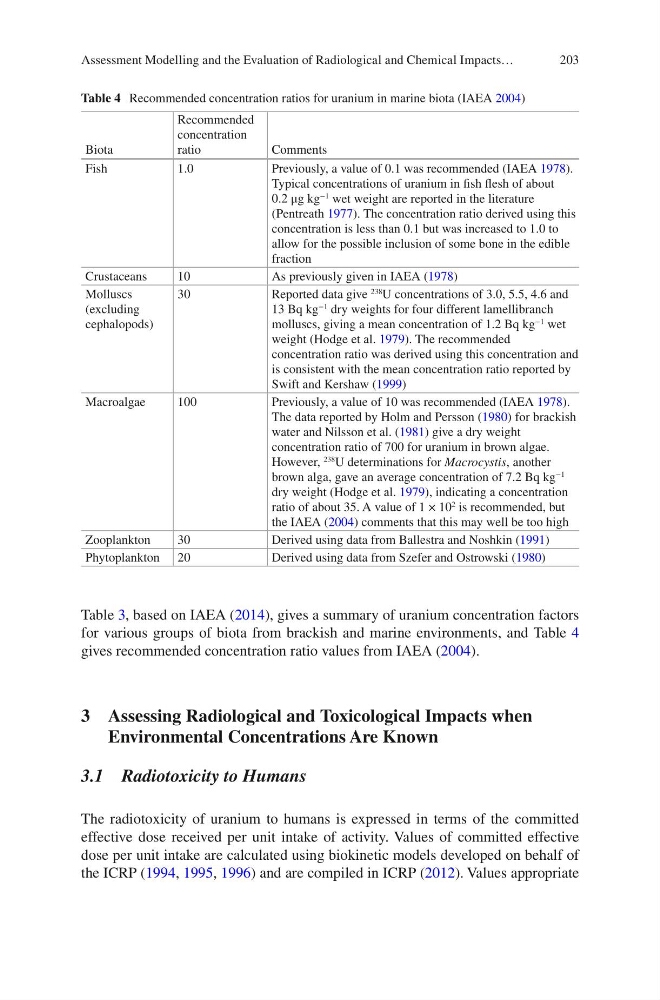
gives recommended concentration ratio values from IAEA (2004).
3 Assessing Radiological and Toxicological Impacts when
Environmental Concentrations Are Known
3.1 Radiotoxicity to Humans
The radiotoxicity of uranium to humans is expressed in terms of the committed
effective dose received per unit intake of activity. Values of committed effective
dose per unit intake are calculated using biokinetic models developed on behalf of
the ICRP (1994, 1995, 1996) and are compiled in ICRP (2012). Values appropriate
Table 4 Recommended concentration ratios for uranium in marine biota (IAEA 2004)
Biota
Recommended
concentration
ratio
Comments
Fish
1.0
Previously, a value of 0.1 was recommended (IAEA 1978).
Typical concentrations of uranium in fish flesh of about
0.2 μg kg
−1 wet weight are reported in the literature
(Pentreath 1977). The concentration ratio derived using this
concentration is less than 0.1 but was increased to 1.0 to
allow for the possible inclusion of some bone in the edible
fraction
Crustaceans
10
As previously given in IAEA (1978)
Molluscs
(excluding
cephalopods)
30
Reported data give
238
U concentrations of 3.0, 5.5, 4.6 and
13 Bq kg
−1 dry weights for four different lamellibranch
molluscs, giving a mean concentration of 1.2 Bq kg
−1 wet
weight (Hodge et al. 1979). The recommended
concentration ratio was derived using this concentration and
is consistent with the mean concentration ratio reported by
Swift and Kershaw (1999)
Macroalgae
100
Previously, a value of 10 was recommended (IAEA 1978).
The data reported by Holm and Persson (1980) for brackish
water and Nilsson et al. (1981) give a dry weight
concentration ratio of 700 for uranium in brown algae.
However,
238 U determinations for Macrocystis, another
brown alga, gave an average concentration of 7.2 Bq kg
−1
dry weight (Hodge et al. 1979), indicating a concentration
ratio of about 35. A value of 1 × 10
2 is recommended, but
the IAEA (2004) comments that this may well be too high
Zooplankton
30
Derived using data from Ballestra and Noshkin (1991)
Phytoplankton 20
Derived using data from Szefer and Ostrowski (1980)
Assessment Modelling and the Evaluation of Radiological and Chemical Impacts…
Table 3, based on IAEA (2014), gives a summary of uranium concentration factors
for various groups of biota from brackish and marine environments, and Table 4
gives recommended concentration ratio values from IAEA (2004).
3 Assessing Radiological and Toxicological Impacts when
Environmental Concentrations Are Known
3.1 Radiotoxicity to Humans
The radiotoxicity of uranium to humans is expressed in terms of the committed
effective dose received per unit intake of activity. Values of committed effective
dose per unit intake are calculated using biokinetic models developed on behalf of
the ICRP (1994, 1995, 1996) and are compiled in ICRP (2012). Values appropriate
Table 4 Recommended concentration ratios for uranium in marine biota (IAEA 2004)
Biota
Recommended
concentration
ratio
Comments
Fish
1.0
Previously, a value of 0.1 was recommended (IAEA 1978).
Typical concentrations of uranium in fish flesh of about
0.2 μg kg
−1 wet weight are reported in the literature
(Pentreath 1977). The concentration ratio derived using this
concentration is less than 0.1 but was increased to 1.0 to
allow for the possible inclusion of some bone in the edible
fraction
Crustaceans
10
As previously given in IAEA (1978)
Molluscs
(excluding
cephalopods)
30
Reported data give
238
U concentrations of 3.0, 5.5, 4.6 and
13 Bq kg
−1 dry weights for four different lamellibranch
molluscs, giving a mean concentration of 1.2 Bq kg
−1 wet
weight (Hodge et al. 1979). The recommended
concentration ratio was derived using this concentration and
is consistent with the mean concentration ratio reported by
Swift and Kershaw (1999)
Macroalgae
100
Previously, a value of 10 was recommended (IAEA 1978).
The data reported by Holm and Persson (1980) for brackish
water and Nilsson et al. (1981) give a dry weight
concentration ratio of 700 for uranium in brown algae.
However,
238 U determinations for Macrocystis, another
brown alga, gave an average concentration of 7.2 Bq kg
−1
dry weight (Hodge et al. 1979), indicating a concentration
ratio of about 35. A value of 1 × 10
2 is recommended, but
the IAEA (2004) comments that this may well be too high
Zooplankton
30
Derived using data from Ballestra and Noshkin (1991)
Phytoplankton 20
Derived using data from Szefer and Ostrowski (1980)
Assessment Modelling and the Evaluation of Radiological and Chemical Impacts…