

3.4 Cost of Carbonation
The purpose of CCS technology is to capture and store CO 2 .
However, in generally used methods, stored CO 2 requires
continuous monitoring to ensure stability (Fricker and Park
2013). Since the normally used processes involved high cost,
the economic cost cannot justify their primary benefit. Based
on previous studies, mineral carbonation shows relatively
high commercial cost, which limits its application, because it
includes cost of mining, pre-treatment, operational technologies of CO 2 sequestration and others.
It is widely known that improved reaction processes are
the most promising route to cutting both the capital and
operating costs for mineral carbonation (Wang and
Maroto-Valer 2011). In this study, the method described
considered integrated processes to reduce the cost and
energy consumption via: (a) utilization of industrial solid
wastes, that is, no need for mining, (b) no need for grinding;
the solid wastes were fine enough for the CO 2 sequestration
and (c) no need for energy consumption through the application of direct gas–solid carbonation in the testing unit at
room temperature since using the pressurized CO 2 provides
a well mixing process of particles with low operation cost.
Therefore, the newly developed process, described in this
study, demonstrated superior material stability over other
proposed methods of CO 2 sequestration, and reduced cost
and energy required during carbonation.
4 Conclusion
The goal of this study was to use some of the industrial
wastes produced in the UAE as low-cost materials for carbon
capture and sequestration. Mineral carbonation was selected
not only to stabilize the active minerals but also to reduce the
emission of CO 2 . The mineral carbonation involves the
reaction of calcium, magnesium oxides and silicates of the
industrial alkaline wastes with CO 2 to form stable mineral
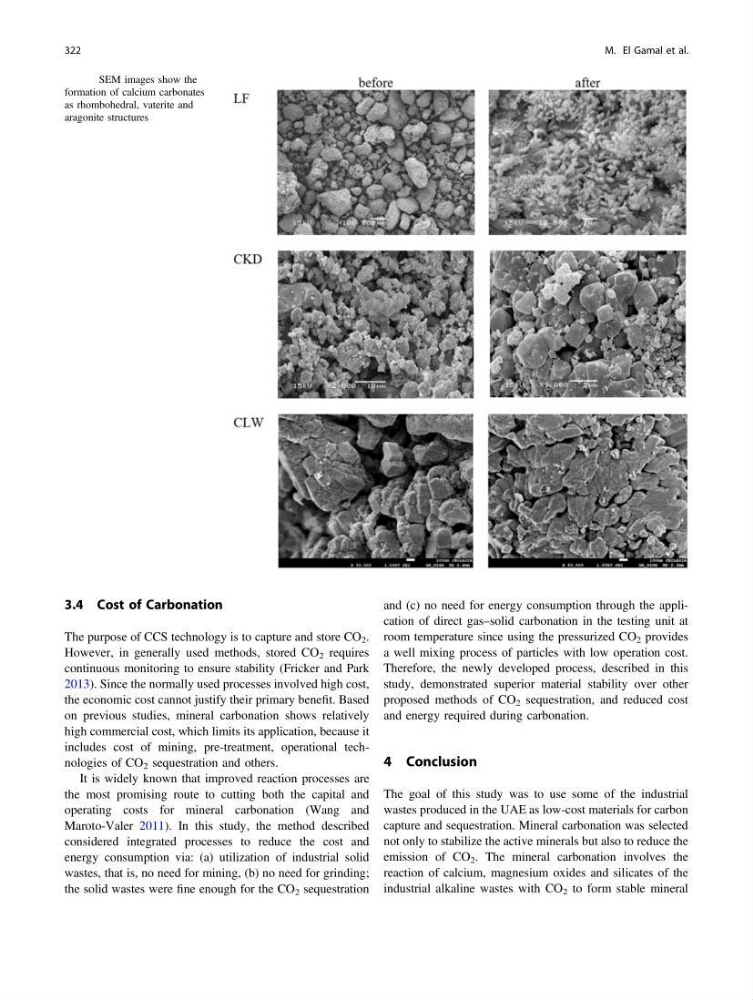
Fig. 5 SEM images show the
formation of calcium carbonates
as rhombohedral, vaterite and
aragonite structures
322
M. El Gamal et al.
The purpose of CCS technology is to capture and store CO 2 .
However, in generally used methods, stored CO 2 requires
continuous monitoring to ensure stability (Fricker and Park
2013). Since the normally used processes involved high cost,
the economic cost cannot justify their primary benefit. Based
on previous studies, mineral carbonation shows relatively
high commercial cost, which limits its application, because it
includes cost of mining, pre-treatment, operational technologies of CO 2 sequestration and others.
It is widely known that improved reaction processes are
the most promising route to cutting both the capital and
operating costs for mineral carbonation (Wang and
Maroto-Valer 2011). In this study, the method described
considered integrated processes to reduce the cost and
energy consumption via: (a) utilization of industrial solid
wastes, that is, no need for mining, (b) no need for grinding;
the solid wastes were fine enough for the CO 2 sequestration
and (c) no need for energy consumption through the application of direct gas–solid carbonation in the testing unit at
room temperature since using the pressurized CO 2 provides
a well mixing process of particles with low operation cost.
Therefore, the newly developed process, described in this
study, demonstrated superior material stability over other
proposed methods of CO 2 sequestration, and reduced cost
and energy required during carbonation.
4 Conclusion
The goal of this study was to use some of the industrial
wastes produced in the UAE as low-cost materials for carbon
capture and sequestration. Mineral carbonation was selected
not only to stabilize the active minerals but also to reduce the
emission of CO 2 . The mineral carbonation involves the
reaction of calcium, magnesium oxides and silicates of the
industrial alkaline wastes with CO 2 to form stable mineral
Fig. 5 SEM images show the
formation of calcium carbonates
as rhombohedral, vaterite and
aragonite structures
322
M. El Gamal et al.