

independent variable is financial knowledge denoted by
KNOW. Financial knowledge is calculated using respondents’ answers to six questions as the simple linear combination. The value of one is attributed to each correct answer,
and for the incorrect or missing answer, the value equals
zero.
Hence, the estimated multiple linear regression model
using ordinary least squares method is given by (1), with
t-values in parentheses:
BEH ¼ À 0:401 þ 0:364 EFF þ 0:109KNOW
ðÀ2:079Þ ð4:909Þ ð2:213Þ
ð1Þ
The estimated regression model indicated that both
self-efficacy and knowledge have statistically significant
positive impact on responsible financial behavior. The
coefficient of determination—the adjusted coefficient of
determination
R
2
—equals 0.157 indicating that two independent variables, namely, EFF and KNOW explain 15.70%
of variance in financial behavior. Although
R
2 is not high
this is expected with dependent behavioral variable, which is
not rare in social research. Financial behavior is affected by
other factors that are not included in this research. However,
the estimated model offers valuable insight into the impact of
self-efficacy and knowledge on financial behavior. Concerning the diagnostics of the model residuals, the F-statistic
of Breuch–Pagan–Godfrey heteroskedasticity test equals
1.481, with corresponding p-value of 0.2309, thus the
problem of heteroscedasticity is not present at any reasonable significance level. Moreover, the Breuch–Godfrey
residual autocorrelation LM test’s F-statistic is calculated
using EViews 9 and equals 1.484 with p-value of 0.2304,
indicating that autocorrelation problem is not present at any
reasonable significance level.
Moreover, the model is also estimated using standardized
values of variables (denoted by *) in order to compare the
strength of the impact of knowledge and self-efficacy on
financial behavior. The estimated model with standardized
coefficients is given by
BEHÃ ¼ 0:374 EFF Ã þ 0:169KNOWÃ
ð4:909Þ ð2:213Þ
ð2Þ
The interesting result is that the impact of self-efficacy on
financial behavior is much stronger than the impact of
knowledge. Hence, the effect of the psychological variable is
more pronounced than the effect of knowledge.
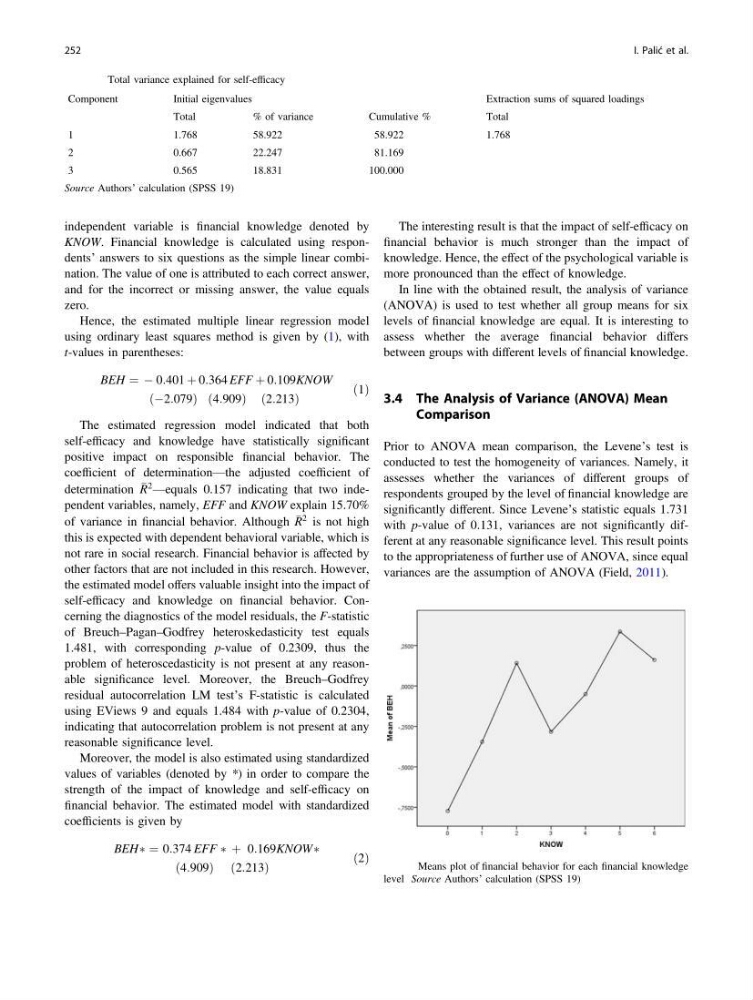
In line with the obtained result, the analysis of variance
(ANOVA) is used to test whether all group means for six
levels of financial knowledge are equal. It is interesting to
assess whether the average financial behavior differs
between groups with different levels of financial knowledge.
3.4 The Analysis of Variance (ANOVA) Mean
Comparison
Prior to ANOVA mean comparison, the Levene’s test is
conducted to test the homogeneity of variances. Namely, it
assesses whether the variances of different groups of
respondents grouped by the level of financial knowledge are
significantly different. Since Levene’s statistic equals 1.731
with p-value of 0.131, variances are not significantly different at any reasonable significance level. This result points
to the appropriateness of further use of ANOVA, since equal
variances are the assumption of ANOVA (Field, 2011).
Table 5 Total variance explained for self-efficacy
Component
Initial eigenvalues
Extraction sums of squared loadings
Total
% of variance
Cumulative %
Total
1
1.768
58.922
58.922
1.768
2
0.667
22.247
81.169
3
0.565
18.831
100.000
Source Authors’ calculation (SPSS 19)
Fig. 2 Means plot of financial behavior for each financial knowledge
level Source Authors’ calculation (SPSS 19)
252
I. Palić et al.
KNOW. Financial knowledge is calculated using respondents’ answers to six questions as the simple linear combination. The value of one is attributed to each correct answer,
and for the incorrect or missing answer, the value equals
zero.
Hence, the estimated multiple linear regression model
using ordinary least squares method is given by (1), with
t-values in parentheses:
BEH ¼ À 0:401 þ 0:364 EFF þ 0:109KNOW
ðÀ2:079Þ ð4:909Þ ð2:213Þ
ð1Þ
The estimated regression model indicated that both
self-efficacy and knowledge have statistically significant
positive impact on responsible financial behavior. The
coefficient of determination—the adjusted coefficient of
determination
R
2
—equals 0.157 indicating that two independent variables, namely, EFF and KNOW explain 15.70%
of variance in financial behavior. Although
R
2 is not high
this is expected with dependent behavioral variable, which is
not rare in social research. Financial behavior is affected by
other factors that are not included in this research. However,
the estimated model offers valuable insight into the impact of
self-efficacy and knowledge on financial behavior. Concerning the diagnostics of the model residuals, the F-statistic
of Breuch–Pagan–Godfrey heteroskedasticity test equals
1.481, with corresponding p-value of 0.2309, thus the
problem of heteroscedasticity is not present at any reasonable significance level. Moreover, the Breuch–Godfrey
residual autocorrelation LM test’s F-statistic is calculated
using EViews 9 and equals 1.484 with p-value of 0.2304,
indicating that autocorrelation problem is not present at any
reasonable significance level.
Moreover, the model is also estimated using standardized
values of variables (denoted by *) in order to compare the
strength of the impact of knowledge and self-efficacy on
financial behavior. The estimated model with standardized
coefficients is given by
BEHÃ ¼ 0:374 EFF Ã þ 0:169KNOWÃ
ð4:909Þ ð2:213Þ
ð2Þ
The interesting result is that the impact of self-efficacy on
financial behavior is much stronger than the impact of
knowledge. Hence, the effect of the psychological variable is
more pronounced than the effect of knowledge.
In line with the obtained result, the analysis of variance
(ANOVA) is used to test whether all group means for six
levels of financial knowledge are equal. It is interesting to
assess whether the average financial behavior differs
between groups with different levels of financial knowledge.
3.4 The Analysis of Variance (ANOVA) Mean
Comparison
Prior to ANOVA mean comparison, the Levene’s test is
conducted to test the homogeneity of variances. Namely, it
assesses whether the variances of different groups of
respondents grouped by the level of financial knowledge are
significantly different. Since Levene’s statistic equals 1.731
with p-value of 0.131, variances are not significantly different at any reasonable significance level. This result points
to the appropriateness of further use of ANOVA, since equal
variances are the assumption of ANOVA (Field, 2011).
Table 5 Total variance explained for self-efficacy
Component
Initial eigenvalues
Extraction sums of squared loadings
Total
% of variance
Cumulative %
Total
1
1.768
58.922
58.922
1.768
2
0.667
22.247
81.169
3
0.565
18.831
100.000
Source Authors’ calculation (SPSS 19)
Fig. 2 Means plot of financial behavior for each financial knowledge
level Source Authors’ calculation (SPSS 19)
252
I. Palić et al.