

suggests that the null hypothesis of no correlation between
the explanatory variables and the random effects should be
rejected. This means estimation of random effects specification is inconsistent. Alternatively, the estimation employs
fixed coefficients effects (Stern 2004) and the empirical
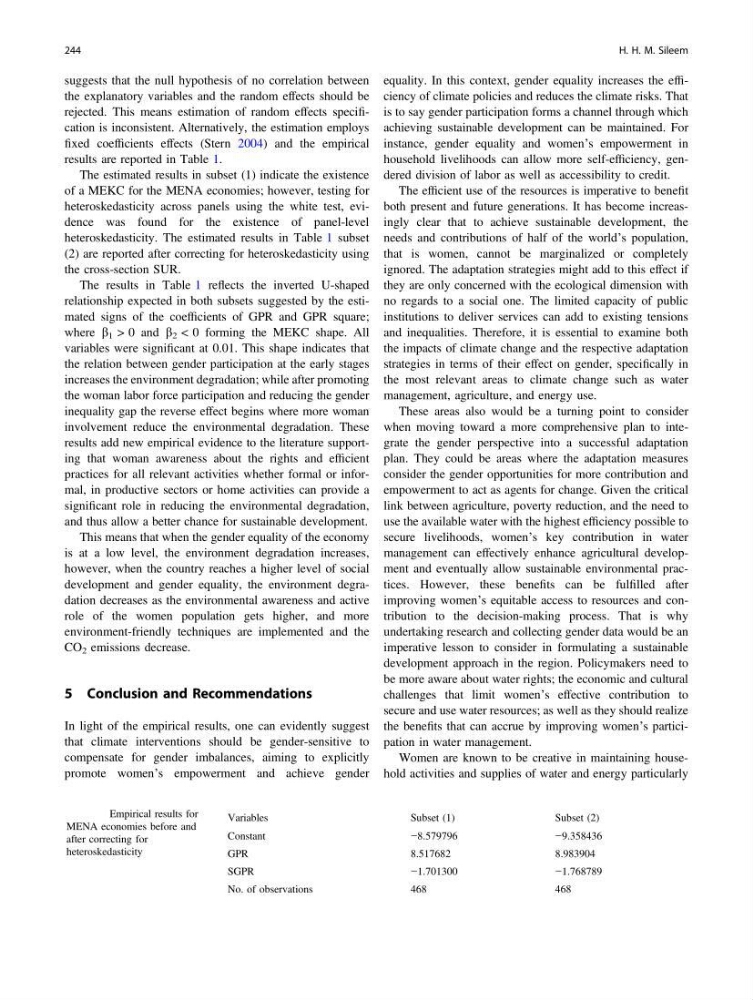
results are reported in Table 1.
The estimated results in subset (1) indicate the existence
of a MEKC for the MENA economies; however, testing for
heteroskedasticity across panels using the white test, evidence was found for the existence of panel-level
heteroskedasticity. The estimated results in Table 1 subset
(2) are reported after correcting for heteroskedasticity using
the cross-section SUR.
The results in Table 1 reflects the inverted U-shaped
relationship expected in both subsets suggested by the estimated signs of the coefficients of GPR and GPR square;
where b 1 > 0 and b 2 < 0 forming the MEKC shape. All
variables were significant at 0.01. This shape indicates that
the relation between gender participation at the early stages
increases the environment degradation; while after promoting
the woman labor force participation and reducing the gender
inequality gap the reverse effect begins where more woman
involvement reduce the environmental degradation. These
results add new empirical evidence to the literature supporting that woman awareness about the rights and efficient
practices for all relevant activities whether formal or informal, in productive sectors or home activities can provide a
significant role in reducing the environmental degradation,
and thus allow a better chance for sustainable development.
This means that when the gender equality of the economy
is at a low level, the environment degradation increases,
however, when the country reaches a higher level of social
development and gender equality, the environment degradation decreases as the environmental awareness and active
role of the women population gets higher, and more
environment-friendly techniques are implemented and the
CO 2 emissions decrease.
5 Conclusion and Recommendations
In light of the empirical results, one can evidently suggest
that climate interventions should be gender-sensitive to
compensate for gender imbalances, aiming to explicitly
promote women’s empowerment and achieve gender
equality. In this context, gender equality increases the efficiency of climate policies and reduces the climate risks. That
is to say gender participation forms a channel through which
achieving sustainable development can be maintained. For
instance, gender equality and women’s empowerment in
household livelihoods can allow more self-efficiency, gendered division of labor as well as accessibility to credit.
The efficient use of the resources is imperative to benefit
both present and future generations. It has become increasingly clear that to achieve sustainable development, the
needs and contributions of half of the world’s population,
that is women, cannot be marginalized or completely
ignored. The adaptation strategies might add to this effect if
they are only concerned with the ecological dimension with
no regards to a social one. The limited capacity of public
institutions to deliver services can add to existing tensions
and inequalities. Therefore, it is essential to examine both
the impacts of climate change and the respective adaptation
strategies in terms of their effect on gender, specifically in
the most relevant areas to climate change such as water
management, agriculture, and energy use.
These areas also would be a turning point to consider
when moving toward a more comprehensive plan to integrate the gender perspective into a successful adaptation
plan. They could be areas where the adaptation measures
consider the gender opportunities for more contribution and
empowerment to act as agents for change. Given the critical
link between agriculture, poverty reduction, and the need to
use the available water with the highest efficiency possible to
secure livelihoods, women’s key contribution in water
management can effectively enhance agricultural development and eventually allow sustainable environmental practices. However, these benefits can be fulfilled after
improving women’s equitable access to resources and contribution to the decision-making process. That is why
undertaking research and collecting gender data would be an
imperative lesson to consider in formulating a sustainable
development approach in the region. Policymakers need to
be more aware about water rights; the economic and cultural
challenges that limit women’s effective contribution to
secure and use water resources; as well as they should realize
the benefits that can accrue by improving women’s participation in water management.
Women are known to be creative in maintaining household activities and supplies of water and energy particularly
Table 1 Empirical results for
MENA economies before and
after correcting for
heteroskedasticity
Variables
Subset (1)
Subset (2)
Constant
−8.579796
−9.358436
GPR
8.517682
8.983904
SGPR
−1.701300
−1.768789
No. of observations
468
468
244
H. H. M. Sileem
the explanatory variables and the random effects should be
rejected. This means estimation of random effects specification is inconsistent. Alternatively, the estimation employs
fixed coefficients effects (Stern 2004) and the empirical
results are reported in Table 1.
The estimated results in subset (1) indicate the existence
of a MEKC for the MENA economies; however, testing for
heteroskedasticity across panels using the white test, evidence was found for the existence of panel-level
heteroskedasticity. The estimated results in Table 1 subset
(2) are reported after correcting for heteroskedasticity using
the cross-section SUR.
The results in Table 1 reflects the inverted U-shaped
relationship expected in both subsets suggested by the estimated signs of the coefficients of GPR and GPR square;
where b 1 > 0 and b 2 < 0 forming the MEKC shape. All
variables were significant at 0.01. This shape indicates that
the relation between gender participation at the early stages
increases the environment degradation; while after promoting
the woman labor force participation and reducing the gender
inequality gap the reverse effect begins where more woman
involvement reduce the environmental degradation. These
results add new empirical evidence to the literature supporting that woman awareness about the rights and efficient
practices for all relevant activities whether formal or informal, in productive sectors or home activities can provide a
significant role in reducing the environmental degradation,
and thus allow a better chance for sustainable development.
This means that when the gender equality of the economy
is at a low level, the environment degradation increases,
however, when the country reaches a higher level of social
development and gender equality, the environment degradation decreases as the environmental awareness and active
role of the women population gets higher, and more
environment-friendly techniques are implemented and the
CO 2 emissions decrease.
5 Conclusion and Recommendations
In light of the empirical results, one can evidently suggest
that climate interventions should be gender-sensitive to
compensate for gender imbalances, aiming to explicitly
promote women’s empowerment and achieve gender
equality. In this context, gender equality increases the efficiency of climate policies and reduces the climate risks. That
is to say gender participation forms a channel through which
achieving sustainable development can be maintained. For
instance, gender equality and women’s empowerment in
household livelihoods can allow more self-efficiency, gendered division of labor as well as accessibility to credit.
The efficient use of the resources is imperative to benefit
both present and future generations. It has become increasingly clear that to achieve sustainable development, the
needs and contributions of half of the world’s population,
that is women, cannot be marginalized or completely
ignored. The adaptation strategies might add to this effect if
they are only concerned with the ecological dimension with
no regards to a social one. The limited capacity of public
institutions to deliver services can add to existing tensions
and inequalities. Therefore, it is essential to examine both
the impacts of climate change and the respective adaptation
strategies in terms of their effect on gender, specifically in
the most relevant areas to climate change such as water
management, agriculture, and energy use.
These areas also would be a turning point to consider
when moving toward a more comprehensive plan to integrate the gender perspective into a successful adaptation
plan. They could be areas where the adaptation measures
consider the gender opportunities for more contribution and
empowerment to act as agents for change. Given the critical
link between agriculture, poverty reduction, and the need to
use the available water with the highest efficiency possible to
secure livelihoods, women’s key contribution in water
management can effectively enhance agricultural development and eventually allow sustainable environmental practices. However, these benefits can be fulfilled after
improving women’s equitable access to resources and contribution to the decision-making process. That is why
undertaking research and collecting gender data would be an
imperative lesson to consider in formulating a sustainable
development approach in the region. Policymakers need to
be more aware about water rights; the economic and cultural
challenges that limit women’s effective contribution to
secure and use water resources; as well as they should realize
the benefits that can accrue by improving women’s participation in water management.
Women are known to be creative in maintaining household activities and supplies of water and energy particularly
Table 1 Empirical results for
MENA economies before and
after correcting for
heteroskedasticity
Variables
Subset (1)
Subset (2)
Constant
−8.579796
−9.358436
GPR
8.517682
8.983904
SGPR
−1.701300
−1.768789
No. of observations
468
468
244
H. H. M. Sileem