

variation in the nature of environmental degradation indictors in relation with the development-level across economies. Following the EKC hypothesis, Costantini and Martini
modified the variables to reflect development perspective,
instead of mere income growth, to examine the sustainability
of the development process, in what they called a Modified EKC (MEKC). They used a panel estimation model to
analyze the relationship between higher human development
levels and the rate of environmental degradation. The findings of their paper identify correlation between human
development and sustainable development, following the
classic inverted U-shaped EKC hypothesis. Their empirical
results showed that human development should be a priority
for an effective international climate policy, and an increase
in human well-being is necessary to maintain a sustainable
development path (Costantini and Martini 2006).
However, the current paper modifies the variables to
focus specifically on gender participation perspective instead
of variables reflecting human development, and thus,
explores whether gender participation has a curvilinear effect
on CO 2 emissions in MENA economies (see Appendix A) or
not. The current study uses the participation of woman labor
force in addition to its square as exogenous variables in the
model. These two variables should predict the level of
development in gender participation effect on environment
degradation in the MENA economies.
4.1 Model Specification
To empirically perform the regression, the current study
estimates both the fixed effects and random effects models;
however, a Hausman test is performed to examine the
inconsistency of the random effects estimation by comparing
the fixed effects and random effects slope parameters.
A significant difference indicates that inconsistent estimation
of the random effects, due to correlation between the
exogenous variables and the error term. In case the test
found that the random effects model cannot be consistently
estimated, only fixed effects estimation is allowed.
To perform the regression, the CO 2 emissions in an
economy i at time t is given by the next MEKC function:
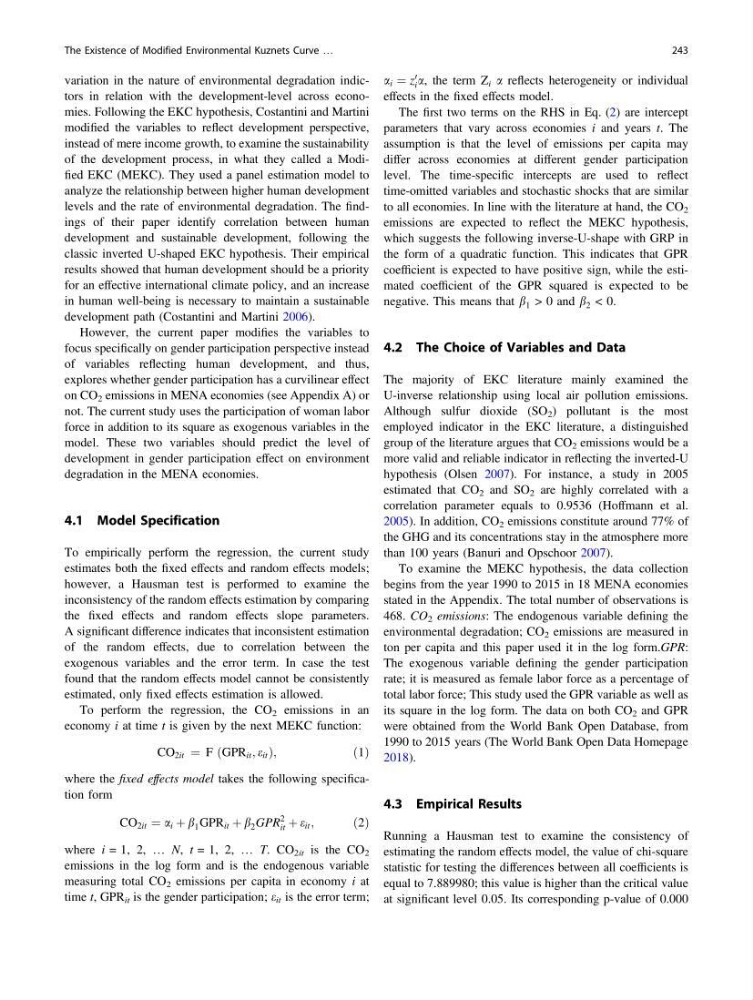
CO 2it ¼ F ðGPR it ; e it Þ;
ð1Þ
where the fixed effects model takes the following specification form
CO 2it ¼ a i þ b 1 GPR it þ b 2 GPR
2
it þ e it ;
ð2Þ
where i = 1, 2, … N, t = 1, 2, … T. CO 2it is the CO 2
emissions in the log form and is the endogenous variable
measuring total CO 2 emissions per capita in economy i at
time t, GPR it is the gender participation; e it is the error term;
a i ¼ z
0
i a, the term Z i a reflects heterogeneity or individual
effects in the fixed effects model.
The first two terms on the RHS in Eq. (2) are intercept
parameters that vary across economies i and years t. The
assumption is that the level of emissions per capita may
differ across economies at different gender participation
level. The time-specific intercepts are used to reflect
time-omitted variables and stochastic shocks that are similar
to all economies. In line with the literature at hand, the CO 2
emissions are expected to reflect the MEKC hypothesis,
which suggests the following inverse-U-shape with GRP in
the form of a quadratic function. This indicates that GPR
coefficient is expected to have positive sign, while the estimated coefficient of the GPR squared is expected to be
negative. This means that b 1 > 0 and b 2 < 0.
4.2 The Choice of Variables and Data
The majority of EKC literature mainly examined the
U-inverse relationship using local air pollution emissions.
Although sulfur dioxide (SO 2 ) pollutant is the most
employed indicator in the EKC literature, a distinguished
group of the literature argues that CO 2 emissions would be a
more valid and reliable indicator in reflecting the inverted-U
hypothesis (Olsen 2007). For instance, a study in 2005
estimated that CO 2 and SO 2 are highly correlated with a
correlation parameter equals to 0.9536 (Hoffmann et al.
2005). In addition, CO 2 emissions constitute around 77% of
the GHG and its concentrations stay in the atmosphere more
than 100 years (Banuri and Opschoor 2007).
To examine the MEKC hypothesis, the data collection
begins from the year 1990 to 2015 in 18 MENA economies
stated in the Appendix. The total number of observations is
468. CO 2 emissions: The endogenous variable defining the
environmental degradation; CO 2 emissions are measured in
ton per capita and this paper used it in the log form.GPR:
The exogenous variable defining the gender participation
rate; it is measured as female labor force as a percentage of
total labor force; This study used the GPR variable as well as
its square in the log form. The data on both CO 2 and GPR
were obtained from the World Bank Open Database, from
1990 to 2015 years (The World Bank Open Data Homepage
2018).
4.3 Empirical Results
Running a Hausman test to examine the consistency of
estimating the random effects model, the value of chi-square
statistic for testing the differences between all coefficients is
equal to 7.889980; this value is higher than the critical value
at significant level 0.05. Its corresponding p-value of 0.000
The Existence of Modified Environmental Kuznets Curve …
243
modified the variables to reflect development perspective,
instead of mere income growth, to examine the sustainability
of the development process, in what they called a Modified EKC (MEKC). They used a panel estimation model to
analyze the relationship between higher human development
levels and the rate of environmental degradation. The findings of their paper identify correlation between human
development and sustainable development, following the
classic inverted U-shaped EKC hypothesis. Their empirical
results showed that human development should be a priority
for an effective international climate policy, and an increase
in human well-being is necessary to maintain a sustainable
development path (Costantini and Martini 2006).
However, the current paper modifies the variables to
focus specifically on gender participation perspective instead
of variables reflecting human development, and thus,
explores whether gender participation has a curvilinear effect
on CO 2 emissions in MENA economies (see Appendix A) or
not. The current study uses the participation of woman labor
force in addition to its square as exogenous variables in the
model. These two variables should predict the level of
development in gender participation effect on environment
degradation in the MENA economies.
4.1 Model Specification
To empirically perform the regression, the current study
estimates both the fixed effects and random effects models;
however, a Hausman test is performed to examine the
inconsistency of the random effects estimation by comparing
the fixed effects and random effects slope parameters.
A significant difference indicates that inconsistent estimation
of the random effects, due to correlation between the
exogenous variables and the error term. In case the test
found that the random effects model cannot be consistently
estimated, only fixed effects estimation is allowed.
To perform the regression, the CO 2 emissions in an
economy i at time t is given by the next MEKC function:
CO 2it ¼ F ðGPR it ; e it Þ;
ð1Þ
where the fixed effects model takes the following specification form
CO 2it ¼ a i þ b 1 GPR it þ b 2 GPR
2
it þ e it ;
ð2Þ
where i = 1, 2, … N, t = 1, 2, … T. CO 2it is the CO 2
emissions in the log form and is the endogenous variable
measuring total CO 2 emissions per capita in economy i at
time t, GPR it is the gender participation; e it is the error term;
a i ¼ z
0
i a, the term Z i a reflects heterogeneity or individual
effects in the fixed effects model.
The first two terms on the RHS in Eq. (2) are intercept
parameters that vary across economies i and years t. The
assumption is that the level of emissions per capita may
differ across economies at different gender participation
level. The time-specific intercepts are used to reflect
time-omitted variables and stochastic shocks that are similar
to all economies. In line with the literature at hand, the CO 2
emissions are expected to reflect the MEKC hypothesis,
which suggests the following inverse-U-shape with GRP in
the form of a quadratic function. This indicates that GPR
coefficient is expected to have positive sign, while the estimated coefficient of the GPR squared is expected to be
negative. This means that b 1 > 0 and b 2 < 0.
4.2 The Choice of Variables and Data
The majority of EKC literature mainly examined the
U-inverse relationship using local air pollution emissions.
Although sulfur dioxide (SO 2 ) pollutant is the most
employed indicator in the EKC literature, a distinguished
group of the literature argues that CO 2 emissions would be a
more valid and reliable indicator in reflecting the inverted-U
hypothesis (Olsen 2007). For instance, a study in 2005
estimated that CO 2 and SO 2 are highly correlated with a
correlation parameter equals to 0.9536 (Hoffmann et al.
2005). In addition, CO 2 emissions constitute around 77% of
the GHG and its concentrations stay in the atmosphere more
than 100 years (Banuri and Opschoor 2007).
To examine the MEKC hypothesis, the data collection
begins from the year 1990 to 2015 in 18 MENA economies
stated in the Appendix. The total number of observations is
468. CO 2 emissions: The endogenous variable defining the
environmental degradation; CO 2 emissions are measured in
ton per capita and this paper used it in the log form.GPR:
The exogenous variable defining the gender participation
rate; it is measured as female labor force as a percentage of
total labor force; This study used the GPR variable as well as
its square in the log form. The data on both CO 2 and GPR
were obtained from the World Bank Open Database, from
1990 to 2015 years (The World Bank Open Data Homepage
2018).
4.3 Empirical Results
Running a Hausman test to examine the consistency of
estimating the random effects model, the value of chi-square
statistic for testing the differences between all coefficients is
equal to 7.889980; this value is higher than the critical value
at significant level 0.05. Its corresponding p-value of 0.000
The Existence of Modified Environmental Kuznets Curve …
243