

ample time for the results to be fully captured by the market.
This research hinges on the fact that the anticipated results
prior to the referendum were that the UK would vote to
remain as part of the EU. Normal returns for our model will,
therefore, be estimated and will proxy actual results if the
event had not occurred. The normal results will be estimated
for the estimation period prior to the event window, which
will cover 180 days. A post-event window of 180 days will
also be examined to see whether the referendum had any
long-term effects.
3.2 The Data
The data series used for the event study are exchange rates,
obtained from the Reuters electronic trading platform at
daily intervals for the period being observed. The exchange
rates being observed is the Euro index in comparison to the
GBP index.
3.2.1 Measuring the results
This research employs both the market and the constant
mean approach to estimate normal returns.
The constant mean approach model is a simple model
with a major underlying assumption that asset’s returns can
differ across companies, yet, they will remain constant for
the same company over a given period. This research will
mirror the effects, which are expected from stock returns
using the GBPX as the asset of interest. The market model
concept is that normal returns can be defined as the returns
that are expected if the event had not taken place.
As currencies are primarily not listed as indices, obtaining
beta values for any given currency at a given point in time
can be challenging. Similar to a simple single factor
regression model, this study will treat the currency exchange
returns as stock returns, which will be observed in relation to
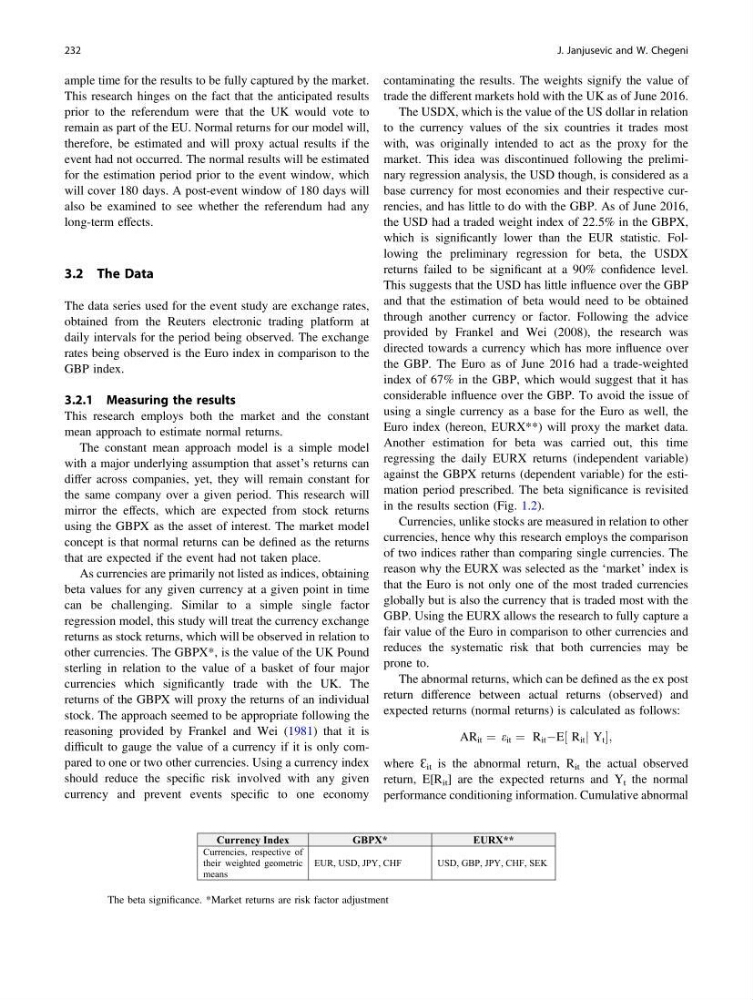
other currencies. The GBPX*, is the value of the UK Pound
sterling in relation to the value of a basket of four major
currencies which significantly trade with the UK. The
returns of the GBPX will proxy the returns of an individual
stock. The approach seemed to be appropriate following the
reasoning provided by Frankel and Wei (1981) that it is
difficult to gauge the value of a currency if it is only compared to one or two other currencies. Using a currency index
should reduce the specific risk involved with any given
currency and prevent events specific to one economy
contaminating the results. The weights signify the value of
trade the different markets hold with the UK as of June 2016.
The USDX, which is the value of the US dollar in relation
to the currency values of the six countries it trades most
with, was originally intended to act as the proxy for the
market. This idea was discontinued following the preliminary regression analysis, the USD though, is considered as a
base currency for most economies and their respective currencies, and has little to do with the GBP. As of June 2016,
the USD had a traded weight index of 22.5% in the GBPX,
which is significantly lower than the EUR statistic. Following the preliminary regression for beta, the USDX
returns failed to be significant at a 90% confidence level.
This suggests that the USD has little influence over the GBP
and that the estimation of beta would need to be obtained
through another currency or factor. Following the advice
provided by Frankel and Wei (2008), the research was
directed towards a currency which has more influence over
the GBP. The Euro as of June 2016 had a trade-weighted
index of 67% in the GBP, which would suggest that it has
considerable influence over the GBP. To avoid the issue of
using a single currency as a base for the Euro as well, the
Euro index (hereon, EURX**) will proxy the market data.
Another estimation for beta was carried out, this time
regressing the daily EURX returns (independent variable)
against the GBPX returns (dependent variable) for the estimation period prescribed. The beta significance is revisited
in the results section (Fig. 1.2).
Currencies, unlike stocks are measured in relation to other
currencies, hence why this research employs the comparison
of two indices rather than comparing single currencies. The
reason why the EURX was selected as the ‘market’ index is
that the Euro is not only one of the most traded currencies
globally but is also the currency that is traded most with the
GBP. Using the EURX allows the research to fully capture a
fair value of the Euro in comparison to other currencies and
reduces the systematic risk that both currencies may be
prone to.
The abnormal returns, which can be defined as the ex post
return difference between actual returns (observed) and
expected returns (normal returns) is calculated as follows:
AR it ¼ e it ¼ R it ÀE R it j Y t
½
;
where Ɛ it is the abnormal return, R it the actual observed
return, E[R it ] are the expected returns and Y t the normal
performance conditioning information. Cumulative abnormal
Currency Index
GBPX*
EURX**
Currencies, respective of
their weighted geometric
means
EUR, USD, JPY, CHF
USD, GBP, JPY, CHF, SEK
Fig. 1.2 The beta significance. *Market returns are risk factor adjustment
232
J. Janjusevic and W. Chegeni
This research hinges on the fact that the anticipated results
prior to the referendum were that the UK would vote to
remain as part of the EU. Normal returns for our model will,
therefore, be estimated and will proxy actual results if the
event had not occurred. The normal results will be estimated
for the estimation period prior to the event window, which
will cover 180 days. A post-event window of 180 days will
also be examined to see whether the referendum had any
long-term effects.
3.2 The Data
The data series used for the event study are exchange rates,
obtained from the Reuters electronic trading platform at
daily intervals for the period being observed. The exchange
rates being observed is the Euro index in comparison to the
GBP index.
3.2.1 Measuring the results
This research employs both the market and the constant
mean approach to estimate normal returns.
The constant mean approach model is a simple model
with a major underlying assumption that asset’s returns can
differ across companies, yet, they will remain constant for
the same company over a given period. This research will
mirror the effects, which are expected from stock returns
using the GBPX as the asset of interest. The market model
concept is that normal returns can be defined as the returns
that are expected if the event had not taken place.
As currencies are primarily not listed as indices, obtaining
beta values for any given currency at a given point in time
can be challenging. Similar to a simple single factor
regression model, this study will treat the currency exchange
returns as stock returns, which will be observed in relation to
other currencies. The GBPX*, is the value of the UK Pound
sterling in relation to the value of a basket of four major
currencies which significantly trade with the UK. The
returns of the GBPX will proxy the returns of an individual
stock. The approach seemed to be appropriate following the
reasoning provided by Frankel and Wei (1981) that it is
difficult to gauge the value of a currency if it is only compared to one or two other currencies. Using a currency index
should reduce the specific risk involved with any given
currency and prevent events specific to one economy
contaminating the results. The weights signify the value of
trade the different markets hold with the UK as of June 2016.
The USDX, which is the value of the US dollar in relation
to the currency values of the six countries it trades most
with, was originally intended to act as the proxy for the
market. This idea was discontinued following the preliminary regression analysis, the USD though, is considered as a
base currency for most economies and their respective currencies, and has little to do with the GBP. As of June 2016,
the USD had a traded weight index of 22.5% in the GBPX,
which is significantly lower than the EUR statistic. Following the preliminary regression for beta, the USDX
returns failed to be significant at a 90% confidence level.
This suggests that the USD has little influence over the GBP
and that the estimation of beta would need to be obtained
through another currency or factor. Following the advice
provided by Frankel and Wei (2008), the research was
directed towards a currency which has more influence over
the GBP. The Euro as of June 2016 had a trade-weighted
index of 67% in the GBP, which would suggest that it has
considerable influence over the GBP. To avoid the issue of
using a single currency as a base for the Euro as well, the
Euro index (hereon, EURX**) will proxy the market data.
Another estimation for beta was carried out, this time
regressing the daily EURX returns (independent variable)
against the GBPX returns (dependent variable) for the estimation period prescribed. The beta significance is revisited
in the results section (Fig. 1.2).
Currencies, unlike stocks are measured in relation to other
currencies, hence why this research employs the comparison
of two indices rather than comparing single currencies. The
reason why the EURX was selected as the ‘market’ index is
that the Euro is not only one of the most traded currencies
globally but is also the currency that is traded most with the
GBP. Using the EURX allows the research to fully capture a
fair value of the Euro in comparison to other currencies and
reduces the systematic risk that both currencies may be
prone to.
The abnormal returns, which can be defined as the ex post
return difference between actual returns (observed) and
expected returns (normal returns) is calculated as follows:
AR it ¼ e it ¼ R it ÀE R it j Y t
½
;
where Ɛ it is the abnormal return, R it the actual observed
return, E[R it ] are the expected returns and Y t the normal
performance conditioning information. Cumulative abnormal
Currency Index
GBPX*
EURX**
Currencies, respective of
their weighted geometric
means
EUR, USD, JPY, CHF
USD, GBP, JPY, CHF, SEK
Fig. 1.2 The beta significance. *Market returns are risk factor adjustment
232
J. Janjusevic and W. Chegeni