

applied, simple returns or continuously compounded returns.
Though continuously compounded returns are generally
regarded to be better suited at satisfying the requirements of
normality assumptions when regressing data, this research
has opted to use simple returns. A study by Warner and
Brown (1980) pointed out the similarity of the two different
models. Despite a recommendation from Fama (Fama 1970)
for using continuously compounded returns, Warner and
Brown (1980) ignored the form of returns in their event
studies, which would suggest that the method applied to
calculating returns has little bearing on the actual results of
an event study.
The other issue when conducting an event study is
eliminating the contagion of other events in an event window of interest. Other events may affect the results of the
event study but also affect the ability of successfully measuring the abnormal returns obtained from the study. This
research has taken this into consideration that a shorter event
window has a lower probability of being contaminated by
other events. Warner and Brown (1980) confirm that there is
a higher chance for a research to control the confusing
events in a short window. Another check is scanning the
event dates for any news that may have considerable bearing
on the event and possibly the results.
As mentioned in the literature review, the researcher
should be aware of the lack of significance, if any in their
observations, this will allow for better research quality.
Other biases that may hinder the research need to be considered, especially when one is conducting an event study.
Trading data such as exchange rates can be subject to bias,
such as the time in which trading ‘closing’ prices are
recorded. One would assume that this data is evenly spread
out, but generally, the closing price is the price at which the
last transaction occurred. Moreover, another bias which
needs to be addressed is the use of daily data rather than data
at shorter intervals. To fully capture the instantaneous results
of the market’s reaction to an event, shorter intervals would
perform better. However, this research fails to eliminate this
bias due to the limitations with the data, which is available,
thus closing prices will be used to conduct this event study.
Robustness concerns with this research are an important
element, which is further addressed in the robustness testing
section.
3 Methodology
Initially, two methodological approaches were considered.
The first method is based on the fundamental time-series
analysis and the second involves engaging an event-study
approach. The latter is the favoured approach as it reduces
the complexity of the analysis by distinguishing whether the
event had a positive or negative effect on the exchange rate.
This reduction in dimensionality objectively enhances the
ability to measure the effectiveness of an event. Moreover,
the event-study method eliminates the ‘noise’ element that
affects the accuracy of time-series estimates.
It is important that the analysis highlights any key events
during our event window other than the Brexit referendum
that may have affected the exchange rates. To satiate the
notion that the Brexit referendum had a long-lasting effect on
the exchange rate, it is important that any ‘noise’ be
accounted for in the analysis. The event study methodology
will be employed to measure abnormal performance during
the event window. This will be achieved through the computation of abnormal and normal returns, which are used to
measure the impact of the event on the GBP’s exchange rate.
3.1 Defining the Event
The definition and duration of the event window are pivotal
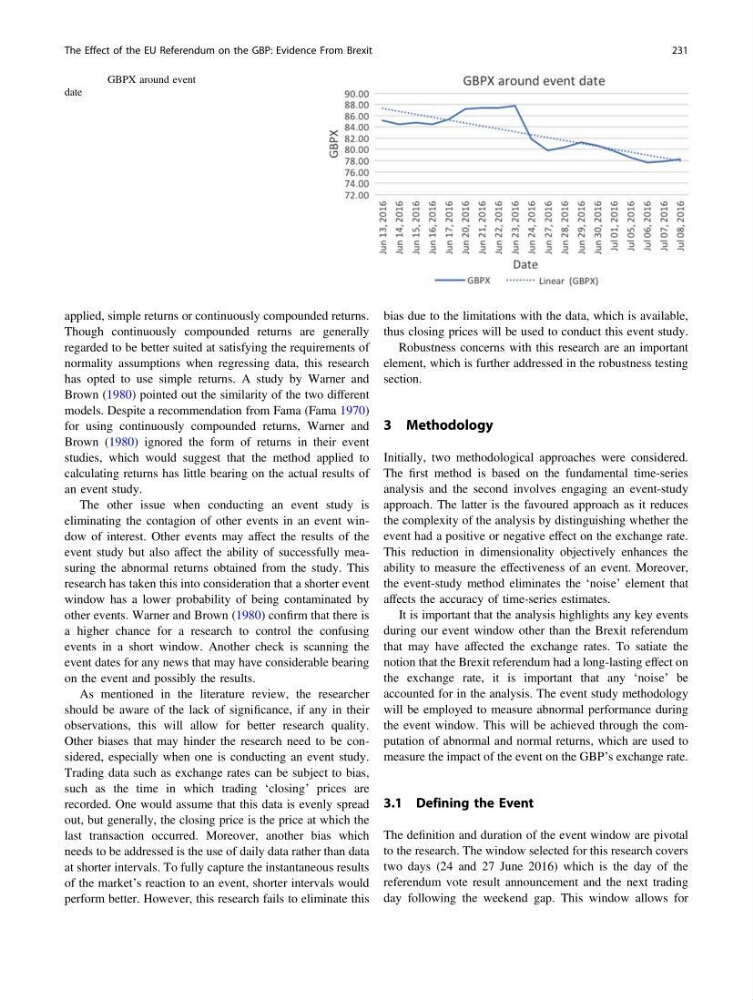
to the research. The window selected for this research covers
two days (24 and 27 June 2016) which is the day of the
referendum vote result announcement and the next trading
day following the weekend gap. This window allows for
Fig. 1.1 GBPX around event
date
The Effect of the EU Referendum on the GBP: Evidence From Brexit
231
Though continuously compounded returns are generally
regarded to be better suited at satisfying the requirements of
normality assumptions when regressing data, this research
has opted to use simple returns. A study by Warner and
Brown (1980) pointed out the similarity of the two different
models. Despite a recommendation from Fama (Fama 1970)
for using continuously compounded returns, Warner and
Brown (1980) ignored the form of returns in their event
studies, which would suggest that the method applied to
calculating returns has little bearing on the actual results of
an event study.
The other issue when conducting an event study is
eliminating the contagion of other events in an event window of interest. Other events may affect the results of the
event study but also affect the ability of successfully measuring the abnormal returns obtained from the study. This
research has taken this into consideration that a shorter event
window has a lower probability of being contaminated by
other events. Warner and Brown (1980) confirm that there is
a higher chance for a research to control the confusing
events in a short window. Another check is scanning the
event dates for any news that may have considerable bearing
on the event and possibly the results.
As mentioned in the literature review, the researcher
should be aware of the lack of significance, if any in their
observations, this will allow for better research quality.
Other biases that may hinder the research need to be considered, especially when one is conducting an event study.
Trading data such as exchange rates can be subject to bias,
such as the time in which trading ‘closing’ prices are
recorded. One would assume that this data is evenly spread
out, but generally, the closing price is the price at which the
last transaction occurred. Moreover, another bias which
needs to be addressed is the use of daily data rather than data
at shorter intervals. To fully capture the instantaneous results
of the market’s reaction to an event, shorter intervals would
perform better. However, this research fails to eliminate this
bias due to the limitations with the data, which is available,
thus closing prices will be used to conduct this event study.
Robustness concerns with this research are an important
element, which is further addressed in the robustness testing
section.
3 Methodology
Initially, two methodological approaches were considered.
The first method is based on the fundamental time-series
analysis and the second involves engaging an event-study
approach. The latter is the favoured approach as it reduces
the complexity of the analysis by distinguishing whether the
event had a positive or negative effect on the exchange rate.
This reduction in dimensionality objectively enhances the
ability to measure the effectiveness of an event. Moreover,
the event-study method eliminates the ‘noise’ element that
affects the accuracy of time-series estimates.
It is important that the analysis highlights any key events
during our event window other than the Brexit referendum
that may have affected the exchange rates. To satiate the
notion that the Brexit referendum had a long-lasting effect on
the exchange rate, it is important that any ‘noise’ be
accounted for in the analysis. The event study methodology
will be employed to measure abnormal performance during
the event window. This will be achieved through the computation of abnormal and normal returns, which are used to
measure the impact of the event on the GBP’s exchange rate.
3.1 Defining the Event
The definition and duration of the event window are pivotal
to the research. The window selected for this research covers
two days (24 and 27 June 2016) which is the day of the
referendum vote result announcement and the next trading
day following the weekend gap. This window allows for
Fig. 1.1 GBPX around event
date
The Effect of the EU Referendum on the GBP: Evidence From Brexit
231