

effects of concrete such as shrinkage and creep (ACI
209.2R-08 2008). This will help in reducing the deflection
and make the effect of the observed reduction in the elastic
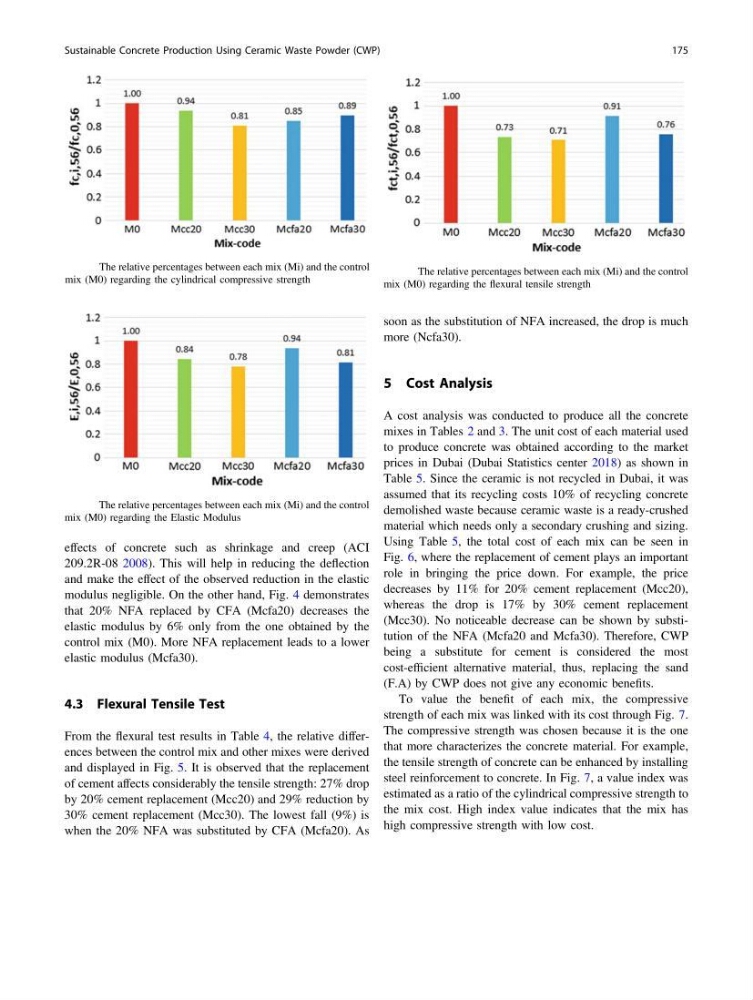
modulus negligible. On the other hand, Fig. 4 demonstrates
that 20% NFA replaced by CFA (Mcfa20) decreases the
elastic modulus by 6% only from the one obtained by the
control mix (M0). More NFA replacement leads to a lower
elastic modulus (Mcfa30).
4.3 Flexural Tensile Test
From the flexural test results in Table 4, the relative differences between the control mix and other mixes were derived
and displayed in Fig. 5. It is observed that the replacement
of cement affects considerably the tensile strength: 27% drop
by 20% cement replacement (Mcc20) and 29% reduction by
30% cement replacement (Mcc30). The lowest fall (9%) is
when the 20% NFA was substituted by CFA (Mcfa20). As
soon as the substitution of NFA increased, the drop is much
more (Ncfa30).
5 Cost Analysis
A cost analysis was conducted to produce all the concrete
mixes in Tables 2 and 3. The unit cost of each material used
to produce concrete was obtained according to the market
prices in Dubai (Dubai Statistics center 2018) as shown in
Table 5. Since the ceramic is not recycled in Dubai, it was
assumed that its recycling costs 10% of recycling concrete
demolished waste because ceramic waste is a ready-crushed
material which needs only a secondary crushing and sizing.
Using Table 5, the total cost of each mix can be seen in
Fig. 6, where the replacement of cement plays an important
role in bringing the price down. For example, the price
decreases by 11% for 20% cement replacement (Mcc20),
whereas the drop is 17% by 30% cement replacement
(Mcc30). No noticeable decrease can be shown by substitution of the NFA (Mcfa20 and Mcfa30). Therefore, CWP
being a substitute for cement is considered the most
cost-efficient alternative material, thus, replacing the sand
(F.A) by CWP does not give any economic benefits.
To value the benefit of each mix, the compressive
strength of each mix was linked with its cost through Fig. 7.
The compressive strength was chosen because it is the one
that more characterizes the concrete material. For example,
the tensile strength of concrete can be enhanced by installing
steel reinforcement to concrete. In Fig. 7, a value index was
estimated as a ratio of the cylindrical compressive strength to
the mix cost. High index value indicates that the mix has
high compressive strength with low cost.
Fig. 3 The relative percentages between each mix (Mi) and the control
mix (M0) regarding the cylindrical compressive strength
Fig. 4 The relative percentages between each mix (Mi) and the control
mix (M0) regarding the Elastic Modulus
Fig. 5 The relative percentages between each mix (Mi) and the control
mix (M0) regarding the flexural tensile strength
Sustainable Concrete Production Using Ceramic Waste Powder (CWP)
175
209.2R-08 2008). This will help in reducing the deflection
and make the effect of the observed reduction in the elastic
modulus negligible. On the other hand, Fig. 4 demonstrates
that 20% NFA replaced by CFA (Mcfa20) decreases the
elastic modulus by 6% only from the one obtained by the
control mix (M0). More NFA replacement leads to a lower
elastic modulus (Mcfa30).
4.3 Flexural Tensile Test
From the flexural test results in Table 4, the relative differences between the control mix and other mixes were derived
and displayed in Fig. 5. It is observed that the replacement
of cement affects considerably the tensile strength: 27% drop
by 20% cement replacement (Mcc20) and 29% reduction by
30% cement replacement (Mcc30). The lowest fall (9%) is
when the 20% NFA was substituted by CFA (Mcfa20). As
soon as the substitution of NFA increased, the drop is much
more (Ncfa30).
5 Cost Analysis
A cost analysis was conducted to produce all the concrete
mixes in Tables 2 and 3. The unit cost of each material used
to produce concrete was obtained according to the market
prices in Dubai (Dubai Statistics center 2018) as shown in
Table 5. Since the ceramic is not recycled in Dubai, it was
assumed that its recycling costs 10% of recycling concrete
demolished waste because ceramic waste is a ready-crushed
material which needs only a secondary crushing and sizing.
Using Table 5, the total cost of each mix can be seen in
Fig. 6, where the replacement of cement plays an important
role in bringing the price down. For example, the price
decreases by 11% for 20% cement replacement (Mcc20),
whereas the drop is 17% by 30% cement replacement
(Mcc30). No noticeable decrease can be shown by substitution of the NFA (Mcfa20 and Mcfa30). Therefore, CWP
being a substitute for cement is considered the most
cost-efficient alternative material, thus, replacing the sand
(F.A) by CWP does not give any economic benefits.
To value the benefit of each mix, the compressive
strength of each mix was linked with its cost through Fig. 7.
The compressive strength was chosen because it is the one
that more characterizes the concrete material. For example,
the tensile strength of concrete can be enhanced by installing
steel reinforcement to concrete. In Fig. 7, a value index was
estimated as a ratio of the cylindrical compressive strength to
the mix cost. High index value indicates that the mix has
high compressive strength with low cost.
Fig. 3 The relative percentages between each mix (Mi) and the control
mix (M0) regarding the cylindrical compressive strength
Fig. 4 The relative percentages between each mix (Mi) and the control
mix (M0) regarding the Elastic Modulus
Fig. 5 The relative percentages between each mix (Mi) and the control
mix (M0) regarding the flexural tensile strength
Sustainable Concrete Production Using Ceramic Waste Powder (CWP)
175