

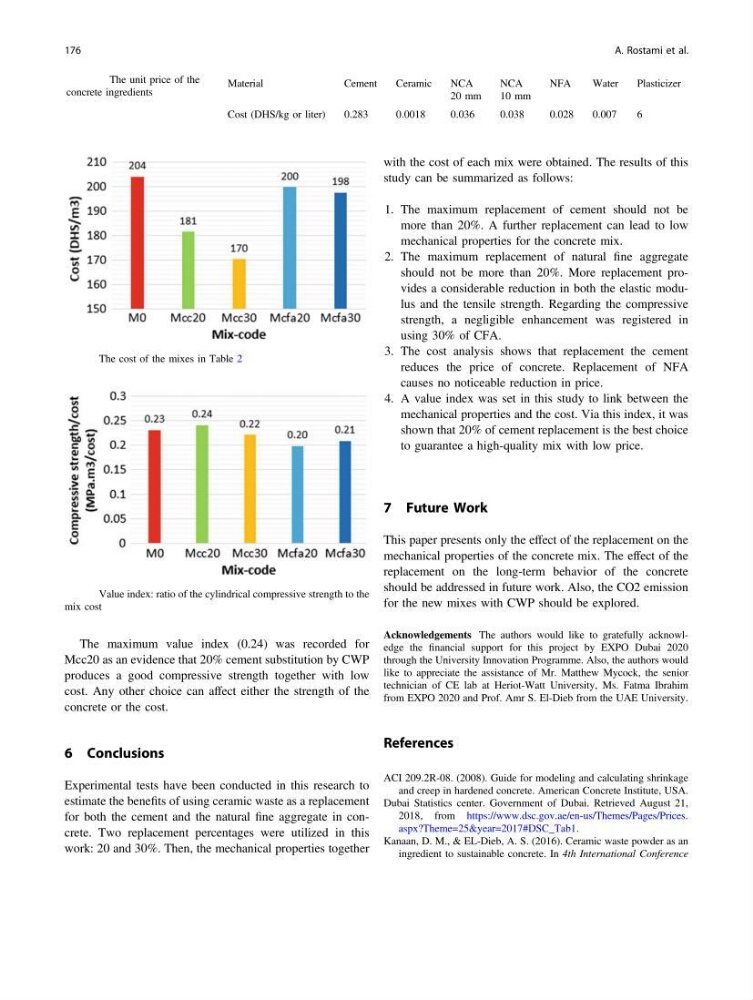
The maximum value index (0.24) was recorded for
Mcc20 as an evidence that 20% cement substitution by CWP
produces a good compressive strength together with low
cost. Any other choice can affect either the strength of the
concrete or the cost.
6 Conclusions
Experimental tests have been conducted in this research to
estimate the benefits of using ceramic waste as a replacement
for both the cement and the natural fine aggregate in concrete. Two replacement percentages were utilized in this
work: 20 and 30%. Then, the mechanical properties together
with the cost of each mix were obtained. The results of this
study can be summarized as follows:
1. The maximum replacement of cement should not be
more than 20%. A further replacement can lead to low
mechanical properties for the concrete mix.
2. The maximum replacement of natural fine aggregate
should not be more than 20%. More replacement provides a considerable reduction in both the elastic modulus and the tensile strength. Regarding the compressive
strength, a negligible enhancement was registered in
using 30% of CFA.
3. The cost analysis shows that replacement the cement
reduces the price of concrete. Replacement of NFA
causes no noticeable reduction in price.
4. A value index was set in this study to link between the
mechanical properties and the cost. Via this index, it was
shown that 20% of cement replacement is the best choice
to guarantee a high-quality mix with low price.
7 Future Work
This paper presents only the effect of the replacement on the
mechanical properties of the concrete mix. The effect of the
replacement on the long-term behavior of the concrete
should be addressed in future work. Also, the CO2 emission
for the new mixes with CWP should be explored.
Acknowledgements The authors would like to gratefully acknowledge the financial support for this project by EXPO Dubai 2020
through the University Innovation Programme. Also, the authors would
like to appreciate the assistance of Mr. Matthew Mycock, the senior
technician of CE lab at Heriot-Watt University, Ms. Fatma Ibrahim
from EXPO 2020 and Prof. Amr S. El-Dieb from the UAE University.
References
ACI 209.2R-08. (2008). Guide for modeling and calculating shrinkage
and creep in hardened concrete. American Concrete Institute, USA.
Dubai Statistics center. Government of Dubai. Retrieved August 21,
2018, from https://www.dsc.gov.ae/en-us/Themes/Pages/Prices.
aspx?Theme=25&year=2017#DSC_Tab1.
Kanaan, D. M., & EL-Dieb, A. S. (2016). Ceramic waste powder as an
ingredient to sustainable concrete. In 4th International Conference
Table 5 The unit price of the
concrete ingredients
Material
Cement
Ceramic
NCA
20 mm
NCA
10 mm
NFA
Water
Plasticizer
Cost (DHS/kg or liter)
0.283
0.0018
0.036
0.038
0.028
0.007
6
Fig. 6 The cost of the mixes in Table 2
Fig. 7 Value index: ratio of the cylindrical compressive strength to the
mix cost
176
A. Rostami et al.
Mcc20 as an evidence that 20% cement substitution by CWP
produces a good compressive strength together with low
cost. Any other choice can affect either the strength of the
concrete or the cost.
6 Conclusions
Experimental tests have been conducted in this research to
estimate the benefits of using ceramic waste as a replacement
for both the cement and the natural fine aggregate in concrete. Two replacement percentages were utilized in this
work: 20 and 30%. Then, the mechanical properties together
with the cost of each mix were obtained. The results of this
study can be summarized as follows:
1. The maximum replacement of cement should not be
more than 20%. A further replacement can lead to low
mechanical properties for the concrete mix.
2. The maximum replacement of natural fine aggregate
should not be more than 20%. More replacement provides a considerable reduction in both the elastic modulus and the tensile strength. Regarding the compressive
strength, a negligible enhancement was registered in
using 30% of CFA.
3. The cost analysis shows that replacement the cement
reduces the price of concrete. Replacement of NFA
causes no noticeable reduction in price.
4. A value index was set in this study to link between the
mechanical properties and the cost. Via this index, it was
shown that 20% of cement replacement is the best choice
to guarantee a high-quality mix with low price.
7 Future Work
This paper presents only the effect of the replacement on the
mechanical properties of the concrete mix. The effect of the
replacement on the long-term behavior of the concrete
should be addressed in future work. Also, the CO2 emission
for the new mixes with CWP should be explored.
Acknowledgements The authors would like to gratefully acknowledge the financial support for this project by EXPO Dubai 2020
through the University Innovation Programme. Also, the authors would
like to appreciate the assistance of Mr. Matthew Mycock, the senior
technician of CE lab at Heriot-Watt University, Ms. Fatma Ibrahim
from EXPO 2020 and Prof. Amr S. El-Dieb from the UAE University.
References
ACI 209.2R-08. (2008). Guide for modeling and calculating shrinkage
and creep in hardened concrete. American Concrete Institute, USA.
Dubai Statistics center. Government of Dubai. Retrieved August 21,
2018, from https://www.dsc.gov.ae/en-us/Themes/Pages/Prices.
aspx?Theme=25&year=2017#DSC_Tab1.
Kanaan, D. M., & EL-Dieb, A. S. (2016). Ceramic waste powder as an
ingredient to sustainable concrete. In 4th International Conference
Table 5 The unit price of the
concrete ingredients
Material
Cement
Ceramic
NCA
20 mm
NCA
10 mm
NFA
Water
Plasticizer
Cost (DHS/kg or liter)
0.283
0.0018
0.036
0.038
0.028
0.007
6
Fig. 6 The cost of the mixes in Table 2
Fig. 7 Value index: ratio of the cylindrical compressive strength to the
mix cost
176
A. Rostami et al.