

3.2 Rainfall Simulators with Thread Droppers or Needle Droppers
33
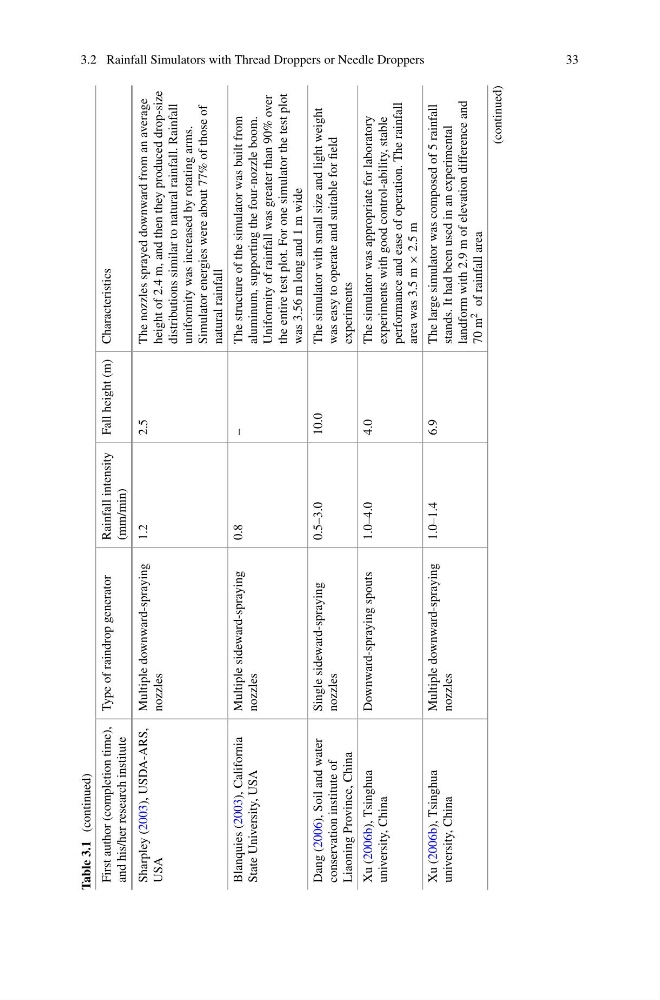
Table 3.1
(continued)
First author (completion time),
and his/her research institute
Type of raindrop generator
Rainfall intensity
(mm/min)
Fall height (m) Characteristics
Sharpley (2003), USDA-ARS,
USA
Multiple downward-spraying
nozzles
1.2
2.5
The nozzles sprayed downward from an average
height of 2.4 m, and then they produced drop-size
distributions similar to natural rainfall. Rainfall
uniformity was increased by rotating arms.
Simulator energies were about 77% of those of
natural rainfall
Blanquies (2003), California
State University, USA
Multiple sideward-spraying
nozzles
0.8
–
The structure of the simulator was built from
aluminum, supporting the four-nozzle boom.
Uniformity of rainfall was greater than 90% over
the entire test plot. For one simulator the test plot
was 3.56 m long and 1 m wide
Dang (2006), Soil and water
conservation institute of
Liaoning Province, China
Single sideward-spraying
nozzles
0.5–3.0
10.0
The simulator with small size and light weight
was easy to operate and suitable for field
experiments
Xu (2006b), Tsinghua
university, China
Downward-spraying spouts
1.0–4.0
4.0
The simulator was appropriate for laboratory
experiments with good control-ability, stable
performance and ease of operation. The rainfall
area was 3.5 m
× 2.5 m
Xu (2006b), Tsinghua
university, China
Multiple downward-spraying
nozzles
1.0–1.4
6.9
The large simulator was composed of 5 rainfall
stands. It had been used in an experimental
landform with 2.9 m of elevation difference and
70 m 2
of rainfall area
(continued)
33
Table 3.1
(continued)
First author (completion time),
and his/her research institute
Type of raindrop generator
Rainfall intensity
(mm/min)
Fall height (m) Characteristics
Sharpley (2003), USDA-ARS,
USA
Multiple downward-spraying
nozzles
1.2
2.5
The nozzles sprayed downward from an average
height of 2.4 m, and then they produced drop-size
distributions similar to natural rainfall. Rainfall
uniformity was increased by rotating arms.
Simulator energies were about 77% of those of
natural rainfall
Blanquies (2003), California
State University, USA
Multiple sideward-spraying
nozzles
0.8
–
The structure of the simulator was built from
aluminum, supporting the four-nozzle boom.
Uniformity of rainfall was greater than 90% over
the entire test plot. For one simulator the test plot
was 3.56 m long and 1 m wide
Dang (2006), Soil and water
conservation institute of
Liaoning Province, China
Single sideward-spraying
nozzles
0.5–3.0
10.0
The simulator with small size and light weight
was easy to operate and suitable for field
experiments
Xu (2006b), Tsinghua
university, China
Downward-spraying spouts
1.0–4.0
4.0
The simulator was appropriate for laboratory
experiments with good control-ability, stable
performance and ease of operation. The rainfall
area was 3.5 m
× 2.5 m
Xu (2006b), Tsinghua
university, China
Multiple downward-spraying
nozzles
1.0–1.4
6.9
The large simulator was composed of 5 rainfall
stands. It had been used in an experimental
landform with 2.9 m of elevation difference and
70 m 2
of rainfall area
(continued)