

32
3 A Conventional Experimental Technique …
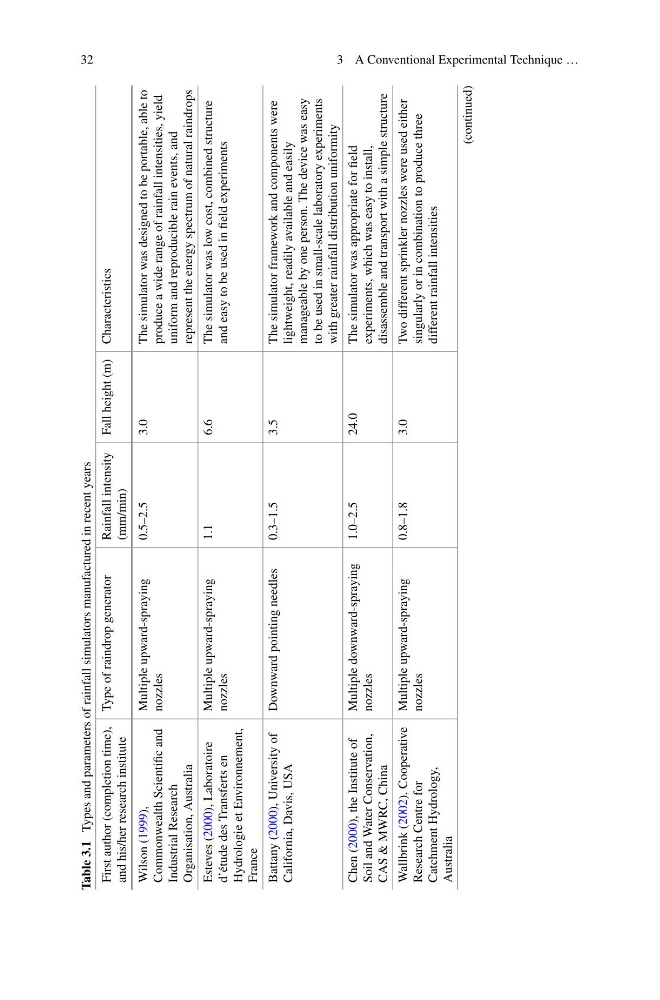
Table 3.1
Types and parameters of rainfall simulators manufactured in recent years
First author (completion time),
and his/her research institute
Type of raindrop generator
Rainfall intensity
(mm/min)
Fall height (m) Characteristics
Wilson (1999),
Commonwealth Scientific and
Industrial Research
Organisation, Australia
Multiple upward-spraying
nozzles
0.5–2.5
3.0
The simulator was designed to be portable, able to
produce a wide range of rainfall intensities, yield
uniform and reproducible rain events, and
represent the energy spectrum of natural raindrops
Esteves (2000), Laboratoire
d’étude des Transferts en
Hydrologie et Environnement,
France
Multiple upward-spraying
nozzles
1.1
6.6
The simulator was low cost, combined structure
and easy to be used in field experiments
Battany (2000), University of
California, Davis, USA
Downward pointing needles
0.3–1.5
3.5
The simulator framework and components were
lightweight, readily available and easily
manageable by one person. The device was easy
to be used in small-scale laboratory experiments
with greater rainfall distribution uniformity
Chen (2000), the Institute of
Soil and Water Conservation,
CAS & MWRC, China
Multiple downward-spraying
nozzles
1.0–2.5
24.0
The simulator was appropriate for field
experiments, which was easy to install,
disassemble and transport with a simple structure
Wallbrink (2002), Cooperative
Research Centre for
Catchment Hydrology,
Australia
Multiple upward-spraying
nozzles
0.8–1.8
3.0
Two different sprinkler nozzles were used either
singularly or in combination to produce three
different rainfall intensities
(continued)
3 A Conventional Experimental Technique …
Table 3.1
Types and parameters of rainfall simulators manufactured in recent years
First author (completion time),
and his/her research institute
Type of raindrop generator
Rainfall intensity
(mm/min)
Fall height (m) Characteristics
Wilson (1999),
Commonwealth Scientific and
Industrial Research
Organisation, Australia
Multiple upward-spraying
nozzles
0.5–2.5
3.0
The simulator was designed to be portable, able to
produce a wide range of rainfall intensities, yield
uniform and reproducible rain events, and
represent the energy spectrum of natural raindrops
Esteves (2000), Laboratoire
d’étude des Transferts en
Hydrologie et Environnement,
France
Multiple upward-spraying
nozzles
1.1
6.6
The simulator was low cost, combined structure
and easy to be used in field experiments
Battany (2000), University of
California, Davis, USA
Downward pointing needles
0.3–1.5
3.5
The simulator framework and components were
lightweight, readily available and easily
manageable by one person. The device was easy
to be used in small-scale laboratory experiments
with greater rainfall distribution uniformity
Chen (2000), the Institute of
Soil and Water Conservation,
CAS & MWRC, China
Multiple downward-spraying
nozzles
1.0–2.5
24.0
The simulator was appropriate for field
experiments, which was easy to install,
disassemble and transport with a simple structure
Wallbrink (2002), Cooperative
Research Centre for
Catchment Hydrology,
Australia
Multiple upward-spraying
nozzles
0.8–1.8
3.0
Two different sprinkler nozzles were used either
singularly or in combination to produce three
different rainfall intensities
(continued)