

162
10 A Sensitivity Analysis on the Gravity …
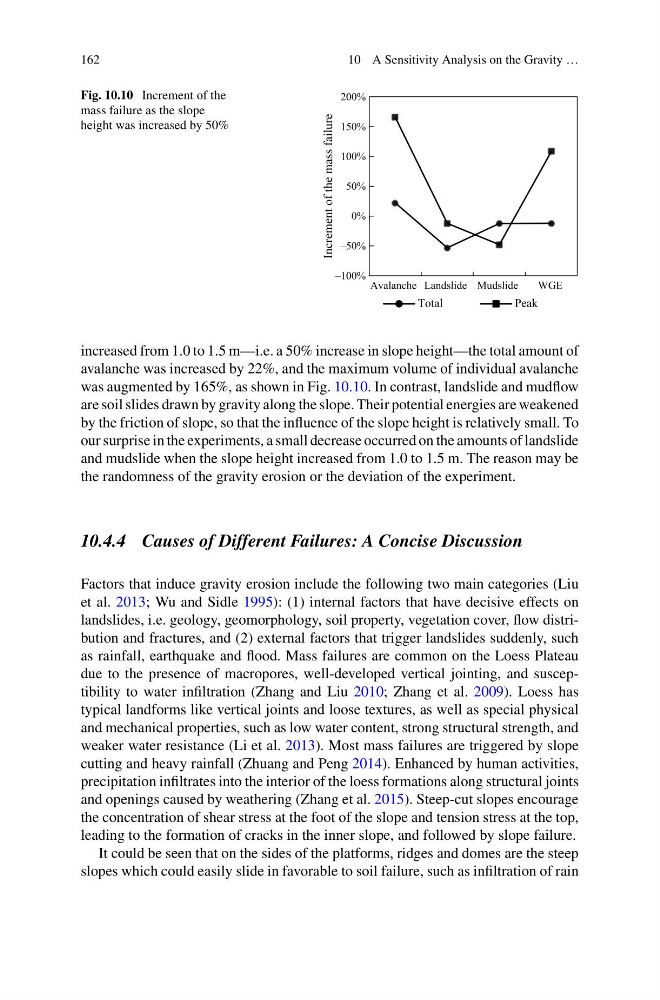
Fig. 10.10 Increment of the
mass failure as the slope
height was increased by 50%
–100%
–50%
0%
50%
100%
150%
200%
Avalanche Landslide Mudslide
WGE
Increment of the mass failure
Total
Peak
increased from 1.0 to 1.5 m—i.e. a 50% increase in slope height—the total amount of
avalanche was increased by 22%, and the maximum volume of individual avalanche
was augmented by 165%, as shown in Fig. 10.10. In contrast, landslide and mudflow
are soil slides drawn by gravity along the slope. Their potential energies are weakened
by the friction of slope, so that the influence of the slope height is relatively small. To
our surprise in the experiments, a small decrease occurred on the amounts of landslide
and mudslide when the slope height increased from 1.0 to 1.5 m. The reason may be
the randomness of the gravity erosion or the deviation of the experiment.
10.4.4 Causes of Different Failures: A Concise Discussion
Factors that induce gravity erosion include the following two main categories (Liu
et al. 2013; Wu and Sidle 1995): (1) internal factors that have decisive effects on
landslides, i.e. geology, geomorphology, soil property, vegetation cover, flow distribution and fractures, and (2) external factors that trigger landslides suddenly, such
as rainfall, earthquake and flood. Mass failures are common on the Loess Plateau
due to the presence of macropores, well-developed vertical jointing, and susceptibility to water infiltration (Zhang and Liu 2010; Zhang et al. 2009). Loess has
typical landforms like vertical joints and loose textures, as well as special physical
and mechanical properties, such as low water content, strong structural strength, and
weaker water resistance (Li et al. 2013). Most mass failures are triggered by slope
cutting and heavy rainfall (Zhuang and Peng 2014). Enhanced by human activities,
precipitation infiltrates into the interior of the loess formations along structural joints
and openings caused by weathering (Zhang et al. 2015). Steep-cut slopes encourage
the concentration of shear stress at the foot of the slope and tension stress at the top,
leading to the formation of cracks in the inner slope, and followed by slope failure.
It could be seen that on the sides of the platforms, ridges and domes are the steep
slopes which could easily slide in favorable to soil failure, such as infiltration of rain
10 A Sensitivity Analysis on the Gravity …
Fig. 10.10 Increment of the
mass failure as the slope
height was increased by 50%
–100%
–50%
0%
50%
100%
150%
200%
Avalanche Landslide Mudslide
WGE
Increment of the mass failure
Total
Peak
increased from 1.0 to 1.5 m—i.e. a 50% increase in slope height—the total amount of
avalanche was increased by 22%, and the maximum volume of individual avalanche
was augmented by 165%, as shown in Fig. 10.10. In contrast, landslide and mudflow
are soil slides drawn by gravity along the slope. Their potential energies are weakened
by the friction of slope, so that the influence of the slope height is relatively small. To
our surprise in the experiments, a small decrease occurred on the amounts of landslide
and mudslide when the slope height increased from 1.0 to 1.5 m. The reason may be
the randomness of the gravity erosion or the deviation of the experiment.
10.4.4 Causes of Different Failures: A Concise Discussion
Factors that induce gravity erosion include the following two main categories (Liu
et al. 2013; Wu and Sidle 1995): (1) internal factors that have decisive effects on
landslides, i.e. geology, geomorphology, soil property, vegetation cover, flow distribution and fractures, and (2) external factors that trigger landslides suddenly, such
as rainfall, earthquake and flood. Mass failures are common on the Loess Plateau
due to the presence of macropores, well-developed vertical jointing, and susceptibility to water infiltration (Zhang and Liu 2010; Zhang et al. 2009). Loess has
typical landforms like vertical joints and loose textures, as well as special physical
and mechanical properties, such as low water content, strong structural strength, and
weaker water resistance (Li et al. 2013). Most mass failures are triggered by slope
cutting and heavy rainfall (Zhuang and Peng 2014). Enhanced by human activities,
precipitation infiltrates into the interior of the loess formations along structural joints
and openings caused by weathering (Zhang et al. 2015). Steep-cut slopes encourage
the concentration of shear stress at the foot of the slope and tension stress at the top,
leading to the formation of cracks in the inner slope, and followed by slope failure.
It could be seen that on the sides of the platforms, ridges and domes are the steep
slopes which could easily slide in favorable to soil failure, such as infiltration of rain