

10.4 Results and Discussion
161
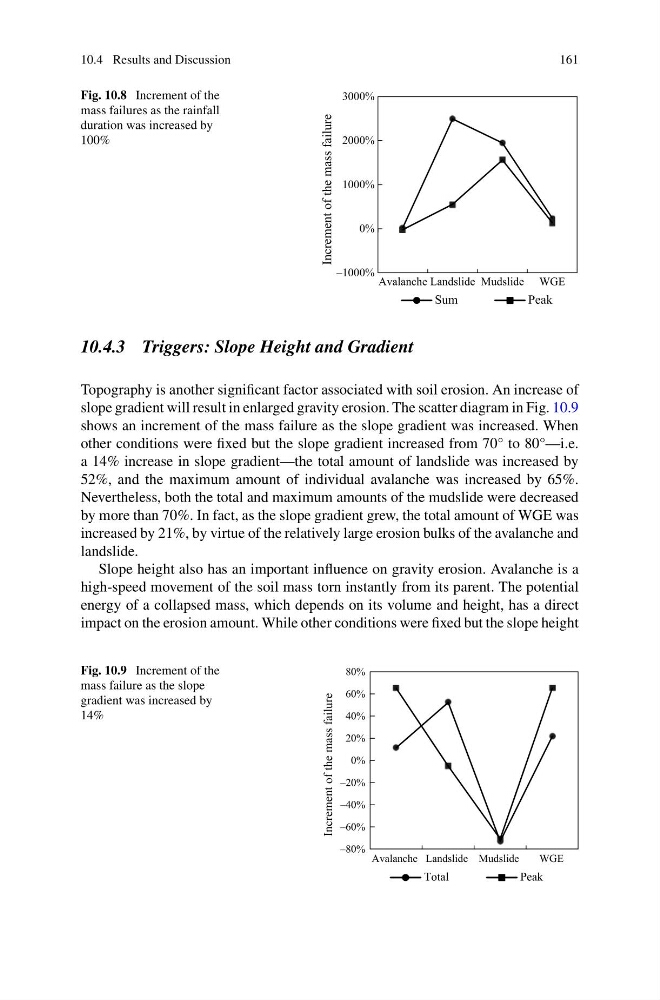
Fig. 10.8 Increment of the
mass failures as the rainfall
duration was increased by
100%
–1000%
0%
1000%
2000%
3000%
Avalanche Landslide Mudslide WGE
Increment of the mass failure
Sum
Peak
10.4.3 Triggers: Slope Height and Gradient
Topography is another significant factor associated with soil erosion. An increase of
slope gradient will result in enlarged gravity erosion. The scatter diagram in Fig. 10.9
shows an increment of the mass failure as the slope gradient was increased. When
other conditions were fixed but the slope gradient increased from 70° to 80°—i.e.
a 14% increase in slope gradient—the total amount of landslide was increased by
52%, and the maximum amount of individual avalanche was increased by 65%.
Nevertheless, both the total and maximum amounts of the mudslide were decreased
by more than 70%. In fact, as the slope gradient grew, the total amount of WGE was
increased by 21%, by virtue of the relatively large erosion bulks of the avalanche and
landslide.
Slope height also has an important influence on gravity erosion. Avalanche is a
high-speed movement of the soil mass torn instantly from its parent. The potential
energy of a collapsed mass, which depends on its volume and height, has a direct
impact on the erosion amount. While other conditions were fixed but the slope height
Fig. 10.9 Increment of the
mass failure as the slope
gradient was increased by
14%
–80%
–60%
–40%
–20%
0%
20%
40%
60%
80%
Avalanche Landslide Mudslide
WGE
Increment of the mass failure
Total
Peak
161
Fig. 10.8 Increment of the
mass failures as the rainfall
duration was increased by
100%
–1000%
0%
1000%
2000%
3000%
Avalanche Landslide Mudslide WGE
Increment of the mass failure
Sum
Peak
10.4.3 Triggers: Slope Height and Gradient
Topography is another significant factor associated with soil erosion. An increase of
slope gradient will result in enlarged gravity erosion. The scatter diagram in Fig. 10.9
shows an increment of the mass failure as the slope gradient was increased. When
other conditions were fixed but the slope gradient increased from 70° to 80°—i.e.
a 14% increase in slope gradient—the total amount of landslide was increased by
52%, and the maximum amount of individual avalanche was increased by 65%.
Nevertheless, both the total and maximum amounts of the mudslide were decreased
by more than 70%. In fact, as the slope gradient grew, the total amount of WGE was
increased by 21%, by virtue of the relatively large erosion bulks of the avalanche and
landslide.
Slope height also has an important influence on gravity erosion. Avalanche is a
high-speed movement of the soil mass torn instantly from its parent. The potential
energy of a collapsed mass, which depends on its volume and height, has a direct
impact on the erosion amount. While other conditions were fixed but the slope height
Fig. 10.9 Increment of the
mass failure as the slope
gradient was increased by
14%
–80%
–60%
–40%
–20%
0%
20%
40%
60%
80%
Avalanche Landslide Mudslide
WGE
Increment of the mass failure
Total
Peak