

10.4 Results and Discussion
163
water, irrigation water, and earthquake effects. Generally, loess landslides occur on
slopes steeper than 35° and higher than 40 m, and the sliding is more likely to occur
on the concave slopes (Li et al. 2013). An investigation on the Loess Plateau by Cao
(1981) illustrates that landslides generally happened on a slope with a gradient of
35°–55°, and most of the avalanches occurred on scarps steeper than 55°. Landslides
were common in the middle and lower reaches of the gully, whereas avalanches
were frequent on the banks of the gully or of the river, especially on the gully head.
Investigations in the northern Shaanxi Province (Li et al. 2013) shows that 80% of
loess landslides occurred in slopes with dip angles exceeding 35°, and failure style
was normally collapse-sliding or purely collapsed as the slope angle became greater
than 50°. On the other hand, increments of different failures due to landform and
rainfall have been described in parts 10.3.2 and 10.3.3 of this paper.
10.4.5 Sensitivity Analysis
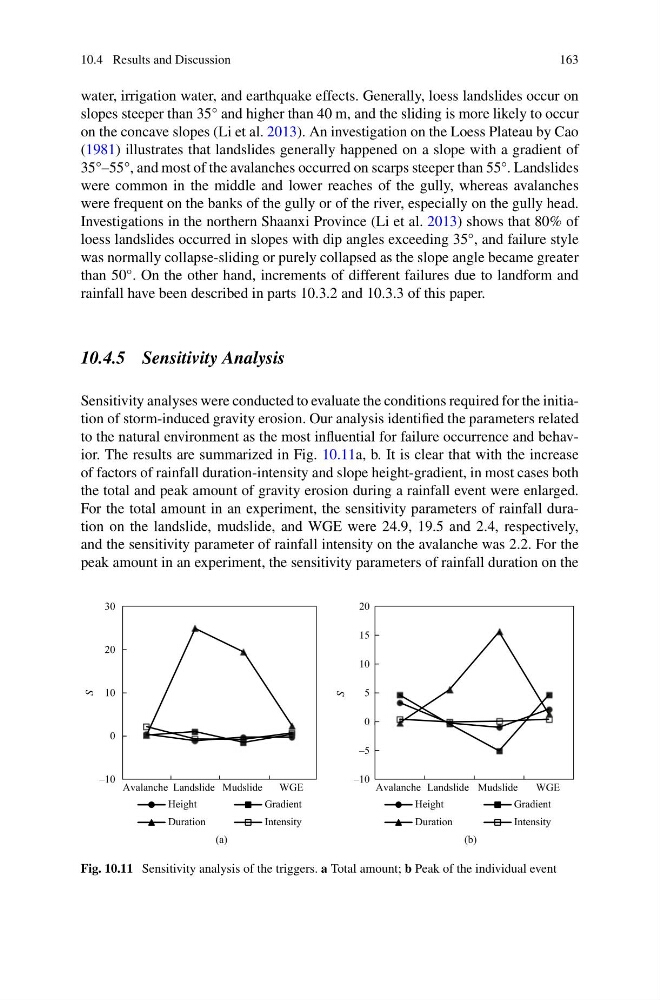
Sensitivity analyses were conducted to evaluate the conditions required for the initiation of storm-induced gravity erosion. Our analysis identified the parameters related
to the natural environment as the most influential for failure occurrence and behavior. The results are summarized in Fig. 10.11a, b. It is clear that with the increase
of factors of rainfall duration-intensity and slope height-gradient, in most cases both
the total and peak amount of gravity erosion during a rainfall event were enlarged.
For the total amount in an experiment, the sensitivity parameters of rainfall duration on the landslide, mudslide, and WGE were 24.9, 19.5 and 2.4, respectively,
and the sensitivity parameter of rainfall intensity on the avalanche was 2.2. For the
peak amount in an experiment, the sensitivity parameters of rainfall duration on the
–10
0
10
20
30
Avalanche Landslide Mudslide
WGE
S
Height
Gradient
Duration
Intensity
(a)
(b)
–10
–5
0
5
10
15
20
Avalanche Landslide Mudslide
WGE
S
Height
Gradient
Duration
Intensity
Fig. 10.11 Sensitivity analysis of the triggers. a Total amount; b Peak of the individual event
163
water, irrigation water, and earthquake effects. Generally, loess landslides occur on
slopes steeper than 35° and higher than 40 m, and the sliding is more likely to occur
on the concave slopes (Li et al. 2013). An investigation on the Loess Plateau by Cao
(1981) illustrates that landslides generally happened on a slope with a gradient of
35°–55°, and most of the avalanches occurred on scarps steeper than 55°. Landslides
were common in the middle and lower reaches of the gully, whereas avalanches
were frequent on the banks of the gully or of the river, especially on the gully head.
Investigations in the northern Shaanxi Province (Li et al. 2013) shows that 80% of
loess landslides occurred in slopes with dip angles exceeding 35°, and failure style
was normally collapse-sliding or purely collapsed as the slope angle became greater
than 50°. On the other hand, increments of different failures due to landform and
rainfall have been described in parts 10.3.2 and 10.3.3 of this paper.
10.4.5 Sensitivity Analysis
Sensitivity analyses were conducted to evaluate the conditions required for the initiation of storm-induced gravity erosion. Our analysis identified the parameters related
to the natural environment as the most influential for failure occurrence and behavior. The results are summarized in Fig. 10.11a, b. It is clear that with the increase
of factors of rainfall duration-intensity and slope height-gradient, in most cases both
the total and peak amount of gravity erosion during a rainfall event were enlarged.
For the total amount in an experiment, the sensitivity parameters of rainfall duration on the landslide, mudslide, and WGE were 24.9, 19.5 and 2.4, respectively,
and the sensitivity parameter of rainfall intensity on the avalanche was 2.2. For the
peak amount in an experiment, the sensitivity parameters of rainfall duration on the
–10
0
10
20
30
Avalanche Landslide Mudslide
WGE
S
Height
Gradient
Duration
Intensity
(a)
(b)
–10
–5
0
5
10
15
20
Avalanche Landslide Mudslide
WGE
S
Height
Gradient
Duration
Intensity
Fig. 10.11 Sensitivity analysis of the triggers. a Total amount; b Peak of the individual event