

146
9 Gravity Erosions on the Loess Gully Bank …
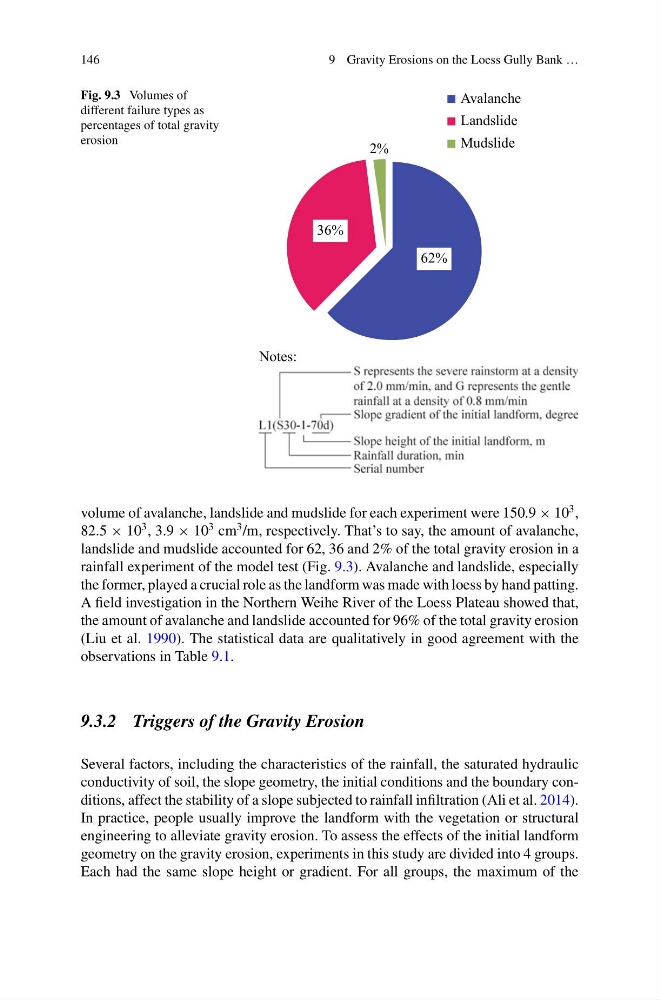
Fig. 9.3 Volumes of
different failure types as
percentages of total gravity
erosion
36%
62%
2%
Avalanche
Landslide
Mudslide
Notes:
volume of avalanche, landslide and mudslide for each experiment were 150.9 × 10
3 ,
82.5 × 10
3 , 3.9 × 10
3 cm
3 /m, respectively. That’s to say, the amount of avalanche,
landslide and mudslide accounted for 62, 36 and 2% of the total gravity erosion in a
rainfall experiment of the model test (Fig. 9.3). Avalanche and landslide, especially
the former, played a crucial role as the landform was made with loess by hand patting.
A field investigation in the Northern Weihe River of the Loess Plateau showed that,
the amount of avalanche and landslide accounted for 96% of the total gravity erosion
(Liu et al. 1990). The statistical data are qualitatively in good agreement with the
observations in Table 9.1.
9.3.2 Triggers of the Gravity Erosion
Several factors, including the characteristics of the rainfall, the saturated hydraulic
conductivity of soil, the slope geometry, the initial conditions and the boundary conditions, affect the stability of a slope subjected to rainfall infiltration (Ali et al. 2014).
In practice, people usually improve the landform with the vegetation or structural
engineering to alleviate gravity erosion. To assess the effects of the initial landform
geometry on the gravity erosion, experiments in this study are divided into 4 groups.
Each had the same slope height or gradient. For all groups, the maximum of the
9 Gravity Erosions on the Loess Gully Bank …
Fig. 9.3 Volumes of
different failure types as
percentages of total gravity
erosion
36%
62%
2%
Avalanche
Landslide
Mudslide
Notes:
volume of avalanche, landslide and mudslide for each experiment were 150.9 × 10
3 ,
82.5 × 10
3 , 3.9 × 10
3 cm
3 /m, respectively. That’s to say, the amount of avalanche,
landslide and mudslide accounted for 62, 36 and 2% of the total gravity erosion in a
rainfall experiment of the model test (Fig. 9.3). Avalanche and landslide, especially
the former, played a crucial role as the landform was made with loess by hand patting.
A field investigation in the Northern Weihe River of the Loess Plateau showed that,
the amount of avalanche and landslide accounted for 96% of the total gravity erosion
(Liu et al. 1990). The statistical data are qualitatively in good agreement with the
observations in Table 9.1.
9.3.2 Triggers of the Gravity Erosion
Several factors, including the characteristics of the rainfall, the saturated hydraulic
conductivity of soil, the slope geometry, the initial conditions and the boundary conditions, affect the stability of a slope subjected to rainfall infiltration (Ali et al. 2014).
In practice, people usually improve the landform with the vegetation or structural
engineering to alleviate gravity erosion. To assess the effects of the initial landform
geometry on the gravity erosion, experiments in this study are divided into 4 groups.
Each had the same slope height or gradient. For all groups, the maximum of the