

9.3 Results and Discussion
145
(a)
(b)
(c)
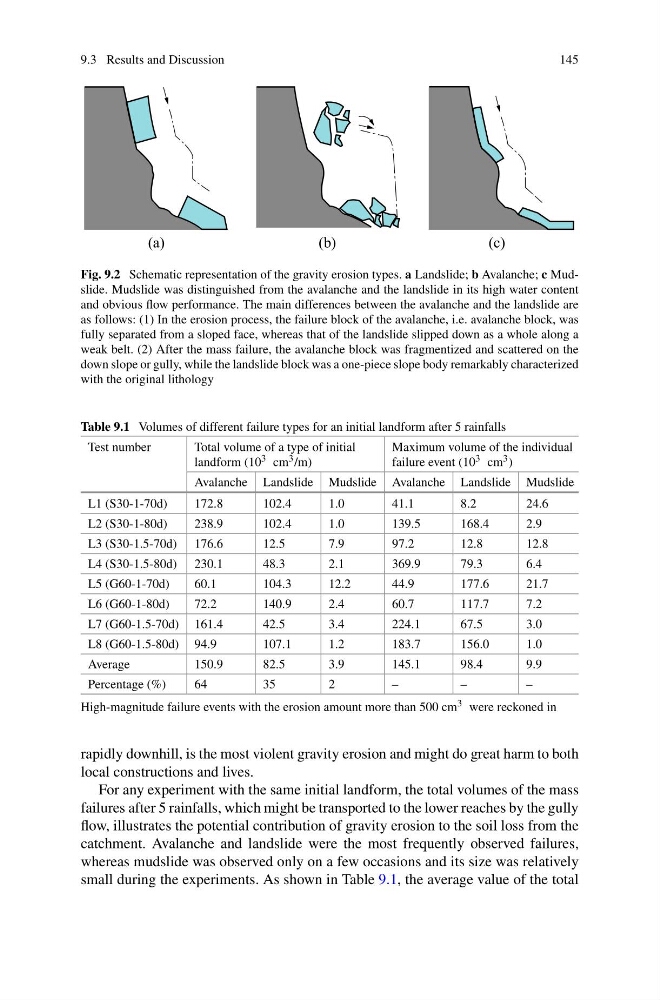
Fig. 9.2 Schematic representation of the gravity erosion types. a Landslide; b Avalanche; c Mudslide. Mudslide was distinguished from the avalanche and the landslide in its high water content
and obvious flow performance. The main differences between the avalanche and the landslide are
as follows: (1) In the erosion process, the failure block of the avalanche, i.e. avalanche block, was
fully separated from a sloped face, whereas that of the landslide slipped down as a whole along a
weak belt. (2) After the mass failure, the avalanche block was fragmentized and scattered on the
down slope or gully, while the landslide block was a one-piece slope body remarkably characterized
with the original lithology
Table 9.1 Volumes of different failure types for an initial landform after 5 rainfalls
Test number
Total volume of a type of initial
landform (10 3 cm 3 /m)
Maximum volume of the individual
failure event (10 3 cm 3 )
Avalanche Landslide Mudslide Avalanche Landslide Mudslide
L1 (S30-1-70d)
172.8
102.4
1.0
41.1
8.2
24.6
L2 (S30-1-80d)
238.9
102.4
1.0
139.5
168.4
2.9
L3 (S30-1.5-70d) 176.6
12.5
7.9
97.2
12.8
12.8
L4 (S30-1.5-80d) 230.1
48.3
2.1
369.9
79.3
6.4
L5 (G60-1-70d)
60.1
104.3
12.2
44.9
177.6
21.7
L6 (G60-1-80d)
72.2
140.9
2.4
60.7
117.7
7.2
L7 (G60-1.5-70d) 161.4
42.5
3.4
224.1
67.5
3.0
L8 (G60-1.5-80d) 94.9
107.1
1.2
183.7
156.0
1.0
Average
150.9
82.5
3.9
145.1
98.4
9.9
Percentage (%)
64
35
2
–
–
–
High-magnitude failure events with the erosion amount more than 500 cm 3 were reckoned in
rapidly downhill, is the most violent gravity erosion and might do great harm to both
local constructions and lives.
For any experiment with the same initial landform, the total volumes of the mass
failures after 5 rainfalls, which might be transported to the lower reaches by the gully
flow, illustrates the potential contribution of gravity erosion to the soil loss from the
catchment. Avalanche and landslide were the most frequently observed failures,
whereas mudslide was observed only on a few occasions and its size was relatively
small during the experiments. As shown in Table 9.1, the average value of the total
145
(a)
(b)
(c)
Fig. 9.2 Schematic representation of the gravity erosion types. a Landslide; b Avalanche; c Mudslide. Mudslide was distinguished from the avalanche and the landslide in its high water content
and obvious flow performance. The main differences between the avalanche and the landslide are
as follows: (1) In the erosion process, the failure block of the avalanche, i.e. avalanche block, was
fully separated from a sloped face, whereas that of the landslide slipped down as a whole along a
weak belt. (2) After the mass failure, the avalanche block was fragmentized and scattered on the
down slope or gully, while the landslide block was a one-piece slope body remarkably characterized
with the original lithology
Table 9.1 Volumes of different failure types for an initial landform after 5 rainfalls
Test number
Total volume of a type of initial
landform (10 3 cm 3 /m)
Maximum volume of the individual
failure event (10 3 cm 3 )
Avalanche Landslide Mudslide Avalanche Landslide Mudslide
L1 (S30-1-70d)
172.8
102.4
1.0
41.1
8.2
24.6
L2 (S30-1-80d)
238.9
102.4
1.0
139.5
168.4
2.9
L3 (S30-1.5-70d) 176.6
12.5
7.9
97.2
12.8
12.8
L4 (S30-1.5-80d) 230.1
48.3
2.1
369.9
79.3
6.4
L5 (G60-1-70d)
60.1
104.3
12.2
44.9
177.6
21.7
L6 (G60-1-80d)
72.2
140.9
2.4
60.7
117.7
7.2
L7 (G60-1.5-70d) 161.4
42.5
3.4
224.1
67.5
3.0
L8 (G60-1.5-80d) 94.9
107.1
1.2
183.7
156.0
1.0
Average
150.9
82.5
3.9
145.1
98.4
9.9
Percentage (%)
64
35
2
–
–
–
High-magnitude failure events with the erosion amount more than 500 cm 3 were reckoned in
rapidly downhill, is the most violent gravity erosion and might do great harm to both
local constructions and lives.
For any experiment with the same initial landform, the total volumes of the mass
failures after 5 rainfalls, which might be transported to the lower reaches by the gully
flow, illustrates the potential contribution of gravity erosion to the soil loss from the
catchment. Avalanche and landslide were the most frequently observed failures,
whereas mudslide was observed only on a few occasions and its size was relatively
small during the experiments. As shown in Table 9.1, the average value of the total