

9.3 Results and Discussion
147
(b)
(a)
60%
40%
20%
0%
20%
40%
0
50
100
150
200
r
Sum (10
3
cm
3
/m)
Ga(L1,L2,L6,L7)
Gb(L3,L4, L8,L9)
As the slope height was increased 0.5 m
100%
50%
0%
50%
100%
0
50
100
150
200
r
Sum (10
3
cm
3
/m)
Gc(L1, L3, L5, L7)
Gd(L2, L4, L6, L8)
As the slope gradient was increased 10º
1000%
500%
0%
500%
1000%
0
100
200
300
400
Avalanche Landslide Mudslide
Avalanche Landslide Mudslide
r
Peak (10
3
cm
3
)
100%
50%
0%
50%
100%
0
100
200
300
400
r
Peak (10
3
cm
3
)
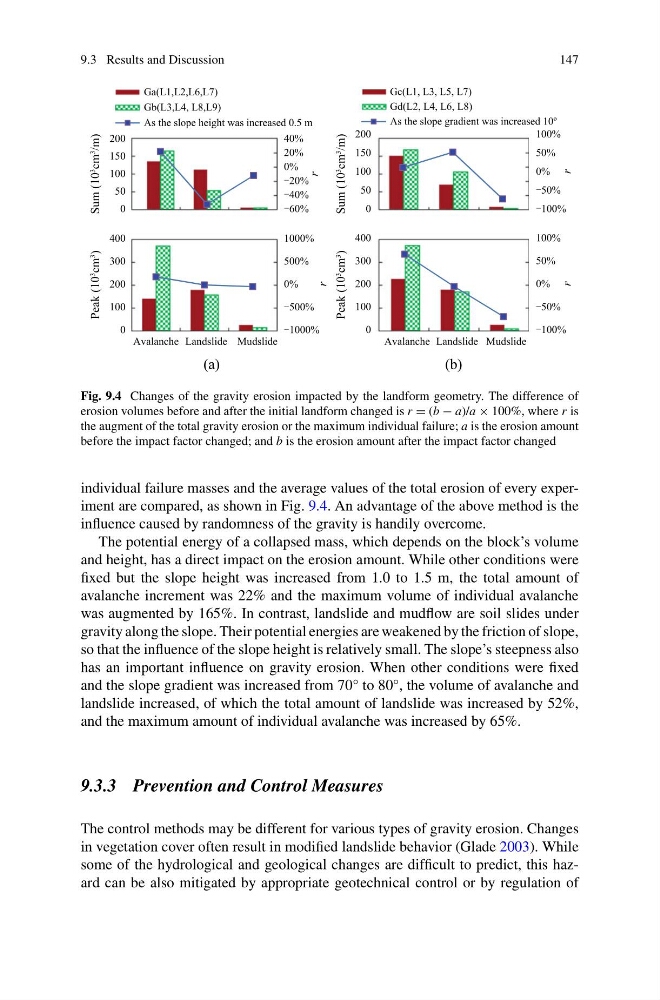
Fig. 9.4 Changes of the gravity erosion impacted by the landform geometry. The difference of
erosion volumes before and after the initial landform changed is r = (b − a)/a × 100%, where r is
the augment of the total gravity erosion or the maximum individual failure; a is the erosion amount
before the impact factor changed; and b is the erosion amount after the impact factor changed
individual failure masses and the average values of the total erosion of every experiment are compared, as shown in Fig. 9.4. An advantage of the above method is the
influence caused by randomness of the gravity is handily overcome.
The potential energy of a collapsed mass, which depends on the block’s volume
and height, has a direct impact on the erosion amount. While other conditions were
fixed but the slope height was increased from 1.0 to 1.5 m, the total amount of
avalanche increment was 22% and the maximum volume of individual avalanche
was augmented by 165%. In contrast, landslide and mudflow are soil slides under
gravity along the slope. Their potential energies are weakened by the friction of slope,
so that the influence of the slope height is relatively small. The slope’s steepness also
has an important influence on gravity erosion. When other conditions were fixed
and the slope gradient was increased from 70° to 80°, the volume of avalanche and
landslide increased, of which the total amount of landslide was increased by 52%,
and the maximum amount of individual avalanche was increased by 65%.
9.3.3 Prevention and Control Measures
The control methods may be different for various types of gravity erosion. Changes
in vegetation cover often result in modified landslide behavior (Glade 2003). While
some of the hydrological and geological changes are difficult to predict, this hazard can be also mitigated by appropriate geotechnical control or by regulation of
147
(b)
(a)
60%
40%
20%
0%
20%
40%
0
50
100
150
200
r
Sum (10
3
cm
3
/m)
Ga(L1,L2,L6,L7)
Gb(L3,L4, L8,L9)
As the slope height was increased 0.5 m
100%
50%
0%
50%
100%
0
50
100
150
200
r
Sum (10
3
cm
3
/m)
Gc(L1, L3, L5, L7)
Gd(L2, L4, L6, L8)
As the slope gradient was increased 10º
1000%
500%
0%
500%
1000%
0
100
200
300
400
Avalanche Landslide Mudslide
Avalanche Landslide Mudslide
r
Peak (10
3
cm
3
)
100%
50%
0%
50%
100%
0
100
200
300
400
r
Peak (10
3
cm
3
)
Fig. 9.4 Changes of the gravity erosion impacted by the landform geometry. The difference of
erosion volumes before and after the initial landform changed is r = (b − a)/a × 100%, where r is
the augment of the total gravity erosion or the maximum individual failure; a is the erosion amount
before the impact factor changed; and b is the erosion amount after the impact factor changed
individual failure masses and the average values of the total erosion of every experiment are compared, as shown in Fig. 9.4. An advantage of the above method is the
influence caused by randomness of the gravity is handily overcome.
The potential energy of a collapsed mass, which depends on the block’s volume
and height, has a direct impact on the erosion amount. While other conditions were
fixed but the slope height was increased from 1.0 to 1.5 m, the total amount of
avalanche increment was 22% and the maximum volume of individual avalanche
was augmented by 165%. In contrast, landslide and mudflow are soil slides under
gravity along the slope. Their potential energies are weakened by the friction of slope,
so that the influence of the slope height is relatively small. The slope’s steepness also
has an important influence on gravity erosion. When other conditions were fixed
and the slope gradient was increased from 70° to 80°, the volume of avalanche and
landslide increased, of which the total amount of landslide was increased by 52%,
and the maximum amount of individual avalanche was increased by 65%.
9.3.3 Prevention and Control Measures
The control methods may be different for various types of gravity erosion. Changes
in vegetation cover often result in modified landslide behavior (Glade 2003). While
some of the hydrological and geological changes are difficult to predict, this hazard can be also mitigated by appropriate geotechnical control or by regulation of