

2 Systematic Descriptions
83
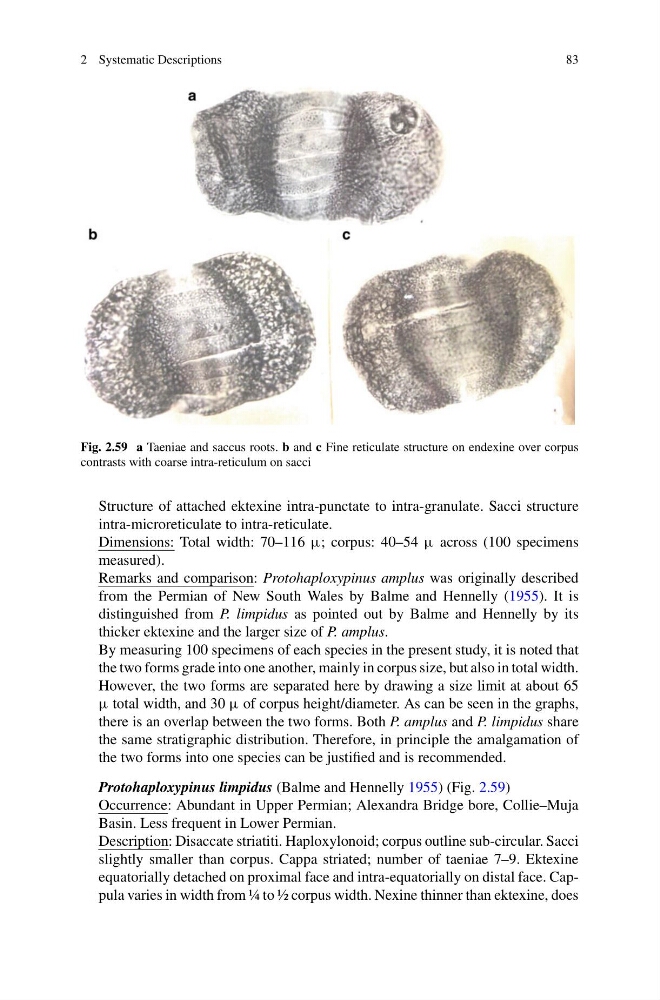
Fig. 2.59 a Taeniae and saccus roots. b and c Fine reticulate structure on endexine over corpus
contrasts with coarse intra-reticulum on sacci
Structure of attached ektexine intra-punctate to intra-granulate. Sacci structure
intra-microreticulate to intra-reticulate.
Dimensions: Total width: 70–116 µ; corpus: 40–54 µ across (100 specimens
measured).
Remarks and comparison: Protohaploxypinus amplus was originally described
from the Permian of New South Wales by Balme and Hennelly (1955). It is
distinguished from P. limpidus as pointed out by Balme and Hennelly by its
thicker ektexine and the larger size of P. amplus.
By measuring 100 specimens of each species in the present study, it is noted that
the two forms grade into one another, mainly in corpus size, but also in total width.
However, the two forms are separated here by drawing a size limit at about 65
µ total width, and 30 µ of corpus height/diameter. As can be seen in the graphs,
there is an overlap between the two forms. Both P. amplus and P. limpidus share
the same stratigraphic distribution. Therefore, in principle the amalgamation of
the two forms into one species can be justified and is recommended.
Protohaploxypinus limpidus (Balme and Hennelly 1955) (Fig. 2.59)
Occurrence: Abundant in Upper Permian; Alexandra Bridge bore, Collie–Muja
Basin. Less frequent in Lower Permian.
Description: Disaccate striatiti. Haploxylonoid; corpus outline sub-circular. Sacci
slightly smaller than corpus. Cappa striated; number of taeniae 7–9. Ektexine
equatorially detached on proximal face and intra-equatorially on distal face. Cappula varies in width from ¼ to ½ corpus width. Nexine thinner than ektexine, does
83
Fig. 2.59 a Taeniae and saccus roots. b and c Fine reticulate structure on endexine over corpus
contrasts with coarse intra-reticulum on sacci
Structure of attached ektexine intra-punctate to intra-granulate. Sacci structure
intra-microreticulate to intra-reticulate.
Dimensions: Total width: 70–116 µ; corpus: 40–54 µ across (100 specimens
measured).
Remarks and comparison: Protohaploxypinus amplus was originally described
from the Permian of New South Wales by Balme and Hennelly (1955). It is
distinguished from P. limpidus as pointed out by Balme and Hennelly by its
thicker ektexine and the larger size of P. amplus.
By measuring 100 specimens of each species in the present study, it is noted that
the two forms grade into one another, mainly in corpus size, but also in total width.
However, the two forms are separated here by drawing a size limit at about 65
µ total width, and 30 µ of corpus height/diameter. As can be seen in the graphs,
there is an overlap between the two forms. Both P. amplus and P. limpidus share
the same stratigraphic distribution. Therefore, in principle the amalgamation of
the two forms into one species can be justified and is recommended.
Protohaploxypinus limpidus (Balme and Hennelly 1955) (Fig. 2.59)
Occurrence: Abundant in Upper Permian; Alexandra Bridge bore, Collie–Muja
Basin. Less frequent in Lower Permian.
Description: Disaccate striatiti. Haploxylonoid; corpus outline sub-circular. Sacci
slightly smaller than corpus. Cappa striated; number of taeniae 7–9. Ektexine
equatorially detached on proximal face and intra-equatorially on distal face. Cappula varies in width from ¼ to ½ corpus width. Nexine thinner than ektexine, does