

82
2 Systematic Descriptions
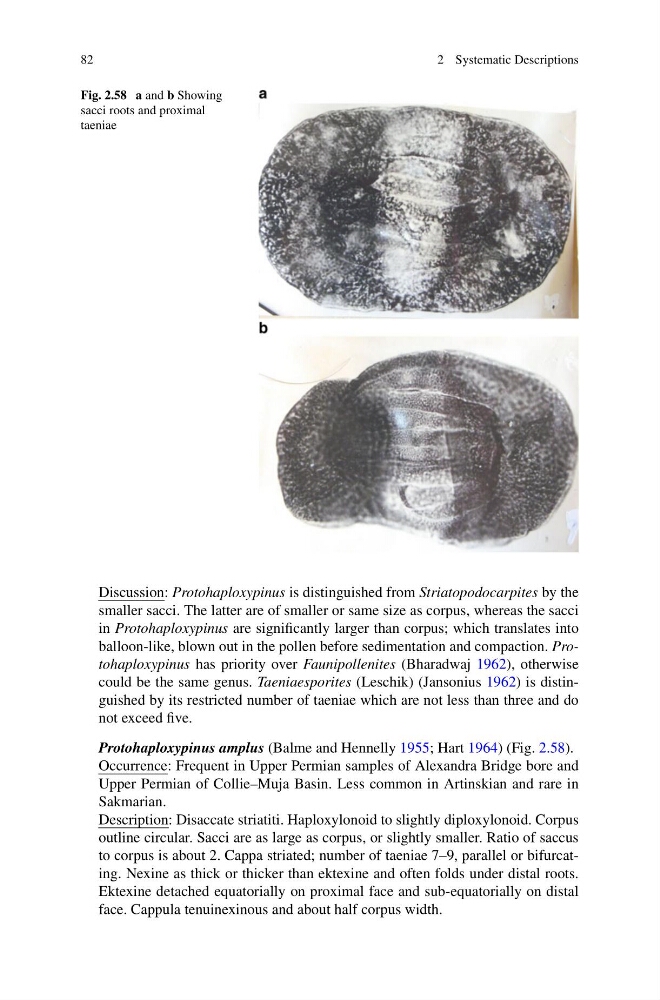
Fig. 2.58 a and b Showing
sacci roots and proximal
taeniae
Discussion: Protohaploxypinus is distinguished from Striatopodocarpites by the
smaller sacci. The latter are of smaller or same size as corpus, whereas the sacci
in Protohaploxypinus are significantly larger than corpus; which translates into
balloon-like, blown out in the pollen before sedimentation and compaction. Protohaploxypinus has priority over Faunipollenites (Bharadwaj 1962), otherwise
could be the same genus. Taeniaesporites (Leschik) (Jansonius 1962) is distinguished by its restricted number of taeniae which are not less than three and do
not exceed five.
Protohaploxypinus amplus (Balme and Hennelly 1955; Hart 1964) (Fig. 2.58).
Occurrence: Frequent in Upper Permian samples of Alexandra Bridge bore and
Upper Permian of Collie–Muja Basin. Less common in Artinskian and rare in
Sakmarian.
Description: Disaccate striatiti. Haploxylonoid to slightly diploxylonoid. Corpus
outline circular. Sacci are as large as corpus, or slightly smaller. Ratio of saccus
to corpus is about 2. Cappa striated; number of taeniae 7–9, parallel or bifurcating. Nexine as thick or thicker than ektexine and often folds under distal roots.
Ektexine detached equatorially on proximal face and sub-equatorially on distal
face. Cappula tenuinexinous and about half corpus width.
2 Systematic Descriptions
Fig. 2.58 a and b Showing
sacci roots and proximal
taeniae
Discussion: Protohaploxypinus is distinguished from Striatopodocarpites by the
smaller sacci. The latter are of smaller or same size as corpus, whereas the sacci
in Protohaploxypinus are significantly larger than corpus; which translates into
balloon-like, blown out in the pollen before sedimentation and compaction. Protohaploxypinus has priority over Faunipollenites (Bharadwaj 1962), otherwise
could be the same genus. Taeniaesporites (Leschik) (Jansonius 1962) is distinguished by its restricted number of taeniae which are not less than three and do
not exceed five.
Protohaploxypinus amplus (Balme and Hennelly 1955; Hart 1964) (Fig. 2.58).
Occurrence: Frequent in Upper Permian samples of Alexandra Bridge bore and
Upper Permian of Collie–Muja Basin. Less common in Artinskian and rare in
Sakmarian.
Description: Disaccate striatiti. Haploxylonoid to slightly diploxylonoid. Corpus
outline circular. Sacci are as large as corpus, or slightly smaller. Ratio of saccus
to corpus is about 2. Cappa striated; number of taeniae 7–9, parallel or bifurcating. Nexine as thick or thicker than ektexine and often folds under distal roots.
Ektexine detached equatorially on proximal face and sub-equatorially on distal
face. Cappula tenuinexinous and about half corpus width.