

2 Systematic Descriptions
93
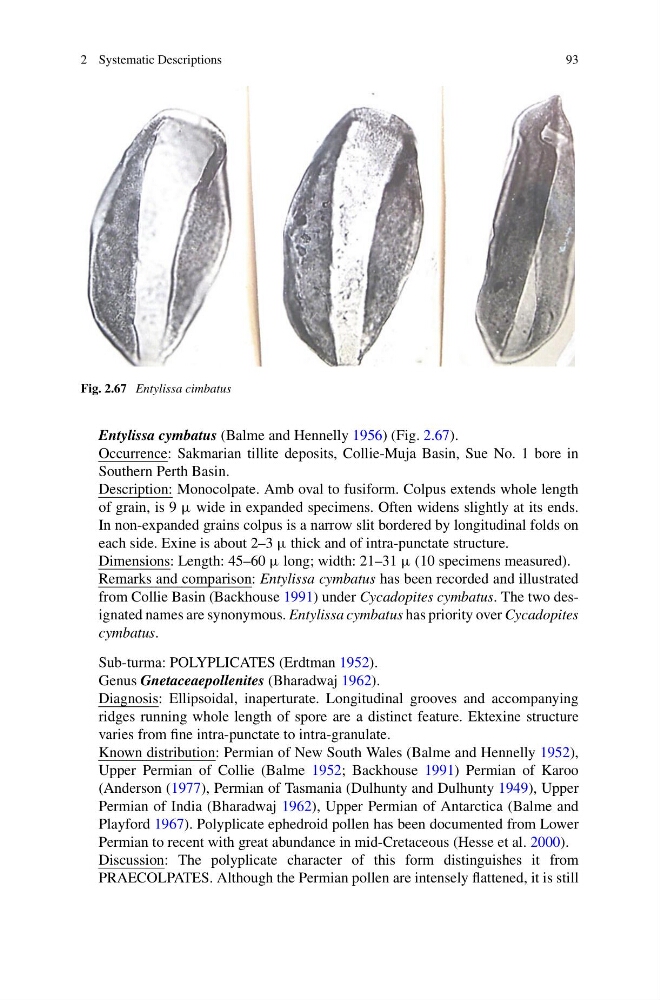
Fig. 2.67 Entylissa cimbatus
Entylissa cymbatus (Balme and Hennelly 1956) (Fig. 2.67).
Occurrence: Sakmarian tillite deposits, Collie-Muja Basin, Sue No. 1 bore in
Southern Perth Basin.
Description: Monocolpate. Amb oval to fusiform. Colpus extends whole length
of grain, is 9 µ wide in expanded specimens. Often widens slightly at its ends.
In non-expanded grains colpus is a narrow slit bordered by longitudinal folds on
each side. Exine is about 2–3 µ thick and of intra-punctate structure.
Dimensions: Length: 45–60 µ long; width: 21–31 µ (10 specimens measured).
Remarks and comparison: Entylissa cymbatus has been recorded and illustrated
from Collie Basin (Backhouse 1991) under Cycadopites cymbatus. The two designated names are synonymous. Entylissa cymbatus has priority over Cycadopites
cymbatus.
Sub-turma: POLYPLICATES (Erdtman 1952).
Genus Gnetaceaepollenites (Bharadwaj 1962).
Diagnosis: Ellipsoidal, inaperturate. Longitudinal grooves and accompanying
ridges running whole length of spore are a distinct feature. Ektexine structure
varies from fine intra-punctate to intra-granulate.
Known distribution: Permian of New South Wales (Balme and Hennelly 1952),
Upper Permian of Collie (Balme 1952; Backhouse 1991) Permian of Karoo
(Anderson (1977), Permian of Tasmania (Dulhunty and Dulhunty 1949), Upper
Permian of India (Bharadwaj 1962), Upper Permian of Antarctica (Balme and
Playford 1967). Polyplicate ephedroid pollen has been documented from Lower
Permian to recent with great abundance in mid-Cretaceous (Hesse et al. 2000).
Discussion: The polyplicate character of this form distinguishes it from
PRAECOLPATES. Although the Permian pollen are intensely flattened, it is still
93
Fig. 2.67 Entylissa cimbatus
Entylissa cymbatus (Balme and Hennelly 1956) (Fig. 2.67).
Occurrence: Sakmarian tillite deposits, Collie-Muja Basin, Sue No. 1 bore in
Southern Perth Basin.
Description: Monocolpate. Amb oval to fusiform. Colpus extends whole length
of grain, is 9 µ wide in expanded specimens. Often widens slightly at its ends.
In non-expanded grains colpus is a narrow slit bordered by longitudinal folds on
each side. Exine is about 2–3 µ thick and of intra-punctate structure.
Dimensions: Length: 45–60 µ long; width: 21–31 µ (10 specimens measured).
Remarks and comparison: Entylissa cymbatus has been recorded and illustrated
from Collie Basin (Backhouse 1991) under Cycadopites cymbatus. The two designated names are synonymous. Entylissa cymbatus has priority over Cycadopites
cymbatus.
Sub-turma: POLYPLICATES (Erdtman 1952).
Genus Gnetaceaepollenites (Bharadwaj 1962).
Diagnosis: Ellipsoidal, inaperturate. Longitudinal grooves and accompanying
ridges running whole length of spore are a distinct feature. Ektexine structure
varies from fine intra-punctate to intra-granulate.
Known distribution: Permian of New South Wales (Balme and Hennelly 1952),
Upper Permian of Collie (Balme 1952; Backhouse 1991) Permian of Karoo
(Anderson (1977), Permian of Tasmania (Dulhunty and Dulhunty 1949), Upper
Permian of India (Bharadwaj 1962), Upper Permian of Antarctica (Balme and
Playford 1967). Polyplicate ephedroid pollen has been documented from Lower
Permian to recent with great abundance in mid-Cretaceous (Hesse et al. 2000).
Discussion: The polyplicate character of this form distinguishes it from
PRAECOLPATES. Although the Permian pollen are intensely flattened, it is still