

94
2 Systematic Descriptions
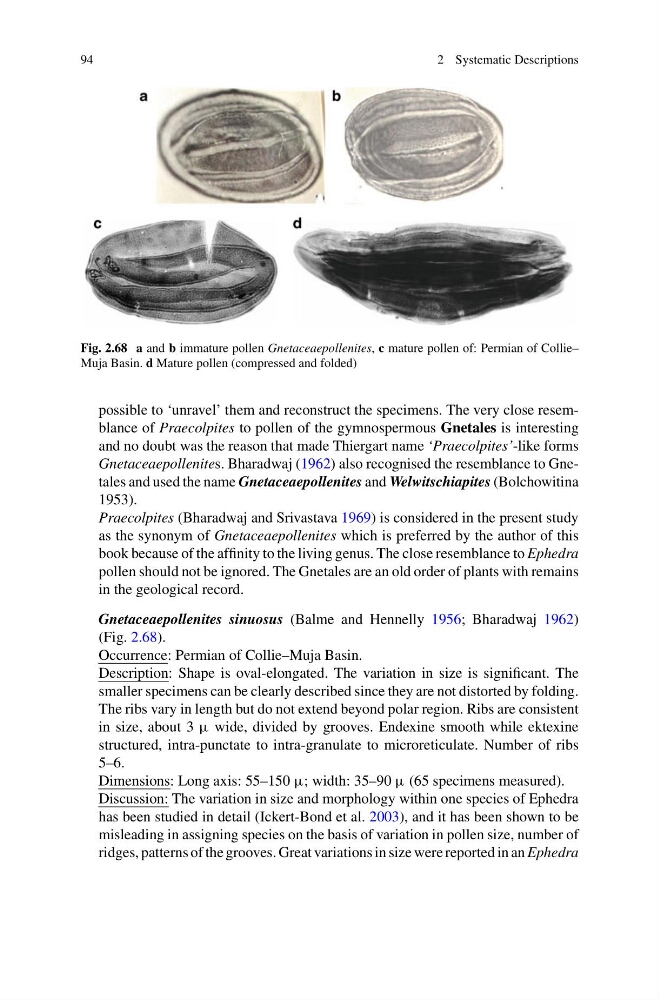
Fig. 2.68 a and b immature pollen Gnetaceaepollenites, c mature pollen of: Permian of Collie–
Muja Basin. d Mature pollen (compressed and folded)
possible to ‘unravel’ them and reconstruct the specimens. The very close resemblance of Praecolpites to pollen of the gymnospermous Gnetales is interesting
and no doubt was the reason that made Thiergart name ‘Praecolpites’-like forms
Gnetaceaepollenites. Bharadwaj (1962) also recognised the resemblance to Gnetales and used the name Gnetaceaepollenites and Welwitschiapites (Bolchowitina
1953).
Praecolpites (Bharadwaj and Srivastava 1969) is considered in the present study
as the synonym of Gnetaceaepollenites which is preferred by the author of this
book because of the affinity to the living genus. The close resemblance to Ephedra
pollen should not be ignored. The Gnetales are an old order of plants with remains
in the geological record.
Gnetaceaepollenites sinuosus (Balme and Hennelly 1956; Bharadwaj 1962)
(Fig. 2.68).
Occurrence: Permian of Collie–Muja Basin.
Description: Shape is oval-elongated. The variation in size is significant. The
smaller specimens can be clearly described since they are not distorted by folding.
The ribs vary in length but do not extend beyond polar region. Ribs are consistent
in size, about 3 µ wide, divided by grooves. Endexine smooth while ektexine
structured, intra-punctate to intra-granulate to microreticulate. Number of ribs
5–6.
Dimensions: Long axis: 55–150 µ; width: 35–90 µ (65 specimens measured).
Discussion: The variation in size and morphology within one species of Ephedra
has been studied in detail (Ickert-Bond et al. 2003), and it has been shown to be
misleading in assigning species on the basis of variation in pollen size, number of
ridges, patterns of the grooves. Great variations in size were reported in an Ephedra
2 Systematic Descriptions
Fig. 2.68 a and b immature pollen Gnetaceaepollenites, c mature pollen of: Permian of Collie–
Muja Basin. d Mature pollen (compressed and folded)
possible to ‘unravel’ them and reconstruct the specimens. The very close resemblance of Praecolpites to pollen of the gymnospermous Gnetales is interesting
and no doubt was the reason that made Thiergart name ‘Praecolpites’-like forms
Gnetaceaepollenites. Bharadwaj (1962) also recognised the resemblance to Gnetales and used the name Gnetaceaepollenites and Welwitschiapites (Bolchowitina
1953).
Praecolpites (Bharadwaj and Srivastava 1969) is considered in the present study
as the synonym of Gnetaceaepollenites which is preferred by the author of this
book because of the affinity to the living genus. The close resemblance to Ephedra
pollen should not be ignored. The Gnetales are an old order of plants with remains
in the geological record.
Gnetaceaepollenites sinuosus (Balme and Hennelly 1956; Bharadwaj 1962)
(Fig. 2.68).
Occurrence: Permian of Collie–Muja Basin.
Description: Shape is oval-elongated. The variation in size is significant. The
smaller specimens can be clearly described since they are not distorted by folding.
The ribs vary in length but do not extend beyond polar region. Ribs are consistent
in size, about 3 µ wide, divided by grooves. Endexine smooth while ektexine
structured, intra-punctate to intra-granulate to microreticulate. Number of ribs
5–6.
Dimensions: Long axis: 55–150 µ; width: 35–90 µ (65 specimens measured).
Discussion: The variation in size and morphology within one species of Ephedra
has been studied in detail (Ickert-Bond et al. 2003), and it has been shown to be
misleading in assigning species on the basis of variation in pollen size, number of
ridges, patterns of the grooves. Great variations in size were reported in an Ephedra