

1.4 Practical Application: Green Termite Architecture
15
effective way of alleviating poverty by employing the young in the community.
Eco-Post Kenya has also been successful in creating employment for 300 Kenyans,
especially marginalized women. An example of an initiative geared at achieving the
sustainable development goals (SDGs) is the Green Campus Initiative in Nigeria
that educates and empowers young people to be environmental and social change
agents in their communities. Since inception by Adenike Akinsemolu, the initiative
has trained thousands of youths in environmental sustainability. The initiative
tackles climate change and environmental sustainability through the development
of socio-environmental conscious leaders (Park 2016). Some of the strategies used
for addressing some of the challenges are nurturing student leaders, promoting
innovative academic research, and results-based eco-initiatives. Students are also
encouraged to use bicycles on their campuses as a way of promoting Green growth
and environmental stewardship.
1.4 Practical Application: Green Termite Architecture
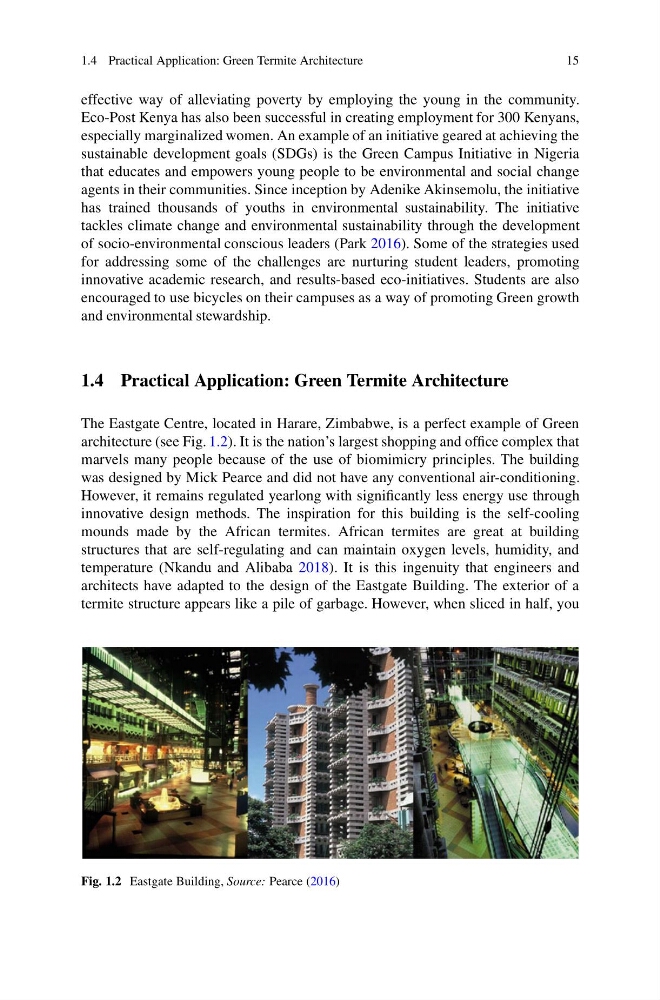
The Eastgate Centre, located in Harare, Zimbabwe, is a perfect example of Green
architecture (see Fig. 1.2). It is the nation’s largest shopping and office complex that
marvels many people because of the use of biomimicry principles. The building
was designed by Mick Pearce and did not have any conventional air-conditioning.
However, it remains regulated yearlong with significantly less energy use through
innovative design methods. The inspiration for this building is the self-cooling
mounds made by the African termites. African termites are great at building
structures that are self-regulating and can maintain oxygen levels, humidity, and
temperature (Nkandu and Alibaba 2018). It is this ingenuity that engineers and
architects have adapted to the design of the Eastgate Building. The exterior of a
termite structure appears like a pile of garbage. However, when sliced in half, you
Fig. 1.2 Eastgate Building, Source: Pearce (2016)
15
effective way of alleviating poverty by employing the young in the community.
Eco-Post Kenya has also been successful in creating employment for 300 Kenyans,
especially marginalized women. An example of an initiative geared at achieving the
sustainable development goals (SDGs) is the Green Campus Initiative in Nigeria
that educates and empowers young people to be environmental and social change
agents in their communities. Since inception by Adenike Akinsemolu, the initiative
has trained thousands of youths in environmental sustainability. The initiative
tackles climate change and environmental sustainability through the development
of socio-environmental conscious leaders (Park 2016). Some of the strategies used
for addressing some of the challenges are nurturing student leaders, promoting
innovative academic research, and results-based eco-initiatives. Students are also
encouraged to use bicycles on their campuses as a way of promoting Green growth
and environmental stewardship.
1.4 Practical Application: Green Termite Architecture
The Eastgate Centre, located in Harare, Zimbabwe, is a perfect example of Green
architecture (see Fig. 1.2). It is the nation’s largest shopping and office complex that
marvels many people because of the use of biomimicry principles. The building
was designed by Mick Pearce and did not have any conventional air-conditioning.
However, it remains regulated yearlong with significantly less energy use through
innovative design methods. The inspiration for this building is the self-cooling
mounds made by the African termites. African termites are great at building
structures that are self-regulating and can maintain oxygen levels, humidity, and
temperature (Nkandu and Alibaba 2018). It is this ingenuity that engineers and
architects have adapted to the design of the Eastgate Building. The exterior of a
termite structure appears like a pile of garbage. However, when sliced in half, you
Fig. 1.2 Eastgate Building, Source: Pearce (2016)