

10.11 Future Trends
295
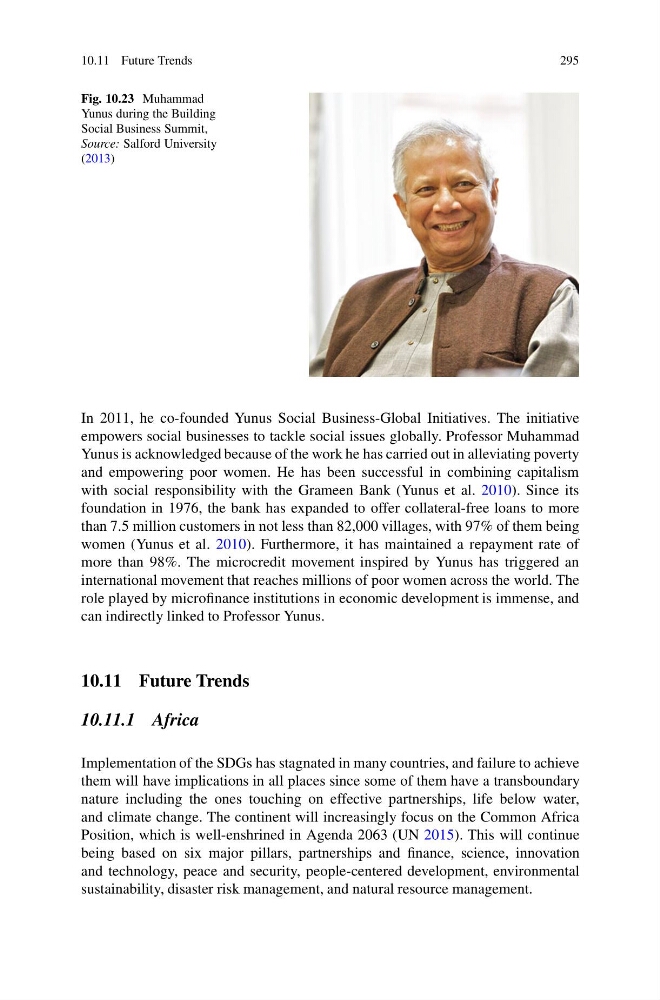
Fig. 10.23 Muhammad
Yunus during the Building
Social Business Summit,
Source: Salford University
(2013)
In 2011, he co-founded Yunus Social Business-Global Initiatives. The initiative
empowers social businesses to tackle social issues globally. Professor Muhammad
Yunus is acknowledged because of the work he has carried out in alleviating poverty
and empowering poor women. He has been successful in combining capitalism
with social responsibility with the Grameen Bank (Yunus et al. 2010). Since its
foundation in 1976, the bank has expanded to offer collateral-free loans to more
than 7.5 million customers in not less than 82,000 villages, with 97% of them being
women (Yunus et al. 2010). Furthermore, it has maintained a repayment rate of
more than 98%. The microcredit movement inspired by Yunus has triggered an
international movement that reaches millions of poor women across the world. The
role played by microfinance institutions in economic development is immense, and
can indirectly linked to Professor Yunus.
10.11 Future Trends
10.11.1 Africa
Implementation of the SDGs has stagnated in many countries, and failure to achieve
them will have implications in all places since some of them have a transboundary
nature including the ones touching on effective partnerships, life below water,
and climate change. The continent will increasingly focus on the Common Africa
Position, which is well-enshrined in Agenda 2063 (UN 2015). This will continue
being based on six major pillars, partnerships and finance, science, innovation
and technology, peace and security, people-centered development, environmental
sustainability, disaster risk management, and natural resource management.
295
Fig. 10.23 Muhammad
Yunus during the Building
Social Business Summit,
Source: Salford University
(2013)
In 2011, he co-founded Yunus Social Business-Global Initiatives. The initiative
empowers social businesses to tackle social issues globally. Professor Muhammad
Yunus is acknowledged because of the work he has carried out in alleviating poverty
and empowering poor women. He has been successful in combining capitalism
with social responsibility with the Grameen Bank (Yunus et al. 2010). Since its
foundation in 1976, the bank has expanded to offer collateral-free loans to more
than 7.5 million customers in not less than 82,000 villages, with 97% of them being
women (Yunus et al. 2010). Furthermore, it has maintained a repayment rate of
more than 98%. The microcredit movement inspired by Yunus has triggered an
international movement that reaches millions of poor women across the world. The
role played by microfinance institutions in economic development is immense, and
can indirectly linked to Professor Yunus.
10.11 Future Trends
10.11.1 Africa
Implementation of the SDGs has stagnated in many countries, and failure to achieve
them will have implications in all places since some of them have a transboundary
nature including the ones touching on effective partnerships, life below water,
and climate change. The continent will increasingly focus on the Common Africa
Position, which is well-enshrined in Agenda 2063 (UN 2015). This will continue
being based on six major pillars, partnerships and finance, science, innovation
and technology, peace and security, people-centered development, environmental
sustainability, disaster risk management, and natural resource management.